
Non-FictionSelf-HelpConcentration
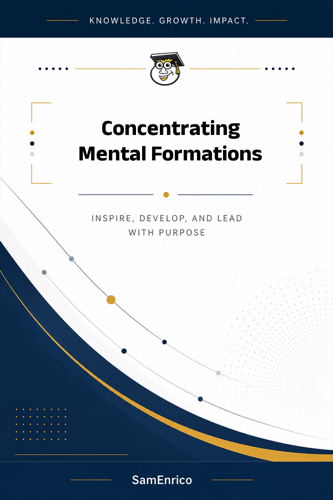
Concentrating Mental Formations eBook
Steady the mind by repeatedly anchoring attention
by Mcgill Zelma
Steady the mind by repeatedly anchoring attention on the breath.
Formats
Free sample
Chapter 1: The Wild Mind Hypothesis--–- Every morning, before your feet touch the floor, your mind is already running. Not a gentle jog—a sprint. By the time you have brushed your teeth, you have probably rehearsed an argument that hasn’t happened, regretted a decision from three years ago, planned a grocery list, and wondered what that strange sound was coming from your car’s engine. None of this feels unusual. This, you have been led to believe, is simply what it means to be a conscious human being.But here is the question that changes everything: what if the constant mental noise is not a sign of intelligence, but a sign of a skill that has never been trained?For most of your life, you have been praised for your ability to think.
Schools reward it. Employers pay for it. Friends admire it. But no one ever taught you how to stop thinking when stopping is exactly what you need. No one gave you a single practical technique for steadying the mind when it spins out of control.
And so you have lived inside a paradox: you have a magnificent brain that cannot sit still for ninety seconds without grabbing its phone, replaying an old wound, or leaping into a fantasy about a future that does not yet exist.This book is built on a single, testable claim: a steady mind is not a gift you are born with. It is a set of mental formations that you can observe, understand, and gradually calm through the repeated, gentle act of anchoring attention on the breath. That claim is not philosophy. It is neurobiology. It is psychology.
And it is the most useful thing you will learn this year.What Are Mental Formations?Let us begin with a word that sounds academic but describes something you experience every ten seconds of your waking life: mental formations. In the Buddhist psychological tradition (the Abhidhamma, specifically), mental formations—saṅkhāra—are the conditioned building blocks of conscious experience. They include every thought, every emotion, every impulse, every judgment, every memory that arises automatically in response to a stimulus. You do not decide to have a mental formation. It simply appears, like weather, based on past conditioning, current circumstances, and the raw data coming through your senses.Here is a concrete example.
You are walking down the street and you see someone you vaguely recognize. Before you can consciously process who they are, a cascade of mental formations has already occurred: a flicker of recognition, a quick search of memory, a label (“oh, that’s Mark from the old job”), an emotion (maybe warmth, maybe annoyance), a story (“he never returned that tool he borrowed”), an impulse (to cross the street or to wave), and finally a decision or an action. All of that—recognition, memory retrieval, emotional coloring, narrative construction, impulse generation—happens in less than a second. And you were not the author of any of it. You were the witness of it, if you were paying attention at all.Most of the time, you are not paying attention.
The formations roll through you like waves through water, and you mistake them for you. “I am angry.” “I am worried.” “I am distracted.” But here is the liberating truth: you are not your mental formations any more than the sky is the storm passing through it.Cognitive science confirms this picture. The brain’s default mode network (DMN) is a collection of interconnected regions—medial prefrontal cortex, posterior cingulate cortex, inferior parietal lobule—that become active when you are not engaged in an external task. The DMN is the neurological substrate of mind-wandering. It generates self-referential thoughts: memories of the past, simulations of the future, social comparisons, moral judgments.
Researchers have found that the DMN is active roughly 47% of waking hours, regardless of what you are doing. That means nearly half of your life, your brain is running its own internal programming while your body goes through the motions of eating, walking, working, or listening to someone speak.The DMN is not a bug. It is a feature that evolution installed for good reasons: planning, learning from the past, imagining contingencies. But like any powerful system, it becomes a problem when it runs unchecked. An overactive DMN is correlated with anxiety, depression, rumination, and poor cognitive control.
The mind that cannot stop wandering is not a creative mind. It is a hijacked mind.Why Distraction Feels Like Your Fault (But Isn’t)Here is where most self-help books get it wrong. They tell you to “focus more” or “eliminate distractions” as if your wandering mind were a moral failure—a sign of laziness, weak willpower, or insufficient ambition. This is not only unkind; it is scientifically backward.Your mind wanders because it was designed to wander. The default mode network is, as the name suggests, the default.
Focused attention requires active effort—specifically, the engagement of the central executive network and the salience network, which must suppress DMN activity. Every moment of concentration is a small act of neurological resistance against the brain’s baseline state. That is why focusing feels hard. It is not because you are broken. It is because you are asking your brain to do something that is not its default setting.Think of it this way: no one blames a river for flowing downhill.
That is what rivers do. No one blames a flame for rising. That is what flames do. And no one should blame a human brain for wandering. That is what brains do.
The question is not why do I keep losing focus? The question is what can I do to train this river to flow in a direction I choose?The answer, which this entire book will unfold, is deceptively simple: you train attention the same way you train a muscle—through repeated, low-stakes, high-frequency practice. You do not need to eliminate mental formations. You need to stop being pushed around by them. And the single most effective tool for doing that is also the most available: your own breath.The Breath as the Ideal Anchor Why the breath?
Of all possible objects of attention—a candle flame, a mantra, a visual image, a sound—why does this book return again and again to the simple sensation of air moving in and out of the body?There are six reasons, and each one matters.First, the breath is always available. You do not need an app, a cushion, a special room, or a teacher. As long as you are alive, your breath is right here. This eliminates every excuse. You can practice breath-anchoring in traffic, in a waiting room, in the middle of a difficult conversation, or lying in bed unable to sleep.
Availability is not a minor convenience; it is the difference between a technique you use occasionally and a skill that becomes part of your life.Second, the breath is neutral. Unlike a personal memory, a goal, or a visualization, the breath carries no inherent emotional charge. It is not your ex-partner, your unfinished project, or your fear of public speaking. It is just air. This neutrality makes it…
This is the end of the free sample. Get the eBook to keep going. Buy now
About this book
Details
- Author
- Mcgill Zelma
- Publisher
- SamEnrico
- Language
- English
- Genre
- Non-Fiction, Self-Help, Concentration
- Released
- 2026-06-06
- Pages (approx.)
- 138
- Available as
- eBook, Audiobook

Read better in the ZLOADR app
Your eBooks on your phone or tablet. Sign in with your SamEnrico account and start reading.
More by Mcgill Zelma
 Gambling Addiction And PetsMcgill Zelma$11.99
 Alcohol Relapse Autopsy GuideMcgill Zelma$11.99
 Emotion Regulation For GriefMcgill Zelma$11.99
 Gary Zukav SeatMcgill Zelma$11.99
 The Elimination Quadrant GuideMcgill Zelma$11.99
 Hypertension GuideMcgill Zelma$11.99
 Antwerp Heist Copycat CrimesMcgill Zelma$11.99
 The Puppeteers of Prague: How Marionettes Conquered the WorldMcgill Zelma$11.99
 The Silent Revolution: How Women in Ancient Egypt Shaped CivilizationMcgill Zelma$11.99
 Mastering The Art of JujitsuMcgill Zelma$11.99
 How to Produce Hair Loss TreatmentsMcgill Zelma$11.99
 Citing AI and ChatGPT GuideMcgill Zelma$12.99
You may also like
 Hong Kong Handover 1997Dunn Johnnie$11.99
 Zumba For Postnatal Recovery CourseNeal Christian$11.99
 Zumba for BeginnersLadner Nikia$11.99
 YouTube Comment Mining GuideHumes Pandora$12.99
 Worry Box MeditationCarlin Rudy$11.99
 Workplace Stress MeditationNguyen Lynn$11.99
 Workplace Stress and Sleep RepairHawley Ivory$11.99
 Workplace Perfectionism CureDelaney Jeffry$11.99
 Workplace Injustice Anger GuideWallen Isabelle$11.99
 Work Addiction and Burnout LinkGreenwood Ester$11.99
 Women in Yoga and WellnessBeattie Galina$11.99
 Women in Stand Up ComedyChun Evangeline$11.99