
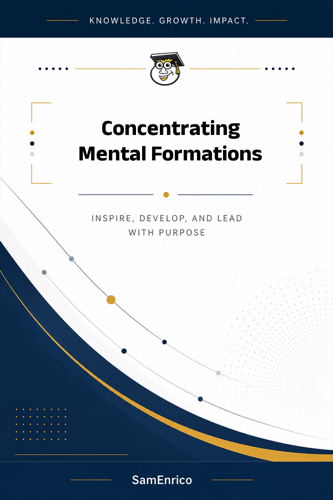
Non-FictionSelf-HelpConcentration
Concentrating Mental Formations Audiobook
Steady the mind by repeatedly anchoring attention
by Mcgill Zelma
Steady the mind by repeatedly anchoring attention on the breath.
Formats
Free sample
Chapter 1: The Wild Mind Hypothesis--–- Every morning, before your feet touch the floor, your mind is already running. Not a gentle jog—a sprint. By the time you have brushed your teeth, you have probably rehearsed an argument that hasn’t happened, regretted a decision from three years ago, planned a grocery list, and wondered what that strange sound was coming from your car’s engine. None of this feels unusual. This, you have been led to believe, is simply what it means to be a conscious human being.But here is the question that changes everything: what if the constant mental noise is not a sign of intelligence, but a sign of a skill that has never been trained?For most of your life, you have been praised for your ability to think.
Schools reward it. Employers pay for it. Friends admire it. But no one ever taught you how to stop thinking when stopping is exactly what you need. No one gave you a single practical technique for steadying the mind when it spins out of control.
And so you have lived inside a paradox: you have a magnificent brain that cannot sit still for ninety seconds without grabbing its phone, replaying an old wound, or leaping into a fantasy about a future that does not yet exist.This book is built on a single, testable claim: a steady mind is not a gift you are born with. It is a set of mental formations that you can observe, understand, and gradually calm through the repeated, gentle act of anchoring attention on the breath. That claim is not philosophy. It is neurobiology. It is psychology.
And it is the most useful thing you will learn this year.What Are Mental Formations?Let us begin with a word that sounds academic but describes something you experience every ten seconds of your waking life: mental formations. In the Buddhist psychological tradition (the Abhidhamma, specifically), mental formations—saṅkhāra—are the conditioned building blocks of conscious experience. They include every thought, every emotion, every impulse, every judgment, every memory that arises automatically in response to a stimulus. You do not decide to have a mental formation. It simply appears, like weather, based on past conditioning, current circumstances, and the raw data coming through your senses.Here is a concrete example.
You are walking down the street and you see someone you vaguely recognize. Before you can consciously process who they…
This is the end of the free sample. Get the Audiobook to keep going. Buy now
About this book
Details
- Author
- Mcgill Zelma
- Publisher
- SamEnrico
- Language
- English
- Genre
- Non-Fiction, Self-Help, Concentration
- Released
- 2026-06-06
- Pages (approx.)
- 138
- Available as
- eBook, Audiobook

Listen in the VoxFlicks app
Audiobooks and audio dramas wherever you go. Sign in with your SamEnrico account and press play.
More by Mcgill Zelma
 Gambling Addiction And PetsMcgill Zelma$11.99
 Alcohol Relapse Autopsy GuideMcgill Zelma$11.99
 Emotion Regulation For GriefMcgill Zelma$11.99
 Gary Zukav SeatMcgill Zelma$11.99
 The Elimination Quadrant GuideMcgill Zelma$11.99
 Hypertension GuideMcgill Zelma$11.99
 Antwerp Heist Copycat CrimesMcgill Zelma$11.99
 The Puppeteers of Prague: How Marionettes Conquered the WorldMcgill Zelma$11.99
 The Silent Revolution: How Women in Ancient Egypt Shaped CivilizationMcgill Zelma$11.99
 Mastering The Art of JujitsuMcgill Zelma$11.99
 How to Produce Hair Loss TreatmentsMcgill Zelma$11.99
 Citing AI and ChatGPT GuideMcgill Zelma$12.99
You may also like
 Hong Kong Handover 1997Dunn Johnnie$11.99
 Zumba For Postnatal Recovery CourseNeal Christian$11.99
 Zumba for BeginnersLadner Nikia$11.99
 YouTube Comment Mining GuideHumes Pandora$12.99
 Worry Box MeditationCarlin Rudy$11.99
 Workplace Stress MeditationNguyen Lynn$11.99
 Workplace Stress and Sleep RepairHawley Ivory$11.99
 Workplace Perfectionism CureDelaney Jeffry$11.99
 Workplace Injustice Anger GuideWallen Isabelle$11.99
 Work Addiction and Burnout LinkGreenwood Ester$11.99
 Women in Yoga and WellnessBeattie Galina$11.99
 Women in Stand Up ComedyChun Evangeline$11.99