
Non-FictionInformativeEducational
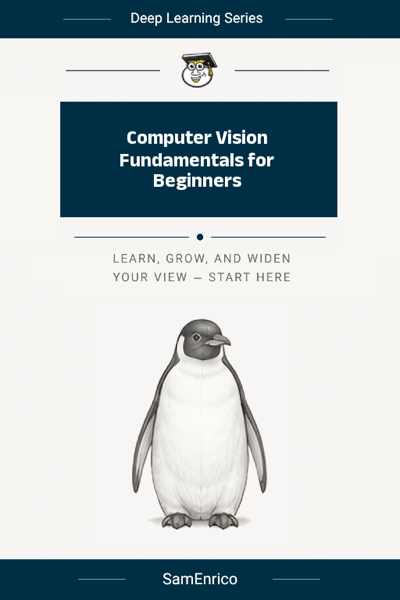
Computer Vision Fundamentals for Beginners eBook
A Coursebook on Computer Vision Fundamentals for B
A Coursebook on Computer Vision Fundamentals for Beginners
Formats
Free sample
Chapter 1: The Seeing Machine--– Close your eyes for a moment and imagine a photograph—perhaps a child blowing out birthday candles, a mountain reflected in a still lake, or a friend waving from a busy street. You see meaning: celebration, majesty, recognition. Now ask yourself: what would a computer see when it looks at that same photograph? The answer is startling in its simplicity and its inadequacy. Where you see a candle’s flame, the computer sees a cluster of numbers around (230, 150, 30). Where you see a smiling face, it sees a rectangular grid of integer values. Where you see friendship and warmth, it sees nothing at all. This is the fundamental reality of computer vision, and it is both the field’s greatest challenge and its deepest source of fascination. Every system that recognizes a face, reads a license plate, or guides a self-driving car must begin from this same humble starting point: a matrix of numbers. This chapter will transform how you see digital images. You will learn what computer vision truly is, how it differs from related fields, and why it has become one of the most transformative technologies of our age. You will confront the ethical responsibilities that accompany the power to build machines that see. Most importantly, you will set up your development environment and write your first working vision code, taking the first step from seeing photographs as pictures to seeing them as data.--The Invisible Chasm Human vision appears effortless, but that appearance is deceptive. Approximately one-third of your brain’s cortex is dedicated to visual processing. Hundreds of millions of neurons fire in parallel to interpret the cascade of light entering your eyes. You are the product of hundreds of millions of years of evolutionary refinement in visual perception. A computer, by contrast, has none of this biological inheritance. No evolution has shaped its circuits. No intuition guides its interpretations. When a computer receives an image, it receives a structured collection of numbers. Nothing more.This chasm between human perception and machine representation is called the semantic gap, and it is the central problem that computer vision seeks to bridge. The term “semantic” refers to meaning—the gap is between the raw measurements of light (pixel values) and the meaningful interpretation we desire (objects, people, actions, emotions). Bridging this gap requires teaching machines to transform grids of numbers into statements like “this is a pedestrian” or “this face belongs to Alice” or “this scene contains a stop sign.”The semantic gap explains why computer vision remained difficult for so long and why certain approaches succeed while others fail. If you slightly modify a single pixel in an image of a panda—a change imperceptible to any human—a state-of-the-art neural network might confidently misclassify that panda as a school bus. This vulnerability, known as an adversarial attack, exists precisely because the machine has no robust understanding of “panda-ness.” It has only statistical correlations learned from training data. The gap narrows with better algorithms and more data, but it never fully closes. That tension—between what the machine sees (numbers) and what we want it to understand (meaning)—drives the entire field.--Defining the Discipline Computer vision is the interdisciplinary field concerned with enabling machines to interpret and understand visual information from the world. More simply: computer vision teaches machines to see. But this simple definition requires careful expansion because computer vision is frequently confused with three related fields.Image processing transforms images into other images. When you apply a filter to brighten a photograph, remove red-eye, or convert color to black and white, you are performing image processing. The input is an image; the output is another image. There is no understanding, no interpretation, no meaning extracted. Image processing is a tool that computer vision uses, but it is not the same goal.Computer graphics starts from the opposite direction. Whereas computer vision takes images and attempts to understand the world that produced them, computer graphics takes descriptions of a virtual world (3D models, lights, cameras, materials) and synthesizes images from those descriptions. Video game rendering, Pixar movies, and architectural visualization are all computer graphics. Vision and graphics are often described as inverse problems: graphics goes from world to image; vision goes from image to world.Machine vision is the subset of computer vision focused specifically on industrial applications. Quality control systems that inspect manufactured parts, assembly line robots that locate components, and agricultural equipment that identifies ripe fruit are all machine vision systems. The term emphasizes reliability, speed, and precision in controlled environments, whereas computer vision encompasses a broader range of algorithms and applications, including those in uncontrolled settings like outdoor scenes, social media, and medical imaging.To remember the distinctions: image processing changes pictures, computer graphics creates pictures from models, and computer vision understands pictures. Machine vision is computer vision applied to factories and industrial settings.--The Landscape of Application Computer vision is not an abstract academic pursuit. It is embedded in technologies that billions of people use daily, and it is driving transformations across multiple industries. Understanding this landscape will motivate your learning and help you see where your new skills might be applied.Autonomous Vehicles. Self-driving cars are perhaps the most demanding computer vision application ever attempted. A vehicle must detect lanes, recognize traffic signs and signals, identify other vehicles (cars, trucks, motorcycles, bicycles), spot pedestrians (adults, children, people using wheelchairs, people walking dogs), interpret hand gestures from crossing guards and police officers, and avoid obstacles ranging from construction barrels to fallen trees. All of this must happen in real time, in all weather conditions, at night, and with near-perfect reliability because mistakes can be fatal. The vision systems in autonomous vehicles combine multiple cameras (stereo for depth, monocular for object detection), radar, and lidar, fusing their outputs into a coherent understanding of the driving environment.Medical Imaging. Radiologists examine thousands of medical images every year—X-rays, CT scans, MRIs, mammograms, ultrasound. Computer vision systems are now achieving expert-level performance at detecting abnormalities in these images: lung nodules that might be cancerous, early signs of diabetic retinopathy in retinal scans, hemorrhages in brain CTs, suspicious masses in mammograms. These systems do not replace doctors, but they act as tireless second readers, flagging potential issues that a human might miss, especially late in a shift when fatigue sets in. In several clinical studies, vision systems have reduced false negatives (missed cancers) by twenty to thirty percent while maintaining the same false positive rate.Facial Recognition. From unlocking your phone to tagging friends on social media to automated border control gates, facial recognition has become ubiquitous. The technology works by detecting faces in an image, aligning them to a canonical pose, extracting distinctive features (arrangements of eyes, nose, mouth shapes, bone structure patterns), and matching those features against a database of enrolled faces. State-of-the-art systems can identify faces with over ninety-nine percent accuracy under good conditions. However—and this is critical—accuracy varies significantly across demographic groups, with higher error rates for darker-skinned individuals, women, and older adults. This ethical dimension will be explored later in this chapter.Augmented and Virtual Reality. When you place a virtual piece of furniture in your living room using an AR app, the app must understand the geometry of your room. Where is the floor? Where…
This is the end of the free sample. Get the eBook to keep going. Buy now
About this book
Details
- Author
- Weldon Roselyn
- Publisher
- SamEnrico
- Language
- English
- Genre
- Non-Fiction, Informative, Educational
- Released
- 2026-05-08
- Pages (approx.)
- 159
- Available as
- eBook, Audiobook

Read better in the ZLOADR app
Your eBooks on your phone or tablet. Sign in with your SamEnrico account and start reading.
More by Weldon Roselyn
 Nobel Laureates In Chemistry BiologyWeldon Roselyn$11.99
 Affirmation Group GuideWeldon Roselyn$11.99
 Drug Dependency and Self Compassion WorkbookWeldon Roselyn$11.99
 The Physics Nobel NeutrinosWeldon Roselyn$11.99
 Stuttering as Stress SignalWeldon Roselyn$11.99
 Crater Lake MysteriesWeldon Roselyn$11.99
 Mitch Hedberg LogicWeldon Roselyn$11.99
 Work to Live Mindset ShiftWeldon Roselyn$11.99
 The Rise and Fall of Xerxes: Persia's Last Great KingWeldon Roselyn$11.99
 The Veles Conspiracy: A Spy Among the GodsWeldon Roselyn$11.99
 The Bone Harp of the Aswang: A Philippine NocturneWeldon Roselyn$11.99
 How to Become a Brim-and-crown PresserWeldon Roselyn$11.99
You may also like
 Hong Kong Handover 1997Dunn Johnnie$11.99
 Zumba For Postnatal Recovery CourseNeal Christian$11.99
 Zumba for BeginnersLadner Nikia$11.99
 YouTube Comment Mining GuideHumes Pandora$12.99
 Worry Box MeditationCarlin Rudy$11.99
 Workplace Stress MeditationNguyen Lynn$11.99
 Workplace Stress and Sleep RepairHawley Ivory$11.99
 Workplace Perfectionism CureDelaney Jeffry$11.99
 Workplace Injustice Anger GuideWallen Isabelle$11.99
 Work Addiction and Burnout LinkGreenwood Ester$11.99
 Women in Yoga and WellnessBeattie Galina$11.99
 Women in Stand Up ComedyChun Evangeline$11.99