
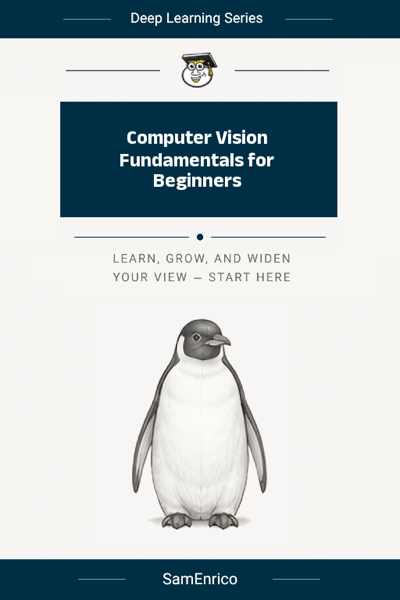
Computer Vision Fundamentals for Beginners
A Coursebook on Computer Vision Fundamentals for B
A Coursebook on Computer Vision Fundamentals for Beginners
Formats
About this book
Free sample
Chapter 1: The Seeing Machine--– Close your eyes for a moment and imagine a photograph—perhaps a child blowing out birthday candles, a mountain reflected in a still lake, or a friend waving from a busy street. You see meaning: celebration, majesty, recognition. Now ask yourself: what would a computer see when it looks at that same photograph? The answer is startling in its simplicity and its inadequacy. Where you see a candle’s flame, the computer sees a cluster of numbers around (230, 150, 30). Where you see a smiling face, it sees a rectangular grid of integer values. Where you see friendship and warmth, it sees nothing at all. This is the fundamental reality of computer vision, and it is both the field’s greatest challenge and its deepest source of fascination. Every system that recognizes a face, reads a license plate, or guides a self-driving car must begin from this same humble starting point: a matrix of numbers. This chapter will transform how you see digital images. You will learn what computer vision truly is, how it differs from related fields, and why it has become one of the most transformative technologies of our age. You will confront the ethical responsibilities that accompany the power to build machines that see. Most importantly, you will set up your development environment and write your first working vision code, taking the first step from seeing photographs as pictures to seeing them as data.--The Invisible Chasm Human vision appears effortless, but that appearance is deceptive. Approximately one-third of your brain’s cortex is dedicated to visual processing. Hundreds of millions of neurons fire in parallel to interpret the cascade of light entering your eyes. You are the product of hundreds of millions of years of evolutionary refinement in visual perception. A computer, by contrast, has none of this biological inheritance. No evolution has shaped its circuits. No intuition guides its interpretations. When a computer receives an image, it receives a structured collection of numbers. Nothing more.This chasm between human perception and machine representation is called the semantic gap, and it is the central problem that…
This is the end of the free sample. Get the eBook to keep going. Buy now
Contents
- Chapter 1
- Chapter 2
- Chapter 3
- Chapter 4
- Chapter 5
- Chapter 6
- Chapter 7
- Chapter 8
- Chapter 9
- Chapter 10
- Chapter 11
- Chapter 12
Details
- Author
- Weldon Roselyn
- Publisher
- SamEnrico
- Language
- English
- Genre
- Non-Fiction, Informative, Educational
- Released
- 2026-05-08
- Pages (approx.)
- 159
- Available as
- eBook, Audiobook

Read better in the ZLOADR app
Your eBooks on your phone or tablet. Sign in with your SamEnrico account and start reading.
More by Weldon Roselyn
 Nobel Laureates In Chemistry BiologyWeldon Roselyn$11.99
 Affirmation Group GuideWeldon Roselyn$11.99
 Drug Dependency and Self Compassion WorkbookWeldon Roselyn$11.99
 The Physics Nobel NeutrinosWeldon Roselyn$11.99
 Stuttering as Stress SignalWeldon Roselyn$11.99
 Crater Lake MysteriesWeldon Roselyn$11.99
 Mitch Hedberg LogicWeldon Roselyn$11.99
 Work to Live Mindset ShiftWeldon Roselyn$11.99
 The Rise and Fall of Xerxes: Persia's Last Great KingWeldon Roselyn$11.99
 The Veles Conspiracy: A Spy Among the GodsWeldon Roselyn$11.99
 The Bone Harp of the Aswang: A Philippine NocturneWeldon Roselyn$11.99
 How to Become a Brim-and-crown PresserWeldon Roselyn$11.99