
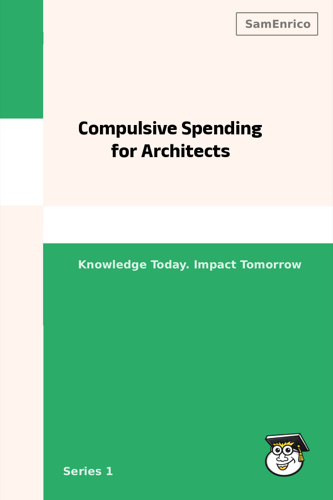
Non-FictionSelf-HelpArchitecture
Compulsive Spending for Architects eBook
Design purchases and lifestyle inflation.
Design purchases and lifestyle inflation.
Formats
Free sample
Chapter 1: The Vitruvian Trap--–- You are sitting in a coffee shop, third-wave espresso in hand, the ceramic cup so perfectly weighted that you find yourself admiring its handle geometry instead of reviewing the redlines spread across your laptop. Across from you, a colleague from the firm is describing their weekend visit to a design museum. You nod along, but your mind is elsewhere—specifically, on the $1,200 drafting stool you just ordered. You told yourself it was an investment in your back health, a necessary tool for the profession, and besides, it held its resale value. But as you take another sip of coffee, a quiet voice whispers: What if I just spent a month's grocery budget on a chair I could have tested for free in a showroom?Welcome to the Vitruvian Trap.This chapter is not about budgeting spreadsheets or debt consolidation plans.
Those tools come later. This chapter is about something more fundamental and far more dangerous: the peculiar way architectural training rewires your brain to confuse aesthetic recognition with financial entitlement. You have spent years learning to see the world differently—to notice the joint where two materials meet, to feel the weight of a door handle, to distinguish between a genuine Eames and a well-executed replica. These skills make you an excellent designer. They also make you a marketer’s dream and your own worst enemy when it comes to personal finance.The trap works like this: because you can recognize quality, you feel entitled to own it.
Not someday, when you have built wealth. Not in a carefully planned way that aligns with your actual income. Right now. The logic feels unassailable. How can you, a trained architect, sit in a mass-produced chair from an office supply store?
Would that not be a betrayal of everything you believe about design, about craft, about the dignity of well-made things?Yes, it would. And that is precisely the problem.Let us be clear about what this chapter does and does not claim. It does not claim that architects should abandon their appreciation for good design. It does not claim that all expensive purchases are irrational. And it certainly does not claim that you should live in a beige box devoid of aesthetic pleasure.
What this chapter claims is that architects have developed a systematic pattern of financial self-deception rooted in their professional identity, and until you name that pattern, you cannot escape it. The Vitruvian Trap is the name. Understanding its mechanisms is the first step toward freedom.The Two Archetypes That Haunt the Profession Every architect recognizes two figures that stalk the corridors of the profession. The first is romanticized, even celebrated. The second is hidden, ashamed, and far more common.The Starving Architect You know this archetype.
Howard Roark blowing up a quarry in The Fountainhead. The solitary genius working by candlelight, indifferent to money, sustained only by vision and cheap coffee. The starving architect is a cultural myth with real consequences. It suggests that financial suffering is a prerequisite for creative authenticity—that if you care about money, you cannot be a real designer.The problem with this archetype is not that it is entirely false. Many brilliant architects have lived modestly, and many have prioritized their work over their wallets.
The problem is that the myth normalizes deprivation and discourages architects from developing basic financial competence. If suffering is virtuous, why learn to negotiate? If poverty signals purity, why pursue a raise? The starving architect archetype keeps salaries low and credit card balances high by framing financial struggle as a badge of honor rather than a problem to be solved.But there is another archetype, less discussed and far more relevant to the pages ahead.The Spending Architect This figure earns a moderate income—perhaps $65,000 as a junior associate, perhaps $90,000 as a project architect with eight years of experience. But their tastes require an income three times that.
They own a Herman Miller Aeron chair ($1,500), a Vitsoe shelving system ($3,000), an espresso machine that cost more than their first car ($2,000), and a collection of monographs that would make a university library envious ($5,000 and climbing). They order Aesop hand soap because it comes in a beautiful bottle. They buy Common Projects sneakers because they are "minimalist and timeless." They live in a converted loft with exposed brick and original industrial windows, paying $2,800 a month for a one-bedroom apartment that leaks heat and has a shower the size of a phone booth.And then they wonder why they cannot save for a down payment. They wonder why their credit card balance never seems to drop. They wonder why, despite working fifty-hour weeks at a prestigious firm, they feel poorer every year.The Spending Architect is not greedy or stupid.
They are not morally flawed. They are caught in a trap that their own training set for them. And the first step out of that trap is understanding how it works.The Paradox at the Center of Architectural Practice Here is a strange fact about the profession: many architects spend their working hours designing affordable housing, community centers, public schools, and hospitals for clients with strict budget constraints. They learn to specify cost-effective materials, to value-engineer details, to fight for every square foot of space within a tight financial envelope. They take pride in delivering dignity and beauty on a budget.Then they go home to their own apartments, and that discipline evaporates.The same architect who specified porcelain tile to save the client $10,000 will spend $5,000 on marble for their own bathroom renovation.
The same architect who convinced a client to accept painted MDF instead of walnut veneer will order custom walnut shelving for their living room. The same architect who patiently explained to a client why a $200 faucet was perfectly adequate will buy a $900 Gaggenau faucet for their kitchen.The dissonance is not lost on them. They feel it. They may even joke about it with colleagues. But they lack a framework for understanding why it happens, and without that framework, they cannot stop it.The explanation lies in the psychology of exposure and normalization.
Architects spend their days surrounded by the best materials the world has to offer. They touch stone samples. They visit tile showrooms. They sit in $8,000 chairs at the client's insistence. Over time, these luxury items cease to feel luxurious.
They become the baseline. Anything less feels like a compromise, a failure of taste, a betrayal of everything the profession stands for.This is not a failure of character. It is a predictable result of the environment in which architects work. But predictable is not the same as inevitable. With awareness and deliberate practice, you can break the cycle.The Ego Validation Loop of Taste The Vitruvian Trap is held in place by a mechanism that this book calls the Ego Validation Loop of Taste.
It operates with mechanical regularity, and once you see it, you will recognize it everywhere.Step One: The Purchase You buy something moderately expensive—a $300 ceramic vase from a studio potter, a $600 coat from a minimalist brand, a $2,000 chair that you have admired for years. The purchase feels significant but justified. You have thought about…
This is the end of the free sample. Get the eBook to keep going. Buy now
About this book
Details
- Author
- Sager Madeleine
- Publisher
- SamEnrico
- Language
- English
- Genre
- Non-Fiction, Self-Help, Architecture
- Released
- 2026-06-05
- Pages (approx.)
- 137
- Available as
- eBook, Audiobook

Read better in the ZLOADR app
Your eBooks on your phone or tablet. Sign in with your SamEnrico account and start reading.
More by Sager Madeleine
 The Binge Eating Journal MethodSager Madeleine$11.99
 IBS Guided Imagery GuideSager Madeleine$11.99
 Steel and Aluminum Tariff GuideSager Madeleine$11.99
 Silent Justice: The Trial of the Last MimeSager Madeleine$11.99
 Utilization Review SpecialistSager Madeleine$11.99
 De Facto Relationship Evidence ManualSager Madeleine$12.99
 How to Produce Apparel and AccessoriesSager Madeleine$11.99
 How to Become a Radio-message RouterSager Madeleine$11.99
You may also like
 Hong Kong Handover 1997Dunn Johnnie$11.99
 Zumba For Postnatal Recovery CourseNeal Christian$11.99
 Zumba for BeginnersLadner Nikia$11.99
 YouTube Comment Mining GuideHumes Pandora$12.99
 Worry Box MeditationCarlin Rudy$11.99
 Workplace Stress MeditationNguyen Lynn$11.99
 Workplace Stress and Sleep RepairHawley Ivory$11.99
 Workplace Perfectionism CureDelaney Jeffry$11.99
 Workplace Injustice Anger GuideWallen Isabelle$11.99
 Work Addiction and Burnout LinkGreenwood Ester$11.99
 Women in Yoga and WellnessBeattie Galina$11.99
 Women in Stand Up ComedyChun Evangeline$11.99