
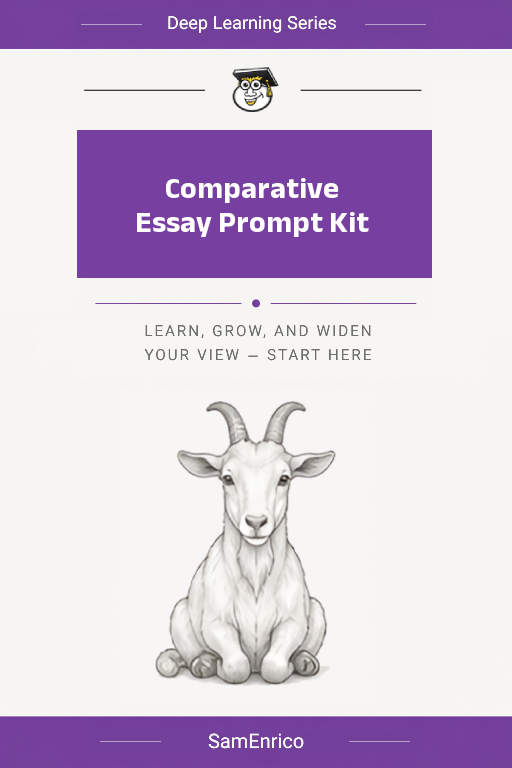
Comparative Essay Prompt Kit eBook
Identify similarities and differences between two
Identify similarities and differences between two subjects using GPT prompts that organize comparison by theme, not by subject.
Formats
Free sample
Chapter 1: The Matrix Pivot--–- Every failed comparison begins with a lie we tell ourselves: that listing facts about Subject A, then listing facts about Subject B, and then calling it a day counts as thinking.The lie is comfortable. It feels productive. You fill half a page with everything you know about the French Revolution, then half a page about the American Revolution, and somewhere in the middle you write the word “however” as if that single conjunction transforms a grocery list into an argument. Professors call this the “block method.” Students call it survival. But the top ten books on writing, critical thinking, and AI converge on one uncomfortable truth: the block method doesn’t compare.
It summarizes. And summary is the enemy of insight.This chapter introduces the foundational shift that the rest of the book depends on. You will learn what a theme actually is (and what it is not), why thematic organization produces sharper arguments than subject-by-subject listing, and how to build a two-column matrix that forces genuine comparison before you write a single sentence of prose. Most importantly, you will learn why every comparative essay you have ever struggled with probably started with the wrong question. The right question is not “How are A and B different?” The right question is “What theme do A and B both illuminate, and what happens when I hold them up to that light together?”Let us begin by dismantling the block method so thoroughly that you will never be tempted to use it again.The Anatomy of a Failed Comparison Imagine you have been asked to compare two political speeches: Frederick Douglass’s 1852 address “What to the Slave Is the Fourth of July?” and Malala Yousafzai’s 2013 speech to the United Nations Youth Assembly.
A student using the block method writes something like this:Douglass’s speech is angry and uses religious imagery. He asks rhetorical questions about the meaning of freedom. He was formerly enslaved, so he speaks from direct experience. The speech is long and builds to a climax. Malala’s speech is hopeful and uses educational metaphors.
She addresses world leaders directly. She survived an assassination attempt, so she speaks from near-death experience. Her speech is shorter and more direct.Where is the comparison? It is nowhere and everywhere. The paragraph describes two speeches in sequence, but it never puts them in a shared analytical space.
The reader must perform the mental work of comparison alone, drawing invisible lines between sentences that the writer refused to draw. That is not comparative writing. That is two separate summaries separated by a paragraph break.The block method fails for three structural reasons. First, it treats the subjects as independent entities rather than as mutual illuminators. Second, it assumes that the reader will automatically see the relationship between the facts, when in fact the writer’s job is to build that relationship sentence by sentence.
Third, it encourages what the cognitive psychologist Daniel Kahneman would call “System 1 thinking”—fast, associative, list-making—rather than the slow, deliberate, relational thinking that genuine comparison requires.Worse, the block method hides its own emptiness behind volume. A student who writes five paragraphs about A and five about B feels that they have done ten paragraphs of work. But an essay of ten descriptive paragraphs is not an argument. It is an encyclopedia entry with a title page.What the Top Ten Books Teach Us About Real Comparison Before we build the better method, we need to understand why the block method persists despite being universally criticized by every major writing guide of the last fifty years. The answer is surprising: the block method persists because it mimics how we naturally notice differences.
When you meet two people, you do not systematically compare them theme by theme. You notice that one is taller, then later that one speaks more quietly, then later that one laughs more easily. The block method feels intuitive because it resembles the loose, associative structure of everyday observation.But essays are not conversations. Essays are arguments. And arguments require a level of structural discipline that everyday observation does not.They Say / I Say (Graff and Birkenstein) teaches that strong academic writing enters an ongoing conversation.
A comparative essay does not just report that two subjects differ; it enters the conversation about why those differences matter. The Pyramid Principle (Barbara Minto) teaches that good arguments start with the conclusion and then support it, rather than listing facts and hoping a conclusion emerges. The Craft of Research (Booth, Colomb, and Williams) teaches that research questions should drive writing, not the accumulation of facts about two separate things. Thinking, Fast and Slow (Kahneman) teaches that our brains default to lazy pattern-matching unless we consciously override it with analytical frameworks.All of these books converge on a single instructional imperative: organize by idea, not by subject. When you organize by idea—by theme—you force yourself to ask, at every point, “What is the relationship between A and B on this specific dimension?” That question produces insight.
The block method never asks it.Defining “Theme” for the First Time (and the Last Time)The word “theme” is used so loosely in writing instruction that it has almost lost meaning. Some teachers use “theme” to mean “topic” (the theme of the essay is the French Revolution). Others use it to mean “moral” (the theme is that freedom requires sacrifice). Still others use it to mean “motif” (the theme of water appears throughout). This book uses “theme” in a precise, narrow, operational sense.A theme is an analytical spine: a concept, value, pattern, or question that applies meaningfully to both subjects and allows a claim about their relationship.
A theme is not a topic. A topic is a subject-matter category like “plot,” “price,” or “color.” Topics describe. Themes analyze.Consider the difference. “Plot” is a topic. You can describe the plot of two novels without ever making a claim about how they relate.
“Narrative structure as an expression of cultural anxiety” is a theme. It forces you to look at how each novel organizes its story and then ask what that organization reveals about deeper fears. “Price” is a topic. “Value signaling through pricing strategy” is a theme. “Color” is a topic.
“Color as a tool for emotional manipulation” is a theme.The test is simple: if you can apply the word to a single subject and produce a complete description without mentioning the other subject, you are probably looking at a topic, not a theme. Themes are relational by definition. They exist in the space between subjects.Here is a quick-reference table that will appear throughout the book:If you are tempted to call this a theme…It is actually a topic. Try this instead.“The plot”“How narrative structure manages reader expectations”“The price”“How pricing communicates brand positioning”“The color blue”“How color choice constructs emotional atmosphere”“The length”“How duration shapes audience attention and fatigue”“The main character”“How protagonist design embodies moral values”“The setting”“How physical environment enables or constrains action”Memorize this distinction. Every time you catch yourself calling a topic a theme, you have found a place where your thinking is still stuck in the block method.…
This is the end of the free sample. Get the eBook to keep going. Buy now
About this book
Details
- Author
- Kowalski Armanda
- Publisher
- SamEnrico
- Language
- English
- Genre
- essays, Student's Shortcut
- Released
- 2026-06-01
- Pages (approx.)
- 148
- Available as
- eBook, Audiobook

Read better in the ZLOADR app
Your eBooks on your phone or tablet. Sign in with your SamEnrico account and start reading.
More by Kowalski Armanda
 Metformin GuideKowalski Armanda$11.99
 Eddy Arnold Make World Go AwayKowalski Armanda$11.99
 Name Recall for PharmacistsKowalski Armanda$11.99
 The Low Energy Love GuideKowalski Armanda$11.99
 Working Memory in Language LearningKowalski Armanda$11.99
 Detect Early WithdrawalKowalski Armanda$11.99
 Ronald Reagan BiographyKowalski Armanda$11.99
 PTSD Relationship AngerKowalski Armanda$11.99
 The Silk Thieves of Samarkand: The Great Carpet Heist of the 16th CenturyKowalski Armanda$11.99
 The Sultan's Shadow: The Trial of Emine Saniye SultanKowalski Armanda$11.99
 How to Start a Nuffield Hospital Trust Business (Beginners Guide)Kowalski Armanda$11.99
 How to Produce SignageKowalski Armanda$11.99
You may also like
 YouTube Video Essay DepthLeon Lala$11.99
 TOEFL Independent Essay GuideMintz Alex$11.99
 Music Theory Essay GuideWilkinson Maisha$11.99
 Expository Essay AI PromptsApplegate Dalia$11.99
 Exam Essay MemorizationMcgovern Johna$11.99
 Compare Contrast Essay PromptsOntiveros Marx$11.99
 College Application Essay GuideSisson Aimee$11.99College Application Essay GuideSisson Aimee$11.99
 The 100 Word Essay ChallengeAli Luciana$11.99
 Journalism Essay PromptsThatcher Williemae$11.99
 Finance Essay PromptsShrader Lamont$11.99
 Cause Effect Essay GPT GuideBland Jacelyn$11.99