
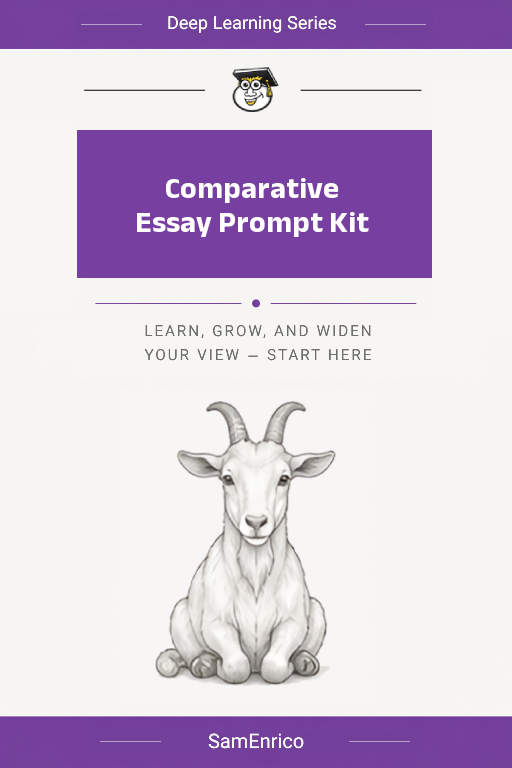
Comparative Essay Prompt Kit
Identify similarities and differences between two
Identify similarities and differences between two subjects using GPT prompts that organize comparison by theme, not by subject.
Formats
About this book
Free sample
Chapter 1: The Matrix Pivot--–- Every failed comparison begins with a lie we tell ourselves: that listing facts about Subject A, then listing facts about Subject B, and then calling it a day counts as thinking.The lie is comfortable. It feels productive. You fill half a page with everything you know about the French Revolution, then half a page about the American Revolution, and somewhere in the middle you write the word “however” as if that single conjunction transforms a grocery list into an argument. Professors call this the “block method.” Students call it survival. But the top ten books on writing, critical thinking, and AI converge on one uncomfortable truth: the block method doesn’t compare.
It summarizes. And summary is the enemy of insight.This chapter introduces the foundational shift that the rest of the book depends on. You will learn what a theme actually is (and what it is not), why thematic organization produces sharper arguments than subject-by-subject listing, and how to build a two-column matrix that forces genuine comparison before you write a single sentence of prose. Most importantly, you will learn why every comparative essay you have ever struggled with probably started with the wrong question. The right question is not “How are A and B different?” The right question is “What theme do A and B both illuminate, and what happens when I hold them up to that light together?”Let us begin by dismantling the block method so thoroughly that you will never be tempted to use it again.The Anatomy of a Failed Comparison Imagine you have been asked to compare two political speeches: Frederick Douglass’s 1852 address “What to the Slave Is the Fourth of July?” and Malala Yousafzai’s 2013 speech to the United Nations Youth Assembly.
A student using the block method writes something like this:Douglass’s speech is angry and uses religious imagery. He asks rhetorical questions about the meaning of freedom. He was formerly enslaved, so he speaks from direct experience. The speech is long and builds to a climax. Malala’s speech is hopeful and uses educational metaphors.…
This is the end of the free sample. Get the eBook to keep going. Buy now
Contents
- Chapter 1
- Chapter 2
- Chapter 3
- Chapter 4
- Chapter 5
- Chapter 6
- Chapter 7
- Chapter 8
- Chapter 9
- Chapter 10
- Chapter 11
- Chapter 12
Details
- Author
- Kowalski Armanda
- Publisher
- SamEnrico
- Language
- English
- Genre
- essays, Student's Shortcut
- Released
- 2026-06-01
- Pages (approx.)
- 148
- Available as
- eBook, Audiobook

Read better in the ZLOADR app
Your eBooks on your phone or tablet. Sign in with your SamEnrico account and start reading.
More by Kowalski Armanda
 Metformin GuideKowalski Armanda$11.99
 Eddy Arnold Make World Go AwayKowalski Armanda$11.99
 Name Recall for PharmacistsKowalski Armanda$11.99
 The Low Energy Love GuideKowalski Armanda$11.99
 Working Memory in Language LearningKowalski Armanda$11.99
 Detect Early WithdrawalKowalski Armanda$11.99
 Ronald Reagan BiographyKowalski Armanda$11.99
 PTSD Relationship AngerKowalski Armanda$11.99
 The Silk Thieves of Samarkand: The Great Carpet Heist of the 16th CenturyKowalski Armanda$11.99
 The Sultan's Shadow: The Trial of Emine Saniye SultanKowalski Armanda$11.99
 How to Start a Nuffield Hospital Trust Business (Beginners Guide)Kowalski Armanda$11.99
 How to Produce SignageKowalski Armanda$11.99
You may also like
 Scholarship Essays On Community ImpactHickey Lawerence$12.99
 Gender and Sexuality Identity EssaysCotton Marissa$12.99
 College Essay For Business MajorsSandlin Sheilah$12.99
 Overcoming Adversity Essay FrameworkLynch Cameron$12.99
 Why This College Essay TemplateWestbrook Shakira$12.99
 Volunteer and Service EssaysForsyth Ivory$12.99
 Voice and Tone for College EssaysBrownlee Jacqualine$12.99
 US Common App Essay GuideBelton Cassidy$12.99
 Undecided Major Essay TemplateSolano Lesia$12.99
 Transfer Application Essay GuideDeaton Deb$12.99
 Supplemental Essay Strategy HandbookLaflamme Bradly$12.99
 Scholarship Essay Writing WorkbookHolden Kory$12.99