
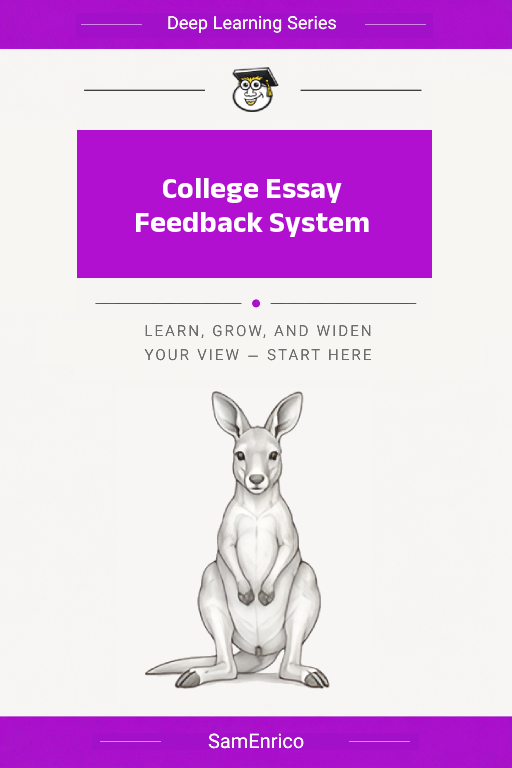
essaysFeedback GuideRevision System
College Essay Feedback System eBook
Get useful feedback from teachers, friends, and fa
by Pitts Maida
Get useful feedback from teachers, friends, and family. Learn what to listen to and what to ignore.
Formats
Free sample
Chapter 1: The 2 AM Masterpiece--The pizza had been sitting on your desk for three hours. Cold pepperoni grease soaked through the cardboard. Your eyes burned from staring at the screen. But none of that mattered because you just typed the final sentence of your college essay, and it was perfect.You read it aloud to your empty room at 2 AM. The words flowed.
The emotions landed. The conclusion gave you chills. You cried a little, honestly. This was the essay. The one that would make admissions officers lean forward in their chairs, reach for their acceptance letter stamps, and say “yes” before finishing the second paragraph.You fell asleep feeling like a literary genius.The next morning, you handed it to your English teacher.
She read it in forty-five seconds—the same amount of time it takes to microwave a burrito—and handed it back with two sentences:“I don’t understand what you’re trying to say. And I’m not sure what happened in the middle.”Your stomach dropped. Your face got hot. Did she even read it? you thought.
Does she not understand good writing? Maybe she just doesn’t like me.You walked out of the classroom carrying an essay that had transformed, overnight, from a masterpiece into a question mark. And you had no idea what to do next.This chapter is about why that happens. Why your draft feels perfect to you but confusing to everyone else. Why you are biologically incapable of seeing your own writing clearly.
And why feedback—even feedback that hurts—is not a verdict on your ability but the only cure for a brain that is working against you.The Two Traps Every Writer Falls Into Let me name the two psychological traps that just ambushed you. Neither one means you are a bad writer. Both mean you are a human being with a normally functioning brain.Trap #1: The Curse of Knowledge You know too much.That sentence sounds backwards. Isn’t knowing more a good thing? Yes, for taking tests.
No, for editing your own writing.The Curse of Knowledge is a cognitive bias discovered by economists Colin Camerer, George Loewenstein, and Martin Weber in 1989. They found that once you know something—really know it, with all its context and backstory and emotional weight—you cannot unknow it. You cannot pretend to be ignorant. Your brain literally cannot simulate the experience of a first-time reader.Here is what you know about your essay that your teacher does not:The inside joke that inspired your opening sentence The three weeks of summer job misery that you summarized in one paragraph The real person behind the pseudonym “Ms. Rivera”Why the broken mixer mattered (because your grandfather gave it to you)What you left out because you ran out of room You carry all of that knowledge in your head as you read your own draft.
Your brain fills in the gaps automatically. When you read “I learned to be patient,” you feel the full weight of the seventy-two hours of impatience that preceded that lesson. Your teacher reads the same two words and feels nothing.This is not a metaphor. Functional MRI studies show that when people read their own writing, the brain regions associated with memory retrieval and personal significance light up. When strangers read the same text, those regions are dark.
They are reading words. You are reading words plus a movie only you can see.The Curse of Knowledge means that your draft is always clearer to you than it will ever be to anyone else. You are not overestimating your writing. You are underestimating how much context you bring to it.Trap #2: The Motherhood Effect You love your sentences because you made them.The Motherhood Effect is named after a well-documented phenomenon: parents rate their own children’s drawings as more creative, more sophisticated, and more emotionally expressive than objective art critics do. The scribble that looks like a potato to a stranger looks like a “bold exploration of organic form” to the parent who watched it being made.The same thing happens with your writing.
You labored over that sentence for twenty minutes. You deleted and rewrote that paragraph four times. You remember the struggle, so you overvalue the result. The reader, who saw none of the struggle, just sees the result—and judges it without sentiment.Studies on self-assessment in writing confirm this. In one study at the University of Texas, students rated their own essays an average of 30 percent higher than anonymous evaluators did.
The gap was largest for the students who had spent the most time writing. The harder you worked, the more you overrated the outcome.This is not arrogance. It is attachment. You are not supposed to be objective about your own creative work any more than you are supposed to be objective about your own child. The problem is that objectivity is exactly what you need right now.The Neuroscience of Self-Blindness Why can’t you just “try harder” to see your draft clearly?
Because the brain regions involved in creating are different from those involved in evaluating. And they do not work well at the same time.When you write, you activate the default mode network—a set of brain regions associated with autobiographical memory, future planning, and creative association. This is the “daydreaming network.” It is loose, associative, and generative. It is great for coming up with ideas. It is terrible for spotting missing commas.When you edit, you activate the executive control network—regions associated with attention, error detection, and rule enforcement.
This is the “drill sergeant network.” It is precise, critical, and exhausting. It is great for finding mistakes. It is terrible for generating new ideas.Here is the problem: these two networks are anticorrelated. When one is active, the other quiets down. You cannot be in full creative mode and full editing mode at the same time.
Your brain literally will not let you.That means every time you try to edit your own draft immediately after writing it, you are asking your brain to do something it is structurally incapable of doing. You are trying to drive with your foot on the gas and the brake at the same time. The result is not better driving. It is stalling.This is why professional writers have a rule: never edit on the same day you write. Stephen King puts the first draft in a drawer for six weeks before he reads it.
Six weeks is unrealistic for a college application, but the principle is the same. You need distance. You need your creative brain to quiet down so your critical brain can wake up.But distance alone is not enough. Because even after six weeks, you still know the backstory. You still remember the struggle.
The Curse of Knowledge and the Motherhood Effect do not fade with time. They fade with other people.Why Feedback Is Not Criticism Here is the most important sentence in this book:Feedback is data. Not a verdict.When your teacher says “I don’t understand what you’re trying to say,” she is not saying “you are a bad writer.” She is saying…
This is the end of the free sample. Get the eBook to keep going. Buy now
About this book
Details
- Author
- Pitts Maida
- Publisher
- SamEnrico
- Language
- English
- Genre
- essays, Feedback Guide, Revision System
- Released
- 2026-05-30
- Pages (approx.)
- 137
- Available as
- eBook, Audiobook

Read better in the ZLOADR app
Your eBooks on your phone or tablet. Sign in with your SamEnrico account and start reading.
More by Pitts Maida
 The Letting Go BreathworkPitts Maida$11.99
 Attempt Survivor Sibling LossPitts Maida$11.99
 Alcohol Sleep Recovery GuidePitts Maida$11.99
 The Pain And Dignity MeditationPitts Maida$11.99
 The Parent Task Batching SystemPitts Maida$11.99
 How to Become a Compounder HelperPitts Maida$11.99
 Project SurveyorPitts Maida$11.99
 Honda Manufacturing SWOTPitts Maida$12.99
 Understanding Nivelon–nivelon–mabille SyndromePitts Maida$17.99
You may also like
 YouTube Video Essay DepthLeon Lala$11.99
 TOEFL Independent Essay GuideMintz Alex$11.99
 Music Theory Essay GuideWilkinson Maisha$11.99
 Expository Essay AI PromptsApplegate Dalia$11.99
 Exam Essay MemorizationMcgovern Johna$11.99
 Compare Contrast Essay PromptsOntiveros Marx$11.99
 College Application Essay GuideSisson Aimee$11.99College Application Essay GuideSisson Aimee$11.99
 The 100 Word Essay ChallengeAli Luciana$11.99
 Journalism Essay PromptsThatcher Williemae$11.99
 Finance Essay PromptsShrader Lamont$11.99
 Cause Effect Essay GPT GuideBland Jacelyn$11.99