
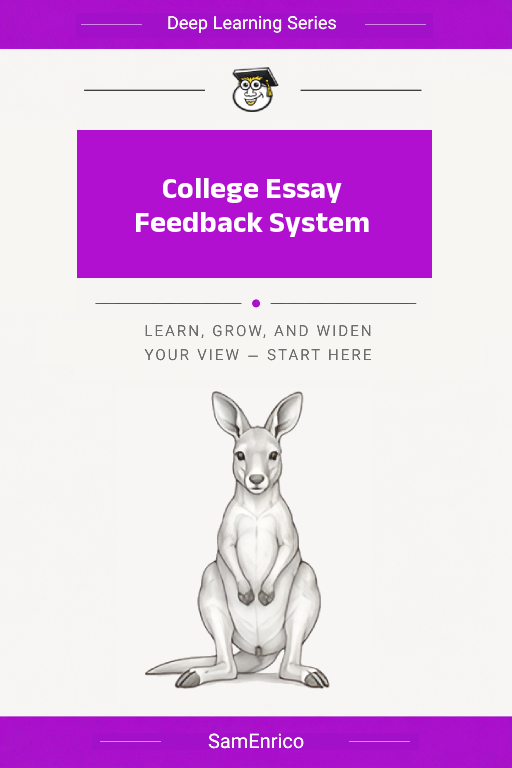
essaysFeedback GuideRevision System
College Essay Feedback System Audiobook
Get useful feedback from teachers, friends, and fa
by Pitts Maida
Get useful feedback from teachers, friends, and family. Learn what to listen to and what to ignore.
Formats
Free sample
Chapter 1: The 2 AM Masterpiece--The pizza had been sitting on your desk for three hours. Cold pepperoni grease soaked through the cardboard. Your eyes burned from staring at the screen. But none of that mattered because you just typed the final sentence of your college essay, and it was perfect.You read it aloud to your empty room at 2 AM. The words flowed.
The emotions landed. The conclusion gave you chills. You cried a little, honestly. This was the essay. The one that would make admissions officers lean forward in their chairs, reach for their acceptance letter stamps, and say “yes” before finishing the second paragraph.You fell asleep feeling like a literary genius.The next morning, you handed it to your English teacher.
She read it in forty-five seconds—the same amount of time it takes to microwave a burrito—and handed it back with two sentences:“I don’t understand what you’re trying to say. And I’m not sure what happened in the middle.”Your stomach dropped. Your face got hot. Did she even read it? you thought.
Does she not understand good writing? Maybe she just doesn’t like me.You walked out of the classroom carrying an essay that had transformed, overnight, from a masterpiece into a question mark. And you had no idea what to do next.This chapter is about why that happens. Why your draft feels perfect to you but confusing to everyone else. Why you are biologically incapable of seeing your own writing clearly.
And why feedback—even feedback that hurts—is not a verdict on your ability but the only cure for a brain that is working against you.The Two Traps Every Writer Falls Into Let me name the two psychological traps that just ambushed you. Neither one means you are a bad writer. Both mean you are a human being with a normally functioning brain.Trap #1: The Curse of Knowledge You know too much.That sentence sounds backwards. Isn’t knowing more a good thing? Yes, for taking tests.
No, for editing your own writing.The Curse of Knowledge is a cognitive bias discovered by economists Colin Camerer, George Loewenstein, and Martin Weber in 1989. They found that once you know something—really know it, with all its context and backstory and emotional weight—you cannot unknow it. You cannot pretend to be ignorant. Your brain literally cannot simulate the experience…
This is the end of the free sample. Get the Audiobook to keep going. Buy now
About this book
Details
- Author
- Pitts Maida
- Publisher
- SamEnrico
- Language
- English
- Genre
- essays, Feedback Guide, Revision System
- Released
- 2026-05-30
- Pages (approx.)
- 137
- Available as
- eBook, Audiobook

Listen in the VoxFlicks app
Audiobooks and audio dramas wherever you go. Sign in with your SamEnrico account and press play.
More by Pitts Maida
 The Letting Go BreathworkPitts Maida$11.99
 Attempt Survivor Sibling LossPitts Maida$11.99
 Alcohol Sleep Recovery GuidePitts Maida$11.99
 The Pain And Dignity MeditationPitts Maida$11.99
 The Parent Task Batching SystemPitts Maida$11.99
 How to Become a Compounder HelperPitts Maida$11.99
 Project SurveyorPitts Maida$11.99
 Honda Manufacturing SWOTPitts Maida$12.99
 Understanding Nivelon–nivelon–mabille SyndromePitts Maida$17.99
You may also like
 YouTube Video Essay DepthLeon Lala$11.99
 TOEFL Independent Essay GuideMintz Alex$11.99
 Music Theory Essay GuideWilkinson Maisha$11.99
 Expository Essay AI PromptsApplegate Dalia$11.99
 Exam Essay MemorizationMcgovern Johna$11.99
 Compare Contrast Essay PromptsOntiveros Marx$11.99
 College Application Essay GuideSisson Aimee$11.99College Application Essay GuideSisson Aimee$11.99
 The 100 Word Essay ChallengeAli Luciana$11.99
 Journalism Essay PromptsThatcher Williemae$11.99
 Finance Essay PromptsShrader Lamont$11.99
 Cause Effect Essay GPT GuideBland Jacelyn$11.99