
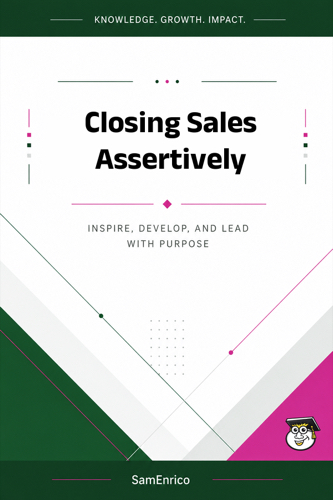
Closing Sales Assertively eBook
Ask for the sale, handle objections, and set terms
Ask for the sale, handle objections, and set terms without being pushy.
Formats
Free sample
Chapter 1: The Disease of Nice--–- Nick was the nicest person in his office. Everyone loved him. Prospects laughed with him, shared personal stories, and called him back. His pipeline was full of "friends." And he was failing.He had been in software sales for four years. His colleagues described him as "a natural relationship builder." His managers praised his ability to make people feel comfortable.
But when the quarterly numbers came out, Nick was consistently in the bottom third of the sales team. He couldn't understand why. He was doing everything right—except one thing. He never asked for the sale.Nick’s story is not unusual. In fact, it is the most common failure mode in professional sales today.
Not the failure of aggression—the failure of nice. And it is devastating.The Central Fear That Plagues Every Salesperson Before we can close sales assertively, we must name the enemy. That enemy is not the prospect. It is not the competition. It is not a bad economy or a difficult product.
The enemy is the fear of rejection.This fear is universal. It lives in the most seasoned sales executive and the newest rookie. It manifests as a physical sensation: tightness in the chest, a dry mouth, the urge to say literally anything other than the words, "So, are you ready to move forward?"The fear of rejection creates two toxic behaviors, and both of them lose deals.Toxic Behavior #1: The Soft Sell (Avoidance)The soft seller does everything except close. They educate. They build rapport.
They send follow-up emails. They wait for the prospect to make the first move. They tell themselves stories: "I'm building trust." "I don't want to be pushy." "When they're ready, they'll tell me." But the prospect never tells them. The prospect waits to be led. And then the prospect buys from someone else—someone less "nice" but more assertive.Toxic Behavior #2: The Hard Sell (Aggression)The hard seller overcompensates for their fear by becoming loud, persistent, and manipulative.
They use high-pressure tactics. They call twelve times in one day. They make the prospect feel trapped. They close the deal sometimes—but they destroy relationships, generate returns and cancellations, and create a reputation that precedes them. Worse, they hate themselves for it.
They go home feeling like a caricature of a salesman.Here is the paradox that will define this entire book: The fear of rejection causes both passivity and aggression. And both are forms of weakness. Assertiveness is the narrow path between them—the path of confidence, service, and control.The Reframe: Assertiveness as an Act of Service Drawing from The Psychology of Selling by Brian Tracy and Sell or Be Sold by Grant Cardone, this chapter introduces a radical reframe: Closing is not something you do to the customer. It is something you do for the customer.Stop and read that again.If you genuinely believe that your product or service solves a real problem—if it saves money, reduces pain, saves time, increases revenue, or improves quality of life—then failing to close is not humility. It is negligence.
It is walking into a burning building with a fire extinguisher and refusing to use it because you don't want to seem pushy.Consider the medical profession. A surgeon does not apologize for recommending a life-saving operation. A dentist does not say, "No pressure, but you might want to consider filling that cavity eventually if you feel like it." They are assertive because the stakes are real. The same is true in sales. Your customer has a problem.
You have a solution. The gap between them is costing money, time, or peace of mind every single day. Closing the sale is how you close that gap.The Service Close Mindset This reframe is so important that it has a name: the Service Close. It is defined by four beliefs that you must internalize before you use any technique in this book:My product solves a real problem. Not a nice-to-have.
A genuine pain point.The prospect is suffering by staying where they are. Every day they wait has a cost.I am not asking for a favor. I am offering a solution.If they say no, I have not lost anything. I have simply identified a mismatch.When you believe these four things, the fear of rejection begins to dissolve. You are not trying to get something from the customer.
You are trying to give them something. And that shift—from "trying to get" to "earning the right to give"—is the foundation of assertive closing.Earning the Right to Ask One of the most destructive myths in sales is that closing is something you do at the end of the conversation. That is like saying the final pitch in baseball is the only thing that matters. In reality, the close is earned long before you speak the words.The Permission Model Assertive salespeople do not ambush their prospects with a sudden request for money. Instead, they earn permission at every stage of the conversation.
Consider the difference between these two approaches:Pushy Approach: "So, let me show you what we can do. (Presents for 45 minutes.) Okay, so what do you think? Can I sign you up today?"Assertive Approach: "Before I show you anything, can I ask you three quick questions to see if this even makes sense for you?" (Gets permission.) "Great. After these questions, if it seems like a fit, I'll show you how we solve exactly these problems. Does that sound fair?" (Gets permission again.) "Perfect.
And if at the end you agree this solves your problem, we can talk about next steps. Is that okay?" (Gets permission a third time.)Do you see the difference? The assertive salesperson is not weaker. They are more in control because they have been invited to close. The prospect has said "yes" three times before the price is even mentioned.The "Earned Right" Checklist Before you ask for the sale, you must be able to answer "yes" to these five questions:Have I identified a specific problem?
(Not a general dissatisfaction. A concrete, measurable issue.)Has the prospect acknowledged that problem? (Not "I think so." A clear, verbal "Yes, that's a problem.")Have I shown how my solution addresses that exact problem? (Not features. The direct link from problem to solution.)Have I quantified the cost of doing nothing?
(Dollars, time, or reputation that will be lost by waiting.)Have I earned permission to ask for the close? (The prospect knows we are moving toward a decision.)If you cannot answer yes to all five, do not close. Go back and do the work. The close is not a magic trick. It is a natural conclusion to a logical process.The Pipeline Formula: The Ultimate Prerequisite There is one more truth that must be established in this first chapter because it will appear again in Chapter 12 and throughout this book.
It is so important that it functions as the foundation beneath every technique you will learn.Desperation kills assertiveness.Read that again. Desperation kills assertiveness.When you need a deal, you will act differently. You will discount too early. You will chase when…
This is the end of the free sample. Get the eBook to keep going. Buy now
About this book
Details
- Author
- Isaacson Winford
- Publisher
- SamEnrico
- Language
- English
- Genre
- Non-Fiction, Self-Help, Sales Skills
- Released
- 2026-06-10
- Pages (approx.)
- 153
- Available as
- eBook, Audiobook

Read better in the ZLOADR app
Your eBooks on your phone or tablet. Sign in with your SamEnrico account and start reading.
More by Isaacson Winford
 Operation Car Wash Paulo PretoIsaacson Winford$11.99
 Phobia and Sleep GuideIsaacson Winford$11.99
 Action Planning for ADHD MindsIsaacson Winford$11.99
 Housing Options After Sixty FiveIsaacson Winford$11.99
 Beware the Bridge Trolls of Norway’s Mountain PassesIsaacson Winford$11.99
 Understanding Interstitial CystitisIsaacson Winford$17.99
 How to Start a Hobby in MotocrossIsaacson Winford$11.99
 Stigma Breaking HandbookIsaacson Winford$12.99
 B2B Digital Procurement Trends GuideIsaacson Winford$12.99
 Crane Game Prize ArrangerIsaacson Winford$11.99
You may also like
 Sales Nonverbal Persuasion GuideGamble Madelyn$11.99
 Active Listening For SalesFrantz Ozie$11.99
 Sales Relationship Building GuideDraper Vanesa$11.99
 The Distraction Proof Sales CallTisdale Keneth$11.99
 Name Memory for Sales PeopleWhite Irving$11.99
 Assertiveness In SalesHouck Mitchel$11.99
 Relationship Building for SalespeoplePlatt Tamiko$11.99
 Difficult Conversations For SalesHumphries Garth$11.99
 Sales Persuasion Closing TechniquesVeal Christin$11.99
 Small Talk for SalespeopleLujan Ngan$11.99
 NVC For Sales ConversationsGreen Noah$11.99
 Assertiveness in Sales GuideBradshaw Rod$11.99