
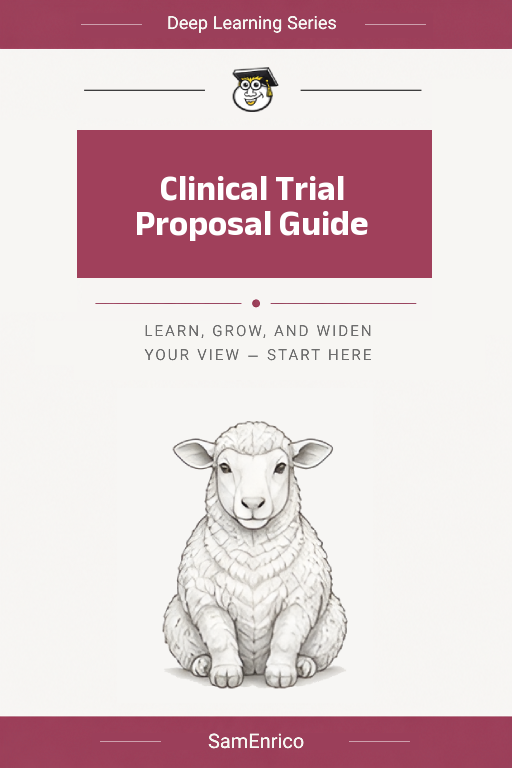
Non-FictionStudent's ShortcutClinical
Clinical Trial Proposal Guide eBook
Propose clinical research with human subjects for
Propose clinical research with human subjects for grad school. Describe phase, randomization, blinding, adverse event monitoring, and stopping rules.
Formats
Free sample
Chapter 1: The Proposal Pivot--You are holding a book about clinical trial proposals, but your first instinct might be to skip this chapter. After all, you already know what a clinical trial is. You have taken the methods course. You have read the papers. You are ready to write.That instinct is exactly why this chapter exists.Because the single most common reason graduate students fail to get their clinical trial proposals approved – by committees, by IRBs, by funding agencies – is not weak statistics or poor design.
It is a fundamental misunderstanding of what kind of project they are actually proposing. They think they are writing a clinical trial proposal when, in fact, they are describing an observational study with clinical trial vocabulary. Or they are describing a Phase III megatrial that would require a team of fifty and a budget of millions. Or they are describing a study that has already been done twice before, which makes it not original research but an expensive duplication of effort.This chapter is called "The Proposal Pivot" because before you write one word of your protocol, you must pivot from what you think you know about clinical trials to what you actually need to know as a graduate student. That pivot requires answering three questions correctly.
Get any of these wrong, and your proposal will not survive first contact with your committee or your IRB.The first question: Is this actually a clinical trial? The second: Has this trial already been done? The third: Can I realistically complete this trial before my funding runs out?This chapter answers all three. By the end, you will know with certainty whether you are writing a clinical trial proposal or something else. You will have a systematic review worksheet that proves your trial is necessary.
And you will have a reality check tool that matches your ambition to your actual resources.Let us begin with the question that derails more graduate students than any other.The Three-Question Litmus Test That Should Be Your First Step Imagine you have spent six months designing a study. You have written a beautiful protocol. You have created case report forms. You have scheduled meetings with your committee. Then, at the defense, someone asks: "Is this actually a clinical trial?" You say yes.
They say: "Show me where the investigator assigns the intervention."You freeze. Because in your study, you are simply observing what patients already do. You are not assigning anything. You are not randomizing. You are chart reviewing.That is not a clinical trial.
It is an observational study. And calling it a trial will not make it one.The three-question litmus test prevents this catastrophe. Apply it to your idea before you invest any time in writing.Question one: Does the investigator determine the intervention? In a true clinical trial, the research team decides which participants receive which intervention. That intervention could be a drug, a device, a behavioral program, a surgical technique, or even a placebo.
The key is active assignment. If you are simply measuring what happens to people who happen to take a medication or who happen to exercise, you are not assigning anything. You are observing. That is a cohort study, not a trial.Question two: Is the study prospective? A clinical trial looks forward in time.
You define your methods, then you enroll participants, then you follow them according to your protocol. If you are looking backward at medical records or existing data sets, you are conducting a retrospective study. Retrospective studies have their place, but they are not clinical trials. The prospective requirement matters because clinical trials are designed to minimize bias through randomization, blinding, and prespecified outcomes. You cannot randomize the past.Question three: Are there human subjects?
This sounds obvious, but the definition under federal regulations (45 CFR 46) is specific: a human subject is a living individual about whom an investigator obtains data through intervention or interaction with the individual, or obtains identifiable private information. If your "trial" uses only de-identified data or does not involve living individuals, it may not meet the regulatory definition of human subjects research. It is certainly not a clinical trial in the sense that this book addresses.If you answered yes to all three questions, you are writing a clinical trial proposal. If you answered no to any of them, stop. You are writing something else.
That something else may be valuable and publishable, but it is not a clinical trial, and submitting it as one will confuse your committee and mislead your IRB.The Decision Tree That Opens Every Successful Proposal Let us make this even more concrete. Here is a decision tree that should be the first page of your proposal notebook.Start at the top. Ask: Does the investigator assign the intervention? If no, stop. You have an observational study.
Proceed to cohort, case-control, or cross-sectional design guides – not this book. If yes, continue.Next ask: Is the assignment prospective? If no, stop. You have a retrospective study. You cannot call a retrospective chart review a clinical trial.
If yes, continue.Next ask: Is there a comparator or control group? If no, stop. A clinical trial without a control group answers no question. You have a case series. If yes, continue.Finally ask: Is the intervention a drug, device, biologic, behavioral, surgical, or procedural intervention involving human subjects?
If yes, you have a clinical trial. Welcome to the rest of this book.This decision tree is not academic pedantry. It is the difference between a proposal that gets approved and one that gets returned with a note saying "reclassify your study design." I have seen this happen to doctoral students in their third year. The humiliation is real. The delay is expensive.
The fix is simple: apply the tree before you write.Why Your Committee Will Ask About Randomization and Blinding – And What to Say Even after you confirm that your project is a genuine clinical trial, you will face a second hurdle: committee members who do not understand clinical trials. This is surprisingly common. Your committee may include brilliant scientists who have never run a randomized trial. They may ask questions like: "Why can't we just compare before and after?" or "Isn't randomization too complicated for a graduate student?" or "Do we really need blinding if the outcome is objective?"You need answers. Not defensive answers.
Educational answers. Here are scripts.When they ask why you cannot use a before-after design, say: "Before-after designs cannot distinguish the effect of the intervention from the effect of time, regression to the mean, or other concurrent changes. Randomization ensures that, on average, the two groups are balanced on known and unknown confounders. Without randomization, we cannot claim that the intervention caused the outcome."When they ask if randomization is too complicated, say: "Block randomization with sequentially numbered opaque envelopes is simple, low-cost, and widely used in graduate student trials. I will provide a detailed allocation concealment plan.
The complexity is manageable, and the validity gain is essential."When they ask if blinding is necessary for objective outcomes, say: "Even objective outcomes like lab values can be influenced by investigator behavior if the investigator knows the…
This is the end of the free sample. Get the eBook to keep going. Buy now
About this book
Details
- Author
- Carbajal Eneida
- Publisher
- SamEnrico
- Language
- English
- Genre
- Non-Fiction, Student's Shortcut, Clinical
- Released
- 2026-06-01
- Pages (approx.)
- 141
- Available as
- eBook, Audiobook

Read better in the ZLOADR app
Your eBooks on your phone or tablet. Sign in with your SamEnrico account and start reading.
More by Carbajal Eneida
 Pacific Theater Memories HandbookCarbajal Eneida$11.99
 The Travel Toxin GuideCarbajal Eneida$11.99
 LSE Online Proctored ExamsCarbajal Eneida$11.99
 Ambassador's Daughter MemoirCarbajal Eneida$11.99
 The Disappearance of the Beale Treasure: America's Greatest Unsolved HeistCarbajal Eneida$11.99
 How to Produce Bicycle HelmetsCarbajal Eneida$11.99
 Samsung Innovation AgentCarbajal Eneida$11.99
 How to Become a Glaze SupervisorCarbajal Eneida$11.99
You may also like
 Hong Kong Handover 1997Dunn Johnnie$11.99
 Zumba For Postnatal Recovery CourseNeal Christian$11.99
 Zumba for BeginnersLadner Nikia$11.99
 YouTube Comment Mining GuideHumes Pandora$12.99
 Worry Box MeditationCarlin Rudy$11.99
 Workplace Stress MeditationNguyen Lynn$11.99
 Workplace Stress and Sleep RepairHawley Ivory$11.99
 Workplace Perfectionism CureDelaney Jeffry$11.99
 Workplace Injustice Anger GuideWallen Isabelle$11.99
 Work Addiction and Burnout LinkGreenwood Ester$11.99
 Women in Yoga and WellnessBeattie Galina$11.99
 Women in Stand Up ComedyChun Evangeline$11.99