
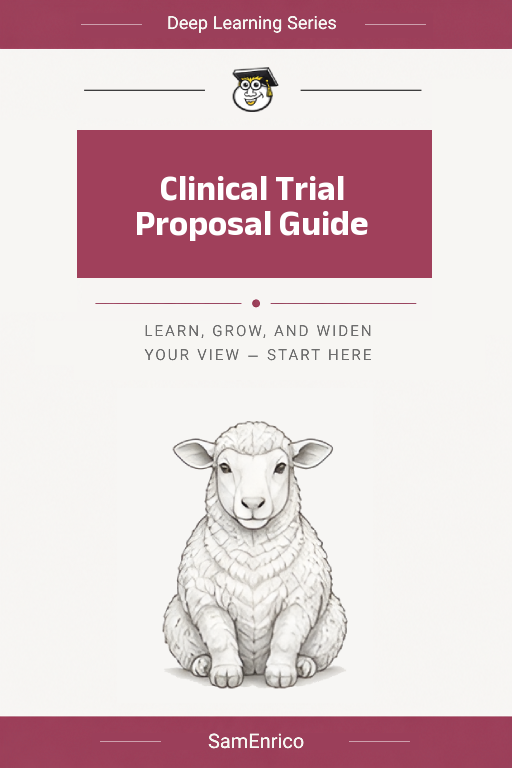
Clinical Trial Proposal Guide
Propose clinical research with human subjects for
Propose clinical research with human subjects for grad school. Describe phase, randomization, blinding, adverse event monitoring, and stopping rules.
Formats
About this book
Free sample
Chapter 1: The Proposal Pivot--You are holding a book about clinical trial proposals, but your first instinct might be to skip this chapter. After all, you already know what a clinical trial is. You have taken the methods course. You have read the papers. You are ready to write.That instinct is exactly why this chapter exists.Because the single most common reason graduate students fail to get their clinical trial proposals approved – by committees, by IRBs, by funding agencies – is not weak statistics or poor design.
It is a fundamental misunderstanding of what kind of project they are actually proposing. They think they are writing a clinical trial proposal when, in fact, they are describing an observational study with clinical trial vocabulary. Or they are describing a Phase III megatrial that would require a team of fifty and a budget of millions. Or they are describing a study that has already been done twice before, which makes it not original research but an expensive duplication of effort.This chapter is called "The Proposal Pivot" because before you write one word of your protocol, you must pivot from what you think you know about clinical trials to what you actually need to know as a graduate student. That pivot requires answering three questions correctly.
Get any of these wrong, and your proposal will not survive first contact with your committee or your IRB.The first question: Is this actually a clinical trial? The second: Has this trial already been done? The third: Can I realistically complete this trial before my funding runs out?This chapter answers all three. By the end, you will know with certainty whether you are writing a clinical trial proposal or something else. You will have a systematic review worksheet that proves your trial is necessary.
And you will have a reality check tool that matches your ambition to your actual resources.Let us begin with the question that derails more graduate students than any other.The Three-Question Litmus Test That Should Be Your First Step Imagine you have spent six months designing a study. You have written a…
This is the end of the free sample. Get the eBook to keep going. Buy now
Contents
- Chapter 1
- Chapter 2
- Chapter 3
- Chapter 4
- Chapter 5
- Chapter 6
- Chapter 7
- Chapter 8
- Chapter 9
- Chapter 10
- Chapter 11
- Chapter 12
Details
- Author
- Carbajal Eneida
- Publisher
- SamEnrico
- Language
- English
- Genre
- Non-Fiction, Student's Shortcut, Clinical
- Released
- 2026-06-01
- Pages (approx.)
- 141
- Available as
- eBook, Audiobook

Read better in the ZLOADR app
Your eBooks on your phone or tablet. Sign in with your SamEnrico account and start reading.
More by Carbajal Eneida
 Pacific Theater Memories HandbookCarbajal Eneida$11.99
 The Travel Toxin GuideCarbajal Eneida$11.99
 LSE Online Proctored ExamsCarbajal Eneida$11.99
 Ambassador's Daughter MemoirCarbajal Eneida$11.99
 The Disappearance of the Beale Treasure: America's Greatest Unsolved HeistCarbajal Eneida$11.99
 How to Produce Bicycle HelmetsCarbajal Eneida$11.99
 Samsung Innovation AgentCarbajal Eneida$11.99
 How to Become a Glaze SupervisorCarbajal Eneida$11.99