
Non-FictionStudent's ShortcutReligious
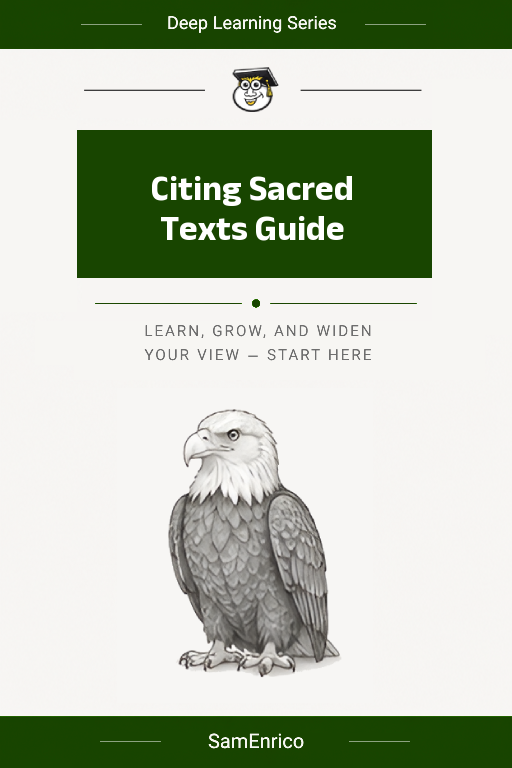
Citing Sacred Texts Guide eBook
Cite Bible, Quran, Torah, and other religious work
Cite Bible, Quran, Torah, and other religious works in academic writing.
Formats
Free sample
Chapter 1: The Silent Killer...–- Every year, thousands of brilliant academic papers, thoughtful theses, and even published books are quietly undermined by a problem that has nothing to do with weak arguments, poor research, or flawed logic. The culprit is something far more mundane, yet devastatingly effective at destroying scholarly credibility: incorrect citation of sacred texts. A single misplaced verse number, an omitted translation name, or a confused canon reference can transform a groundbreaking argument into a footnote of embarrassment. Unlike citing a novel or a scientific paper—where the author, title, and page number follow predictable rules—sacred texts carry centuries of interpretive tradition, multiple competing canons, and translation philosophies that fundamentally alter meaning. This chapter reveals why most students, and even some professors, get sacred text citations wrong, and why mastering this skill is not merely about following rules but about practicing intellectual integrity and interfaith respect.
By the end of this chapter, you will understand the hidden stakes behind every citation you write and why this book exists to save you from the silent killer of academic credibility.The Retraction That Shook a Department In 2018, a respected religious studies journal published an article comparing Islamic and Christian conceptions of divine mercy. The author, a mid-career scholar with a decade of publications, had cited a Quranic verse as the centerpiece of their argument. The verse in question appeared to support the claim that divine mercy was conditional upon specific human actions. The article passed peer review, was published online, and began accumulating citations from other scholars.Then came the email.A graduate student in comparative theology noticed something odd. The verse cited—Quran 5:18 as rendered in a popular English translation—contained a parenthetical insertion by the translator that was not marked as interpretive.
The translator had added the words "according to your deeds" in brackets, implying that the original Arabic contained a conditional clause. It did not. The original Arabic, checked against multiple manuscripts and the standard Cairo edition, simply stated God's mercy without any conditional qualification.The author had not consulted the original Arabic. They had not compared multiple translations. They had copied the verse from a popular online Quranic database that did not clearly distinguish between the revealed text and the translator's interpretive additions.
The entire thesis of the article—that the Quran and Bible diverged on the conditionality of divine mercy—collapsed when the verse was correctly understood.The journal issued a retraction. The author's reputation suffered lasting damage. And a graduate student who had simply checked the original text became the cautionary tale that now circulates in doctoral seminars across the country.This is not an isolated incident. It is a recurring pattern.Beyond Plagiarism: Why Sacred Citation Is Different Most students enter their first religious studies or theology course believing that citation is only about avoiding plagiarism. Do not take credit for someone else's words.
Give attribution where attribution is due. Provide a bibliography. These are necessary foundations, but when it comes to sacred texts, the stakes are considerably higher.The Revealed Versus Authored Distinction A novel has an author. A scientific paper has authors. A history monograph has an author.
These are human creators who made choices about wording, structure, and argument. When you cite them, you are acknowledging their intellectual labor.Sacred texts, within their own traditions, are not authored in the same sense. The Quran, for Muslims, is the literal word of God revealed to the Prophet Muhammad through the Angel Jibril (Gabriel). The Torah, for observant Jews, contains the words of God as given to Moses at Sinai. The New Testament, for Christians, is inspired Scripture written by human authors under divine guidance.
The Vedas, for Hindus, are śruti ("that which is heard")—eternal truths heard by ancient sages.This distinction matters for citation in three ways.First, there is no "author" to credit in the standard citation format. You do not write "Muhammad, 610 CE" or "Moses, c. 1200 BCE" as the author of a sacred text. This is not an oversight. It is a theological claim embedded in citation practices.
The major style manuals (MLA, APA, Chicago, SBL) all treat sacred texts as having no author, with the title or translation moving into the author position.Second, translations of sacred texts are not merely linguistic conversions. They are hermeneutical acts. A translator who chooses "Lord" versus "Yahweh" versus "the Eternal" for the Tetragrammaton (the four-letter Hebrew name of God) is making a theological decision. A translator who renders jihad as "holy war" versus "struggle" is making an interpretive choice that carries political and religious weight. This is why Chapter 5 of this book dedicates extensive space to comparing Quranic translators, and why Chapter 4 addresses the theological differences between the King James Version, the New Revised Standard Version, and the English Standard Version.Third, the textual tradition itself is complex.
The Bible does not exist as a single, stable document. The Protestant Old Testament has 39 books. The Catholic Old Testament has 46 books. The Orthodox canon includes up to 51 books. The Jewish Tanakh arranges the same material differently and counts differently (24 books).
When you cite "Psalm 23," which numbering system are you using? The Hebrew versification? The Greek Septuagint (where it is Psalm 24)? The Latin Vulgate? These are not trivial differences.
A student who cites Psalm 23:1-6 without specifying the version is, in a very real sense, not citing a text that exists.The Interfaith Dimension Sacred text citation is also an act of interfaith communication. When you cite the Quran in a paper that includes Christian and Jewish sources, your citation choices signal your level of respect for each tradition.Consider the following scenarios.A student writes: "The Quran says 2:255..." without including the translation name or a respectful full citation. A Muslim reader may perceive this as treating the Quran carelessly, as if its words are interchangeable with any other text.A student writes: "The Bible states (Genesis 1:1)..." without specifying which Bible. A Jewish reader may wonder: which Bible? The Christian Old Testament?
The Jewish Tanakh? The student has inadvertently erased the distinctiveness of the Jewish scripture by assuming a single "Bible" exists.A student writes: "According to the Talmud..." but does not specify whether they are citing the Babylonian Talmud or the Jerusalem Talmud, which tractate, and which edition. A Jewish reader familiar with rabbinic literature knows that these details matter enormously for interpretation.Proper citation is not merely about correctness. It is about demonstrating that you understand the text you are citing as part of a living tradition, not as a static artifact to be mined for quotations. This is why Chapter 6 of this book devotes significant space to the unique conventions of citing the Talmud, and why Chapter 5 emphasizes the reverence expected when handling the Quran.The Five Deadliest Citation Myths (And Why They Fail)Before we proceed to the mechanics of citation in later chapters, we must clear away the misconceptions that lead most students into error.
These myths persist because they contain a kernel of truth, but in academic writing, they are dangerously incomplete.Myth 1: "Everyone knows that verse, so I don't need to cite it"The kernel of truth: Some verses are culturally ubiquitous. "Love your neighbor…
This is the end of the free sample. Get the eBook to keep going. Buy now
About this book
Details
- Author
- Spence Marianna
- Publisher
- SamEnrico
- Language
- English
- Genre
- Non-Fiction, Student's Shortcut, Religious
- Released
- 2026-05-26
- Pages (approx.)
- 150
- Available as
- eBook, Audiobook

Read better in the ZLOADR app
Your eBooks on your phone or tablet. Sign in with your SamEnrico account and start reading.
More by Spence Marianna
 Helena Blavatsky Theosophy GuideSpence Marianna$11.99
 The Physical Priority BoardSpence Marianna$11.99
 DBT For BPD EmotionsSpence Marianna$11.99
 ABCDE Method for Overwhelmed ProfessionalsSpence Marianna$11.99
 Pelvic Floor for Heavy LiftingSpence Marianna$11.99
 Breath Awareness In PregnancySpence Marianna$11.99
 Whitley StrieberSpence Marianna$11.99
 Pomodoro Interval AdjustmentsSpence Marianna$11.99
 The Siege of Constantinople: The Ottoman Empire's First Great Triumph (1453)Spence Marianna$11.99
 The Golden Quills of Kush: Poets Who Shaped CivilizationSpence Marianna$11.99
 How to Produce Stovetop KettlesSpence Marianna$11.99
 How to Produce Hair Styling ToolsSpence Marianna$11.99
You may also like
 Hong Kong Handover 1997Dunn Johnnie$11.99
 Zumba For Postnatal Recovery CourseNeal Christian$11.99
 Zumba for BeginnersLadner Nikia$11.99
 YouTube Comment Mining GuideHumes Pandora$12.99
 Worry Box MeditationCarlin Rudy$11.99
 Workplace Stress MeditationNguyen Lynn$11.99
 Workplace Stress and Sleep RepairHawley Ivory$11.99
 Workplace Perfectionism CureDelaney Jeffry$11.99
 Workplace Injustice Anger GuideWallen Isabelle$11.99
 Work Addiction and Burnout LinkGreenwood Ester$11.99
 Women in Yoga and WellnessBeattie Galina$11.99
 Women in Stand Up ComedyChun Evangeline$11.99