
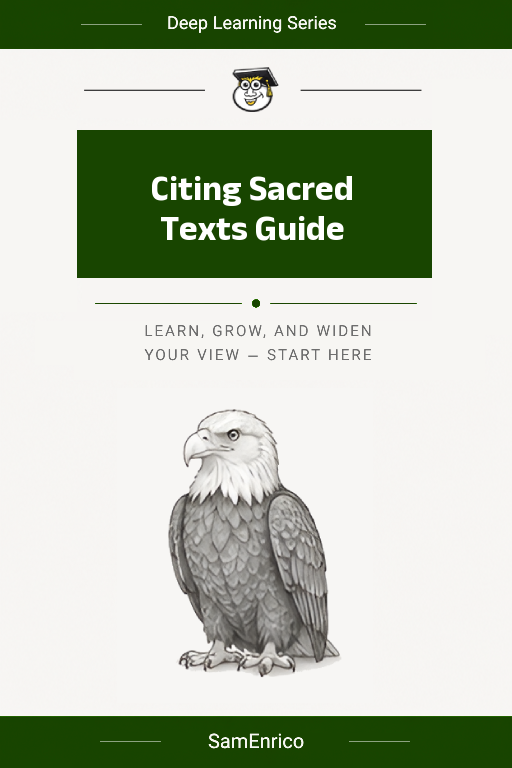
Non-FictionStudent's ShortcutReligious
Citing Sacred Texts Guide
Cite Bible, Quran, Torah, and other religious work
Cite Bible, Quran, Torah, and other religious works in academic writing.
Formats
About this book
Free sample
Chapter 1: The Silent Killer...–- Every year, thousands of brilliant academic papers, thoughtful theses, and even published books are quietly undermined by a problem that has nothing to do with weak arguments, poor research, or flawed logic. The culprit is something far more mundane, yet devastatingly effective at destroying scholarly credibility: incorrect citation of sacred texts. A single misplaced verse number, an omitted translation name, or a confused canon reference can transform a groundbreaking argument into a footnote of embarrassment. Unlike citing a novel or a scientific paper—where the author, title, and page number follow predictable rules—sacred texts carry centuries of interpretive tradition, multiple competing canons, and translation philosophies that fundamentally alter meaning. This chapter reveals why most students, and even some professors, get sacred text citations wrong, and why mastering this skill is not merely about following rules but about practicing intellectual integrity and interfaith respect.
By the end of this chapter, you will understand the hidden stakes behind every citation you write and why this book exists to save you from the silent killer of academic credibility.The Retraction That Shook a Department In 2018, a respected religious studies journal published an article comparing Islamic and Christian conceptions of divine mercy. The author, a mid-career scholar with a decade of publications, had cited a Quranic verse as the centerpiece of their argument. The verse in question appeared to support the claim that divine mercy was conditional upon specific human actions. The article passed peer review, was published online, and began accumulating citations from other scholars.Then came the email.A graduate student in comparative theology noticed something odd. The verse cited—Quran 5:18 as rendered in a popular English translation—contained a parenthetical insertion by the translator that was not marked as interpretive.
The translator had added the words "according to your deeds" in brackets, implying that the original Arabic contained a conditional clause. It did not. The original Arabic, checked against multiple manuscripts and the standard Cairo edition, simply stated God's mercy without any conditional qualification.The author had not consulted the original Arabic. They had not compared…
This is the end of the free sample. Get the eBook to keep going. Buy now
Contents
- Chapter 1
- Chapter 2
- Chapter 3
- Chapter 4
- Chapter 5
- Chapter 6
- Chapter 7
- Chapter 8
- Chapter 9
- Chapter 10
- Chapter 11
- Chapter 12
Details
- Author
- Spence Marianna
- Publisher
- SamEnrico
- Language
- English
- Genre
- Non-Fiction, Student's Shortcut, Religious
- Released
- 2026-05-26
- Pages (approx.)
- 150
- Available as
- eBook, Audiobook

Read better in the ZLOADR app
Your eBooks on your phone or tablet. Sign in with your SamEnrico account and start reading.
More by Spence Marianna
 Helena Blavatsky Theosophy GuideSpence Marianna$11.99
 The Physical Priority BoardSpence Marianna$11.99
 DBT For BPD EmotionsSpence Marianna$11.99
 ABCDE Method for Overwhelmed ProfessionalsSpence Marianna$11.99
 Pelvic Floor for Heavy LiftingSpence Marianna$11.99
 Breath Awareness In PregnancySpence Marianna$11.99
 Whitley StrieberSpence Marianna$11.99
 Pomodoro Interval AdjustmentsSpence Marianna$11.99
 The Siege of Constantinople: The Ottoman Empire's First Great Triumph (1453)Spence Marianna$11.99
 The Golden Quills of Kush: Poets Who Shaped CivilizationSpence Marianna$11.99
 How to Produce Stovetop KettlesSpence Marianna$11.99
 How to Produce Hair Styling ToolsSpence Marianna$11.99
You may also like
 Hong Kong Handover 1997Dunn Johnnie$11.99
 Zumba For Postnatal Recovery CourseNeal Christian$11.99
 Zumba for BeginnersLadner Nikia$11.99
 YouTube Comment Mining GuideHumes Pandora$12.99
 Worry Box MeditationCarlin Rudy$11.99
 Workplace Stress MeditationNguyen Lynn$11.99
 Workplace Stress and Sleep RepairHawley Ivory$11.99
 Workplace Perfectionism CureDelaney Jeffry$11.99
 Workplace Injustice Anger GuideWallen Isabelle$11.99
 Work Addiction and Burnout LinkGreenwood Ester$11.99
 Women in Yoga and WellnessBeattie Galina$11.99
 Women in Stand Up ComedyChun Evangeline$11.99