
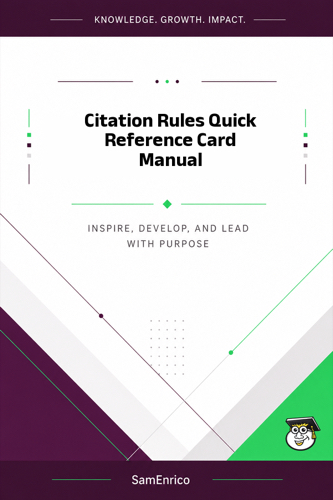
Non-FictionStudent's ShortcutQuick Reference
Citation Rules Quick Reference Card Manual eBook
undefined
undefined
Formats
Free sample
Chapter 1: The Four Pillars--–- Every citation in human history, from Plato’s footnotes to your professor’s syllabus, asks the same four questions. You have never been told this directly. Most style guides bury this truth under thousands of style-specific rules, leaving you to believe that APA, MLA, Chicago, and Bluebook are separate languages rather than dialects of a single, logical system. This chapter dismantles that confusion. Before you learn how to italicize a journal title or abbreviate a legal reporter, you must understand the universal grammar that makes all citations work.
Master this chapter, and every subsequent page of this manual becomes intuitive. Ignore it, and you will spend years memorizing rules instead of understanding principles.The Secret That Style Guides Won’t Tell You Open any citation manual. You will see endless entries: how to cite a You Tube video, how to cite a government document, how to cite a tweet, how to cite a lecture, how to cite a painting. These are not separate rules. They are variations on a single template.
Every source ever cited contains exactly four categories of information, no more and no less. Call them the Four Pillars.The first pillar is Who – the author, creator, editor, or institution responsible for the work. The second pillar is When – the date of publication, creation, or last update. The third pillar is What – the title of the specific work you consulted. The fourth pillar is Where – the location where a reader can find that work, whether a publisher’s name, a page range, a URL, a DOI, or a physical archive.That is it.
Every citation in APA, MLA, Chicago, Bluebook, Harvard, Vancouver, Turabian, or any other system is simply a rearrangement of these four pillars with different punctuation and typography. A citation is not magic. It is a standardized address. The Four Pillars tell your reader: This person (Who) created this thing (What) at this time (When), and you can find it here (Where).Why has no one told you this before? Because style guides profit from complexity.
The American Psychological Association sells its 400-page manual. The Modern Language Association sells its 400-page handbook. The Chicago Manual of Style sells a 1,200-page behemoth. These are excellent reference works, but they are not designed to teach you principles. They are designed to answer every possible edge case.
This manual takes the opposite approach. You will learn the universal framework first. Then you will learn where the major styles disagree. And you will never again panic when you encounter a source type you have never seen before, because you will know how to extract the Four Pillars from any document, photograph, recording, or webpage.Pillar One: Who – The Author Problem The first pillar seems obvious. Find the author’s name and write it down.
But the “Who” pillar hides more traps than any other. Consider a book with three authors. Consider a book with an editor but no author. Consider a website with “Anonymous” listed as the author. Consider a government report written by a committee.
Consider a film directed by one person, written by another, and performed by a third. Which name belongs in the “Who” slot?The universal rule is this: the “Who” pillar contains the entity primarily responsible for the intellectual or artistic content of the specific work you are citing. For a typical book, that is the author. For a chapter within an edited collection, that is the chapter’s author, not the book’s editor. For a film, most styles place the director in the “Who” slot, though some disciplines prioritize the writer.
For a song, the “Who” is usually the performing artist or the composer, depending on your field. When no individual is named, the “Who” becomes the organization – the corporation, government agency, or institution that published the work.The most common mistake beginners make is copying whatever name appears first on the title page without asking whether that person is actually the creator. A book might list a famous scholar as the “general editor” while the individual chapters were written by graduate students. The general editor is not the “Who” for a specific chapter. The graduate student is.
Similarly, a Wikipedia article has no single author. The “Who” for Wikipedia is the Wikimedia Foundation as a corporate author, or you omit the “Who” pillar entirely and start with the “What” pillar (the article title).This manual dedicates an entire chapter to the complexities of authorship. For now, internalize this principle: every citation begins by identifying who made the thing you are citing. If you cannot answer that question in plain English, you cannot build a correct citation.Pillar Two: When – The Date’s Hidden Role The second pillar seems even simpler. Find the publication date and write it down.
But the “When” pillar serves two entirely different functions, and confusing them leads to incorrect citations.The first function is chronological placement. Your reader needs to know whether you are citing a study from 1954 or 2024 because knowledge evolves. A medical claim from 1954 might be disproven. A historical analysis from 2024 might incorporate newly opened archives. The date tells your reader how much trust to place in the source’s currency.The second function is alphabetical sorting.
In APA style, the date appears immediately after the author because APA reference lists are sorted first by author last name and then by year (oldest to newest). In MLA style, the date appears near the end of the citation because MLA reference lists are sorted alphabetically by author last name, with the date playing no role in sorting. This is not random. Each style prioritizes different research workflows. APA is common in the sciences, where recent research is most valuable, so the date is visually prominent.
MLA is common in the humanities, where historical context matters more than currency, so the date recedes to the end.The universal rule is this: always record the full date as it appears on the source – year, month, and day when available – because you can always discard detail later, but you cannot add it back if you failed to record it. A website might show “Updated March 15, 2024.” Record that entire string. A scholarly journal might show “2023” only. Record the year. A newspaper article might show “Thursday, June 5, 2022, p.
A4.” Record the full date and the page.The most common date-related mistake is confusing the copyright date of a book (often on the back of the title page) with the publication date. They are usually the same, but not always. A book might be copyrighted in 2020 but not published until 2021. Cite the publication date. Another common mistake is using the database “date added” field instead of the source’s original publication date.
Your library database might show “Added to JSTOR on April 12, 2023,” but that is not the “When” pillar. The original publication date is.Pillar Three: What – Titles and Their Typography The third pillar is the title of the specific work you consulted. This seems straightforward, but the “What” pillar is where most students lose points because they fail to distinguish between the work and the container.Consider a journal article. The article has its own title…
This is the end of the free sample. Get the eBook to keep going. Buy now
About this book
Details
- Author
- Bagwell Noreen
- Publisher
- SamEnrico
- Language
- English
- Genre
- Non-Fiction, Student's Shortcut, Quick Reference
- Released
- 2026-06-06
- Pages (approx.)
- 146
- Available as
- eBook, Audiobook

Read better in the ZLOADR app
Your eBooks on your phone or tablet. Sign in with your SamEnrico account and start reading.
More by Bagwell Noreen
 Postpartum Depression GuideBagwell Noreen$11.99
 Career Transition for Retail WorkersBagwell Noreen$11.99
 Thunderbirds Pilot MemoirBagwell Noreen$11.99
 Psychological Relapse Prevention GuideBagwell Noreen$11.99
 Practical Exam Skills GuideBagwell Noreen$11.99
 Career Transition Without BurnoutBagwell Noreen$11.99
 Disappointment After SuccessBagwell Noreen$11.99
 Bombing Accuracy: Norden vs. British SightsBagwell Noreen$11.99
 The Lost Giants of the Indian Ocean: Uncovering Ancient Fossils Beneath the WavesBagwell Noreen$11.99
 The Vanishing of the Honey Island Swamp MonsterBagwell Noreen$11.99
 The Frozen Hour: The 1972 Andes Flight Disaster RevisitedBagwell Noreen$11.99
 How to Become a Quality-control InspectorBagwell Noreen$11.99
You may also like
 Hong Kong Handover 1997Dunn Johnnie$11.99
 Zumba For Postnatal Recovery CourseNeal Christian$11.99
 Zumba for BeginnersLadner Nikia$11.99
 YouTube Comment Mining GuideHumes Pandora$12.99
 Worry Box MeditationCarlin Rudy$11.99
 Workplace Stress MeditationNguyen Lynn$11.99
 Workplace Stress and Sleep RepairHawley Ivory$11.99
 Workplace Perfectionism CureDelaney Jeffry$11.99
 Workplace Injustice Anger GuideWallen Isabelle$11.99
 Work Addiction and Burnout LinkGreenwood Ester$11.99
 Women in Yoga and WellnessBeattie Galina$11.99
 Women in Stand Up ComedyChun Evangeline$11.99