

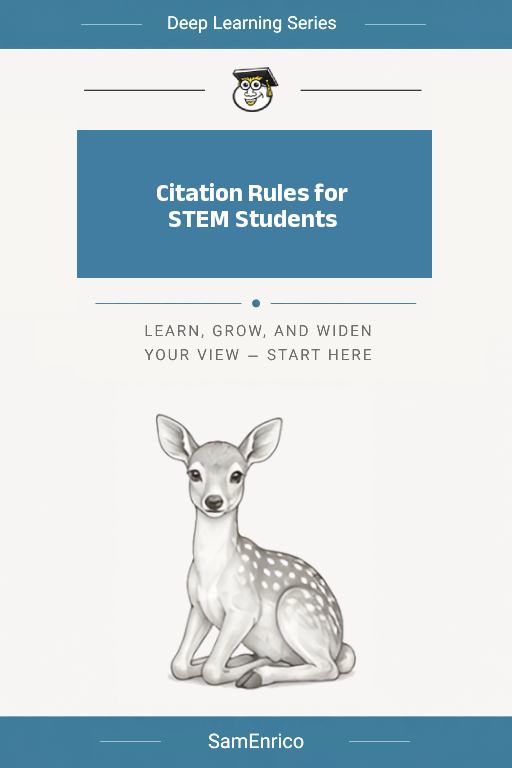
Non-FictionSTEM GuideTechnical Reference
Citation Rules for STEM Students eBook
Focus on CSE, IEEE, and numbered citation styles.
by Pugh Lexie
Focus on CSE, IEEE, and numbered citation styles. Includes citing lab manuals, data sets, and conference papers.
Formats
Free sample
Chapter 1: The Broken Experiment--–- Maria had just spent sixteen hours in the biochemistry lab. Her Western blot was beautiful—perfect bands, clean background, the kind of image that wins poster prizes. She wrote her lab report with care, citing eleven sources, including the crucial 2019 paper that established her assay protocol. She triple-checked every comma and bracket. Her professor returned the report with a grade of C-minus and a single comment scrawled in red: "Cannot locate source [7].
Citation error. See me."Maria’s story is not unusual. It happens every semester, in every STEM department, to students who work hard and intend to do the right thing. The problem is not laziness or dishonesty. The problem is a fundamental misunderstanding of what citations are for in science, technology, engineering, and mathematics.
Most students enter STEM fields believing that citation rules are arbitrary traps designed by professors to deduct points. That belief is wrong—and it is costing you grades, credibility, and eventually, professional reputation.This chapter dismantles that misconception. You will learn why STEM citation is fundamentally different from citation in English or history classes. You will understand the difference between primary and secondary sources—a distinction that can make or break a literature review. You will confront the ethics of citation errors, including why a misplaced bracket can be functionally equivalent to fabricated data in the eyes of a peer reviewer.
And you will leave with a field guide that helps you instantly recognize whether your assignment requires CSE or IEEE style.By the end of this chapter, you will never again think of citation as a hoop to jump through. You will see it for what it is: a tool for reproducibility, a chain of evidence, and a professional obligation to the researchers who come after you.The Great Misconception: Citation as Punishment Walk into any university library during finals week. Find the students who look most stressed. Ask them what they are struggling with. A shocking number will say "citations" or "formatting" or "the bibliography." Now ask them why citations matter.
Most will say something like "because the professor takes points off" or "because they want to see if you plagiarized."This is the Great Misconception. It treats citation as an externally imposed burden rather than an internally useful tool. The misconception persists because it is reinforced by how citation is taught—or rather, not taught. In high school, many students learn a simplified version of MLA or APA, memorize a few templates, and never learn the logic behind those templates. By the time they reach college STEM courses, they have internalized the idea that citation is about punishment avoidance.The truth is almost the opposite.
Citation exists first for the benefit of the reader and second for the benefit of the writer. For the reader, a citation is a roadmap. It tells you where a piece of information came from, how to find it yourself, and whether to trust it. For the writer, a citation is a shield. It shows that you have done the reading, that you understand the conversation, and that you are not claiming others' work as your own.In STEM fields, this logic becomes even more urgent.
Unlike a poem or a historical argument, a scientific claim can be tested. If you cite a paper that describes a method for measuring enzyme activity, your reader should be able to follow that citation, find that paper, and replicate the method exactly. If your citation is wrong—if you misidentify the author, misplace the volume number, or omit the DOI—your reader cannot find the source. The chain of evidence breaks. Your claim becomes unverifiable.This is why STEM professors treat citation errors more seriously than humanities professors might.
It is not pedantry. It is the difference between science that progresses and science that stalls.Intellectual Property in the Lab: Why Your Data Isn't Really Yours The concept of intellectual property in a laboratory setting is more complex than most students realize. When you generate a data point—say, the absorbance reading of an enzyme assay at 450 nanometers—who owns that number? The immediate answer is "you do, because you ran the experiment." But the full answer is more nuanced.That absorbance reading is only meaningful in relation to other readings: controls, standards, replicates. Those controls were designed by your professor or lab manager.
The protocol you followed was published by a researcher in Sweden in 2018. The spectrophotometer you used was calibrated according to a manufacturer's manual. The statistical test you ran was developed by a mathematician in the 1930s. Your data point sits at the intersection of hundreds of prior contributions.This is not a philosophical abstraction. It has practical consequences for citation.
Every time you write a lab report, you are standing on the shoulders of people you have never met. Some of them are famous (Watson and Crick, Rosalind Franklin, Norman Borlaug). Most are not. They are graduate students who ran one extra gel in 2015. They are technicians who optimized a buffer recipe in 2009.
They are postdocs who noticed a weird anomaly and published it as a short communication in 2022.Citing their work is not just about avoiding plagiarism. It is about acknowledging the distributed, cumulative nature of scientific knowledge. It is about saying, "This claim is not just mine. It is supported by a chain of evidence that includes these specific people at these specific times in these specific places."There is a darker side to this as well. When you fail to cite a source properly—or fail to cite it at all—you are not just hurting your grade.
You are erasing someone's contribution. You are taking credit that belongs to another researcher. In the professional world, this can end careers. In academic settings, it can lead to formal charges of research misconduct. The line between sloppy citation and plagiarism is thinner than most students think, and the consequences are severe.Primary vs.
Secondary Sources: The STEM Distinction That Changes Everything If you take only one concept from this chapter, make it this: in STEM, primary and secondary sources are not interchangeable. Many students use them interchangeably because they were never taught the difference in a way that matters for lab reports.Primary sources are original research reports. They are written by the people who did the experiments. They contain methods sections, raw data, statistical analyses, and conclusions drawn directly from that data. Examples include:Original research articles in peer-reviewed journals Conference papers presenting new findings (see Chapter 6)Data sets deposited in repositories (see Chapter 7)Lab notebooks (rarely cited, but theoretically citable)Preprints on ar Xiv or bio Rxiv (with caveats—see Chapter 5)Secondary sources summarize or synthesize primary research.
They are written by people who did not do the experiments. They digest, interpret, and critique the work of others. Examples include:Review articles (e.g., "Annual Review of Biochemistry")Textbooks Encyclopedias (including Wikipedia)Most lab manuals (see Chapter 8 for the exceptions)News articles about science Here is the rule that will save you countless points: In original research reports—including lab reports, senior theses, and journal articles—you must cite primary sources whenever possible. Secondary sources are for background, context, and textbook knowledge.…
This is the end of the free sample. Get the eBook to keep going. Buy now
About this book
Details
- Author
- Pugh Lexie
- Publisher
- SamEnrico
- Language
- English
- Genre
- Non-Fiction, STEM Guide, Technical Reference
- Released
- 2026-05-30
- Pages (approx.)
- 148
- Available as
- eBook, Audiobook

Read better in the ZLOADR app
Your eBooks on your phone or tablet. Sign in with your SamEnrico account and start reading.
More by Pugh Lexie
 Exam Anxiety Reduction WorkbookPugh Lexie$11.99
 Emotionally Immature Parents WorkbookPugh Lexie$11.99
 Reddit Forum Envy and Imposter SyndromePugh Lexie$11.99
 Assertive vs Aggressive at HomePugh Lexie$11.99
 Calf and Ankle Mobility GuidePugh Lexie$11.99
 The Maestro of Sound: Edison and the Birth of the PhonographPugh Lexie$11.99
 Computer ProgrammingPugh Lexie$11.99
 Broadcom SWOT LibraryPugh Lexie$12.99
 How to Start a Calculating Instruments (non-electronic) Business (Beginners Guide)Pugh Lexie$11.99
 Understanding Myotonia AtrophicaPugh Lexie$17.99
You may also like
 Hong Kong Handover 1997Dunn Johnnie$11.99
 Zumba For Postnatal Recovery CourseNeal Christian$11.99
 Zumba for BeginnersLadner Nikia$11.99
 YouTube Comment Mining GuideHumes Pandora$12.99
 Worry Box MeditationCarlin Rudy$11.99
 Workplace Stress MeditationNguyen Lynn$11.99
 Workplace Stress and Sleep RepairHawley Ivory$11.99
 Workplace Perfectionism CureDelaney Jeffry$11.99
 Workplace Injustice Anger GuideWallen Isabelle$11.99
 Work Addiction and Burnout LinkGreenwood Ester$11.99
 Women in Yoga and WellnessBeattie Galina$11.99
 Women in Stand Up ComedyChun Evangeline$11.99