

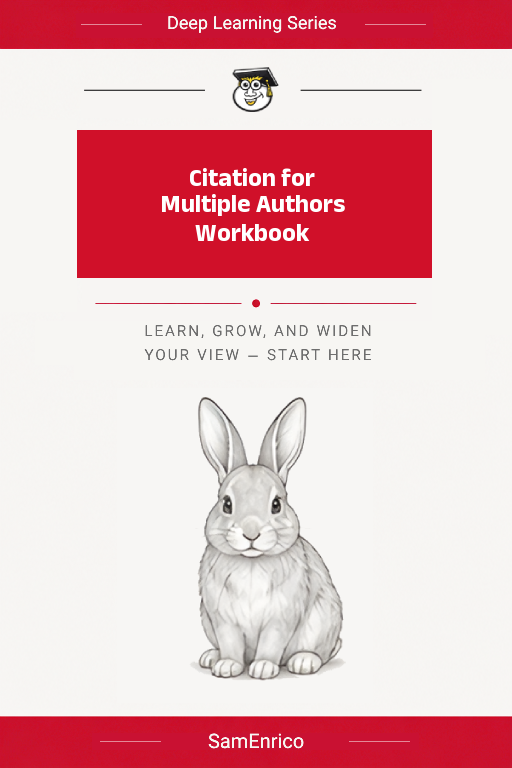
Non-FictionStudent's ShortcutAuthor Citation
Citation for Multiple Authors Workbook eBook
Handle two, three, or twenty authors in citations
Handle two, three, or twenty authors in citations for APA, MLA, and Chicago.
Formats
Free sample
Chapter 1: The First Author’s Throne...--The most dangerous moment in any academic paper comes not when you stare at a blank page, but when you type the words “et al.” for the first time. Your cursor hovers. Your confidence wavers. Did you use the right number of names? Should there be a comma before “et al.”?
Is it italicized? And what happens if you cite another paper next week with the same first author but different co-authors?Welcome to the anxiety that has derailed more graduate students, frustrated more journal editors, and wasted more late-night writing hours than any other citation problem in existence. This chapter dismantles that anxiety at its source by teaching you the single most important principle in all of multi-author citation: the primacy of the first author.The Invisible Hierarchy That Rules Academic Writing Every citation style guide ever written—from APA’s first edition in 1952 to the latest Chicago Manual of Style—agrees on one foundational truth: the first author listed on a source is the most important author. This is not an accident. It is not a quirk of history.
It is a deliberate design choice that serves three critical functions in academic communication.First, the first-author rule creates scanability. When you are reading a research paper, your eyes naturally lock onto the first name in a citation. “Smith et al. 2020” tells you immediately whose research you are looking at. If citation styles required readers to scan all six authors every time, reading speed would plummet, and cognitive load would skyrocket.
The first-author rule is a cognitive shortcut, and like all good shortcuts, it works because it is consistent.Second, the first-author rule enables alphabetical sorting in reference lists. Every style guide organizes sources by the last name of the first author. Without this rule, reference lists would descend into chaos. Should you sort by the second author? The third?
The year? The first-author rule provides a stable anchor that never changes, regardless of how many co-authors join the party.Third, and most importantly for this workbook, the first-author rule determines every single multi-author formatting decision you will ever make. When to use “et al.” depends entirely on what happens after the first author. Whether you invert names in a bibliography depends on whether you are formatting the first author or a subsequent author. Even the placement of a simple ampersand versus the word “and” circles back to the primacy of the first author in the narrative flow of your sentence.Let us prove this to you with a simple exercise.
Cover the rest of this page with your hand. Answer this question: In a citation with three authors, which author’s name appears first in the reference list? If you said “the first author,” you are correct. Now answer this: Which author’s name appears first in an in-text citation? Again, the first author.
Now answer this: If you have two different papers, both with “Smith” as the first author but different co-authors, how do you tell them apart in your text? You keep adding names after Smith until the ambiguity disappears—but you always start with Smith.The first author sits on a throne. Everyone else is a subject. Once you understand this hierarchy, every other rule in this workbook becomes intuitive.The Critical Distinction That Most Writers Miss Here is where even experienced academic writers stumble. The first-author rule operates differently depending on where the citation appears in your sentence.
This is not a trivial formatting quirk. It changes the actual words you type.Narrative citations place the author’s name inside the sentence itself, as part of the grammatical structure. For example: “Smith and Jones (2020) argue that citation anxiety is real.” In this construction, the authors are the subject of the sentence. The word “and” appears because English grammar requires a conjunction between two nouns serving as a compound subject.Parenthetical citations place the author’s name inside parentheses at the end of a sentence, separate from the main grammatical structure. For example: “Citation anxiety affects most graduate students (Smith & Jones, 2020).” In this construction, the authors are not the subject of the sentence.
They are an attribution appended to the claim.Here is the trap that catches countless writers: APA style treats these two positions differently. In narrative citations, APA requires the word “and.” In parenthetical citations, APA requires the ampersand (&). This is not arbitrary. The ampersand is a typographic shorthand that belongs in the compressed space of a parenthetical, while the full word “and” belongs in the flow of a sentence.MLA and Chicago do not make this distinction. Both styles use the word “and” in all contexts, narrative and parenthetical alike.
But do not let that simplicity fool you. If you are writing in APA—as most social science, education, nursing, and business students do—mixing up “and” and “&” is one of the most common citation errors professors mark with red ink.Let us test your understanding immediately. Which of the following is correct in APA style?A) Johnson and Lee (2019) found that practice reduces errors, and this finding was replicated (Johnson & Lee, 2020).B) Johnson & Lee (2019) found that practice reduces errors, and this finding was replicated (Johnson and Lee, 2020).C) Johnson and Lee (2019) found that practice reduces errors, and this finding was replicated (Johnson and Lee, 2020).The correct answer is A. The narrative citation uses “and.” The parenthetical citation uses “&.” If you answered incorrectly, do not worry. By the end of this chapter, this distinction will feel automatic.Why Two Authors Is Not Always Simple You might be thinking, “This chapter is supposed to be about multiple authors, but so far we have only talked about two-author examples.” That is intentional.
The two-author case is the foundation upon which all multi-author rules are built. If you cannot handle two authors correctly, adding a third, fourth, or twentieth author will only compound your errors.Consider the humble two-author citation. In APA style, the reference list entry inverts both names: “Smith, J. A., & Jones, B. C.” Notice the ampersand between the two names.
Notice the comma after the first author’s first initial. Notice the period after the second author’s middle initial. Every punctuation mark serves a purpose. The comma separates the first author’s last name from their initials. The ampersand signals a second author.
The period after the second author’s initials marks the end of the author portion of the entry.Now look at the same two authors in MLA style: “Smith, John A., and Jane B. Jones.” The first author’s name is inverted (last name first), but the second author’s name appears in normal order (first name first). There is no ampersand—MLA uses the word “and.” There are no periods after initials because MLA spells out first names (or uses initials only when the source does so).Now look at Chicago style, which splits its rules between notes and bibliographies. In a Chicago footnote, two authors appear as “John A. Smith and Jane B.
Jones.” No inversion. No ampersand. Just two names connected by “and” in normal order. In the Chicago bibliography, however, the first author inverts (“Smith, John A.”) while…
This is the end of the free sample. Get the eBook to keep going. Buy now
About this book
Details
- Author
- Mcmahon Agnus
- Publisher
- SamEnrico
- Language
- English
- Genre
- Non-Fiction, Student's Shortcut, Author Citation
- Released
- 2026-06-01
- Pages (approx.)
- 148
- Available as
- eBook, Audiobook

Read better in the ZLOADR app
Your eBooks on your phone or tablet. Sign in with your SamEnrico account and start reading.
More by Mcmahon Agnus
 UAE Ramadan Interview TimingMcmahon Agnus$11.99
 Immigrant Staffing Agency FounderMcmahon Agnus$11.99
 ESL Class MemoriesMcmahon Agnus$11.99
 Sexual Orientation ChildhoodMcmahon Agnus$11.99
 SAS Gas Station AttackMcmahon Agnus$11.99
 Teen People Pleasing GuideMcmahon Agnus$11.99
 Dream Hairstyle LogMcmahon Agnus$11.99
 Heat Stress GuideMcmahon Agnus$11.99
 The Wendigo's Hollow: A Cursed Hunger in the Northern WildernessMcmahon Agnus$11.99
 Ironclad Skies: The Birth of the Floating Fortress (1798)Mcmahon Agnus$11.99
 How to Become a Parimutuel-ticket SellerMcmahon Agnus$11.99
 A Collector's Handbook to the Ss Jaguar 1½-litre (1936-37)Mcmahon Agnus$11.99
You may also like
 Hong Kong Handover 1997Dunn Johnnie$11.99
 Zumba For Postnatal Recovery CourseNeal Christian$11.99
 Zumba for BeginnersLadner Nikia$11.99
 YouTube Comment Mining GuideHumes Pandora$12.99
 Worry Box MeditationCarlin Rudy$11.99
 Workplace Stress MeditationNguyen Lynn$11.99
 Workplace Stress and Sleep RepairHawley Ivory$11.99
 Workplace Perfectionism CureDelaney Jeffry$11.99
 Workplace Injustice Anger GuideWallen Isabelle$11.99
 Work Addiction and Burnout LinkGreenwood Ester$11.99
 Women in Yoga and WellnessBeattie Galina$11.99
 Women in Stand Up ComedyChun Evangeline$11.99