
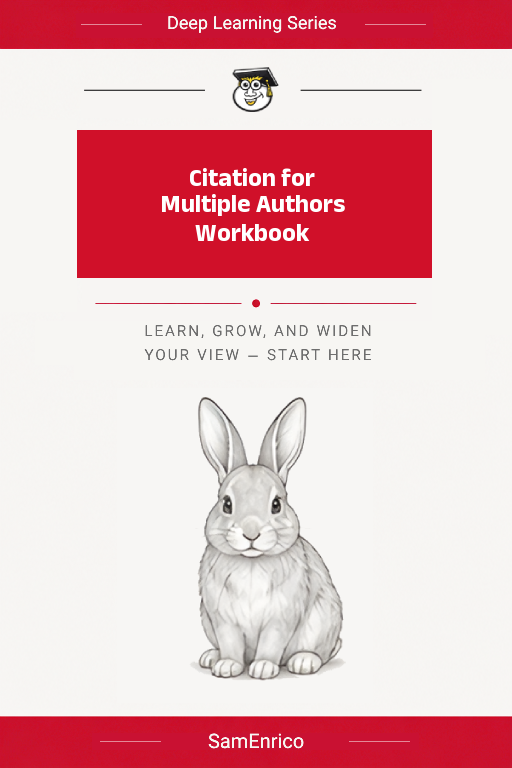
Citation for Multiple Authors Workbook
Handle two, three, or twenty authors in citations
Handle two, three, or twenty authors in citations for APA, MLA, and Chicago.
Formats
About this book
Free sample
Chapter 1: The First Author’s Throne...--The most dangerous moment in any academic paper comes not when you stare at a blank page, but when you type the words “et al.” for the first time. Your cursor hovers. Your confidence wavers. Did you use the right number of names? Should there be a comma before “et al.”?
Is it italicized? And what happens if you cite another paper next week with the same first author but different co-authors?Welcome to the anxiety that has derailed more graduate students, frustrated more journal editors, and wasted more late-night writing hours than any other citation problem in existence. This chapter dismantles that anxiety at its source by teaching you the single most important principle in all of multi-author citation: the primacy of the first author.The Invisible Hierarchy That Rules Academic Writing Every citation style guide ever written—from APA’s first edition in 1952 to the latest Chicago Manual of Style—agrees on one foundational truth: the first author listed on a source is the most important author. This is not an accident. It is not a quirk of history.
It is a deliberate design choice that serves three critical functions in academic communication.First, the first-author rule creates scanability. When you are reading a research paper, your eyes naturally lock onto the first name in a citation. “Smith et al. 2020” tells you immediately whose research you are looking at. If citation styles required readers to scan all six authors every time, reading speed would plummet, and cognitive load would skyrocket.
The first-author rule is a cognitive shortcut, and like all good shortcuts, it works because it is consistent.Second, the first-author rule enables alphabetical sorting in reference lists. Every style guide organizes sources by the last name of the first author. Without this rule, reference lists would descend into chaos. Should you sort by the second author? The third?
The year? The first-author rule provides a stable anchor that never changes, regardless of how many co-authors join the party.Third, and most importantly for this workbook, the first-author rule determines every single multi-author…
This is the end of the free sample. Get the eBook to keep going. Buy now
Contents
- Chapter 1
- Chapter 2
- Chapter 3
- Chapter 4
- Chapter 5
- Chapter 6
- Chapter 7
- Chapter 8
- Chapter 9
- Chapter 10
- Chapter 11
- Chapter 12
Details
- Author
- Mcmahon Agnus
- Publisher
- SamEnrico
- Language
- English
- Genre
- Non-Fiction, Student's Shortcut, Author Citation
- Released
- 2026-06-01
- Pages (approx.)
- 148
- Available as
- eBook, Audiobook

Read better in the ZLOADR app
Your eBooks on your phone or tablet. Sign in with your SamEnrico account and start reading.
More by Mcmahon Agnus
 UAE Ramadan Interview TimingMcmahon Agnus$11.99
 Immigrant Staffing Agency FounderMcmahon Agnus$11.99
 ESL Class MemoriesMcmahon Agnus$11.99
 Sexual Orientation ChildhoodMcmahon Agnus$11.99
 SAS Gas Station AttackMcmahon Agnus$11.99
 Teen People Pleasing GuideMcmahon Agnus$11.99
 Dream Hairstyle LogMcmahon Agnus$11.99
 Heat Stress GuideMcmahon Agnus$11.99
 The Wendigo's Hollow: A Cursed Hunger in the Northern WildernessMcmahon Agnus$11.99
 Ironclad Skies: The Birth of the Floating Fortress (1798)Mcmahon Agnus$11.99
 How to Become a Parimutuel-ticket SellerMcmahon Agnus$11.99
 A Collector's Handbook to the Ss Jaguar 1½-litre (1936-37)Mcmahon Agnus$11.99