
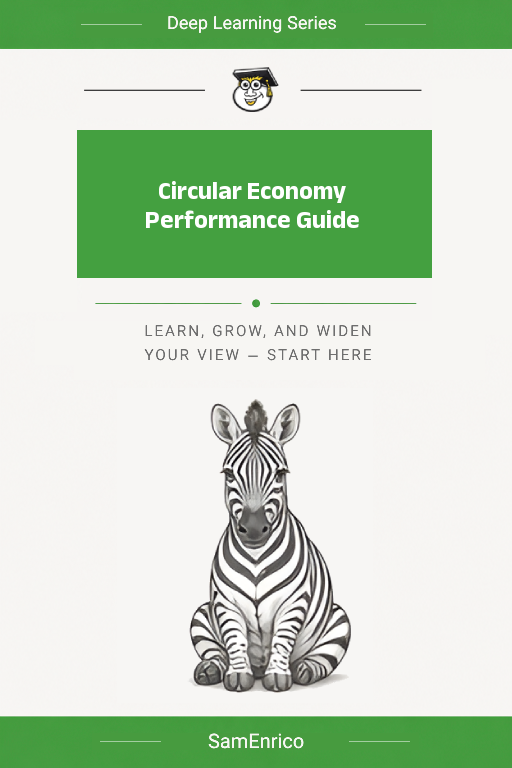
Non-FictionStrategic AtlasCircular Economy
Circular Economy Performance Guide eBook
Compares public firms on recycled content, product
by Watt Talia
Compares public firms on recycled content, product repairability, take-back programs, and waste diversion rates.
Formats
Free sample
Chapter 1: The $50 Billion Lie--–- Maya Chen had been staring at the same spreadsheet for four hours. It was 11:47 PM on a Tuesday, and her desk at Rhapsody Capital Management looked like a recycling bin had exploded—crumpled coffee cups, printouts of 10-K filings, and a half-eaten protein bar melting into a stack of sustainability reports. She was supposed to be analyzing a mid-cap beverage company's quarterly earnings, but something kept nagging at her. The company, Thirst Co (ticker: THST), had just announced a sweeping new sustainability initiative. Their CEO, a silver-haired man named Harold Vane who looked like he'd never recycled anything in his life, had declared on the shareholder call: "Thirst Co is proud to announce that by 2026, 100% of our plastic packaging will be recyclable.
We are leading the circular economy revolution."The stock popped 4% the next day.Maya didn't believe a word of it.She had been a financial analyst for nine years, the last three specializing in what her boss called "ESG alpha"—finding market inefficiencies hidden in sustainability claims. Most people in her field treated ESG as a compliance checkbox. Maya treated it as a treasure map. She had learned early that companies lie constantly about being "green," but they lie in predictable patterns. And Thirst Co's claim had all the hallmarks of a classic greenwash: bold, vague, and utterly unverifiable."Recyclable," she muttered, highlighting the word.
"Not recycled. Recyclable."There was a universe of difference, and most investors didn't know it.She pulled up Thirst Co's most recent 10-K filing—the annual report public companies are required to file with the SEC. She searched for "recycled content." Nothing. "Post-consumer." Nothing. "Circular." One mention, buried in a boilerplate risk factor: "Changes in consumer preferences regarding circular economy principles could affect demand for our products." That was it.
A multi-billion dollar company with a brand built on plastic bottles had exactly one sentence about the circular economy, and it was about risk to them, not risk to the planet.Then she searched for "pre-consumer."Bingo. Footnote 47: "Approximately 35% of our packaging material consists of pre-consumer recycled content from internal manufacturing processes."Pre-consumer. That was the trick.Maya smiled grimly. Pre-consumer recycled content meant factory scrap—the plastic trimmings, off-cuts, and defective bottles that never left the factory floor. It was technically "recycled" because it got ground up and put back into the production line, but it had never been waste.
It was like bragging about eating your own leftovers before they hit the trash can. Any company with an injection molding machine could claim high "recycled content" by simply regrinding their own scrap. The gold standard—the only standard that actually mattered—was post-consumer recycled content: plastic that had been bought, used, and thrown away by an actual human being, then collected, sorted, cleaned, and turned back into a bottle.Thirst Co hadn't disclosed any post-consumer content. That meant it was probably zero.But the stock had popped 4% on a lie.Maya opened a new spreadsheet and started building a model. She titled it "Circular Liabilities." She began with four columns: Recycled Content (actual, not pre-consumer), Repairability (which didn't apply to bottles, so she would flag as N/A), Take-Back Programs (did Thirst Co have a deposit scheme?), and Waste Diversion (what happened to their factory waste?).
She had just started entering data when her phone buzzed. A text from her boss, Marcus: "THST analysis. Tomorrow 8 AM. Bring your thesis."She typed back: "I have one. You won't like it."His response: "I never like anything.
That's why we make money."The Most Expensive Words in Finance What Maya was uncovering that night would become the central thesis of this book: circular economy metrics are not environmental niceties—they are the largest undisclosed liability on corporate balance sheets.In the chapters that follow, you will learn a proprietary scoring system called the Circular Performance Score (CPS). You will learn how to evaluate any public company on four pillars: recycled content (and by that, we mean only post-consumer, not the pre-consumer garbage that Thirst Co was peddling), product repairability (for electronics, appliances, and anything with a battery), take-back programs (does the company actually recover its products after use?), and waste diversion (are they truly recycling or just burning trash and calling it something else?).But before we get to the how, we need to understand the why. And the why starts with money—specifically, the $50 billion that public companies spend every year marketing their circular economy credentials, and the trillions of dollars in market value that will shift as regulators and investors finally learn to distinguish real circularity from the fake kind.This chapter is the investor's case for circular metrics. It will dismantle the common misconception that these numbers are "feel-good" ESG indicators. It will show you, with hard data and real examples, how circularity directly affects supply chain resilience, regulatory exposure, customer lifetime value, and litigation risk.
And it will give you a roadmap for where to find the data that companies don't want you to see.Let's start with a story about a company that did everything right—and got slaughtered anyway because it ignored circular metrics.The Nokia Warning In 2007, Nokia was the undisputed king of mobile phones. It had a 40% global market share, a fortress balance sheet, and a reputation for building indestructible devices. Its phones were repairable: you could pop off the back cover, swap the battery, and replace the screen with a simple screwdriver. Nokia even sold spare parts directly to consumers. By the metrics we will develop in this book, Nokia would have scored high on repairability—perhaps an 8 or 9 out of 10.Then the i Phone happened.Nokia's engineers looked at the first i Phone and dismissed it.
The battery was glued in. The screen was fused. You couldn't replace anything without proprietary tools. From a repairability perspective, the i Phone was garbage—maybe a 2 out of 10. Nokia's executives famously said, "No one wants a phone you can't repair."They were right about the metric.
They were wrong about the market.Consumers didn't care about repairability in 2007. They cared about thinness, screen quality, and ecosystem lock-in. Apple had traded repairability for sleekness and water resistance, and consumers voted with their wallets. Nokia collapsed, and its phone division was sold to Microsoft for a fraction of its former value.But here is what Nokia's executives didn't foresee: the regulatory pendulum would swing back.Fast forward to 2024. The European Union has passed the Ecodesign for Sustainable Products Regulation (ESPR), which imposes escalating fines on non-repairable electronics.
By 2026, any phone sold in the EU must have a repairability score displayed at point of sale. By 2028, manufacturers must provide spare parts for seven years. Violations can be fined up to 10% of EU revenue—for Apple, that would be over $8 billion annually.Nokia's executives were right that repairability didn't matter in 2007. But investors in 2024 cannot afford to make that mistake. Repairability has become a material financial risk factor.The same transformation is happening across all four of our pillars.
Recycled content is shifting from a marketing claim to a hedge against volatile virgin material prices. Take-back programs are evolving from a cost center to a…
This is the end of the free sample. Get the eBook to keep going. Buy now
About this book
Details
- Author
- Watt Talia
- Publisher
- SamEnrico
- Language
- English
- Genre
- Non-Fiction, Strategic Atlas, Circular Economy
- Released
- 2026-06-01
- Pages (approx.)
- 158
- Available as
- eBook, Audiobook

Read better in the ZLOADR app
Your eBooks on your phone or tablet. Sign in with your SamEnrico account and start reading.
More by Watt Talia
 Peg System for To Do ListsWatt Talia$11.99
 Workplace Bullying Nonverbal GuideWatt Talia$11.99
 Remote Review for VolunteersWatt Talia$11.99
 Laci Peterson Media Frenzy DocumentaryWatt Talia$11.99
 Carbon Accounting Software GuideWatt Talia$11.99
 Phantom Freight: The Trucker Who Vanished into the NightWatt Talia$11.99
 Hotel Night AuditorWatt Talia$11.99
 Understanding Pars PlanitisWatt Talia$17.99
 LinkedIn Mentor Search AutomationWatt Talia$12.99
 How to Start a Hunting Guide Service BusinessWatt Talia$11.99
You may also like
 Hong Kong Handover 1997Dunn Johnnie$11.99
 Zumba For Postnatal Recovery CourseNeal Christian$11.99
 Zumba for BeginnersLadner Nikia$11.99
 YouTube Comment Mining GuideHumes Pandora$12.99
 Worry Box MeditationCarlin Rudy$11.99
 Workplace Stress MeditationNguyen Lynn$11.99
 Workplace Stress and Sleep RepairHawley Ivory$11.99
 Workplace Perfectionism CureDelaney Jeffry$11.99
 Workplace Injustice Anger GuideWallen Isabelle$11.99
 Work Addiction and Burnout LinkGreenwood Ester$11.99
 Women in Yoga and WellnessBeattie Galina$11.99
 Women in Stand Up ComedyChun Evangeline$11.99