
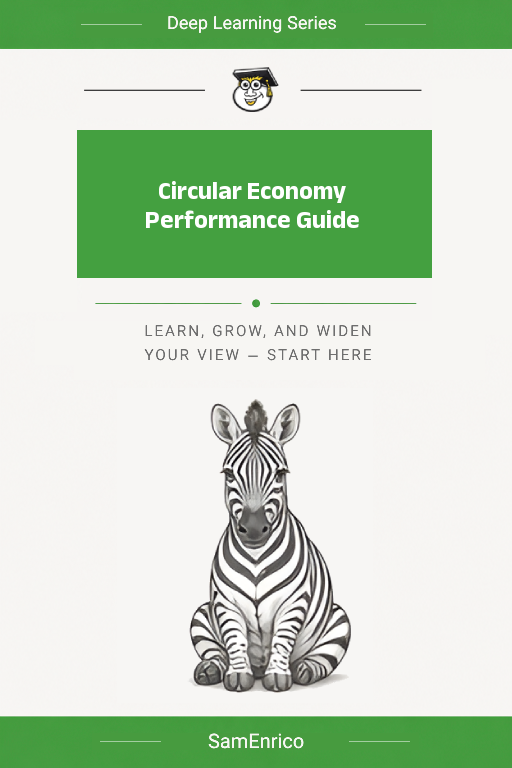
Non-FictionStrategic AtlasCircular Economy
Circular Economy Performance Guide Audiobook
Compares public firms on recycled content, product
by Watt Talia
Compares public firms on recycled content, product repairability, take-back programs, and waste diversion rates.
Formats
Free sample
Chapter 1: The $50 Billion Lie--–- Maya Chen had been staring at the same spreadsheet for four hours. It was 11:47 PM on a Tuesday, and her desk at Rhapsody Capital Management looked like a recycling bin had exploded—crumpled coffee cups, printouts of 10-K filings, and a half-eaten protein bar melting into a stack of sustainability reports. She was supposed to be analyzing a mid-cap beverage company's quarterly earnings, but something kept nagging at her. The company, Thirst Co (ticker: THST), had just announced a sweeping new sustainability initiative. Their CEO, a silver-haired man named Harold Vane who looked like he'd never recycled anything in his life, had declared on the shareholder call: "Thirst Co is proud to announce that by 2026, 100% of our plastic packaging will be recyclable.
We are leading the circular economy revolution."The stock popped 4% the next day.Maya didn't believe a word of it.She had been a financial analyst for nine years, the last three specializing in what her boss called "ESG alpha"—finding market inefficiencies hidden in sustainability claims. Most people in her field treated ESG as a compliance checkbox. Maya treated it as a treasure map. She had learned early that companies lie constantly about being "green," but they lie in predictable patterns. And Thirst Co's claim had all the hallmarks of a classic greenwash: bold, vague, and utterly unverifiable."Recyclable," she muttered, highlighting the word.
"Not recycled. Recyclable."There was a universe of difference, and most investors didn't know it.She pulled up Thirst Co's most recent 10-K filing—the annual report public companies are required to file with the SEC. She searched for "recycled content." Nothing. "Post-consumer." Nothing. "Circular." One mention, buried in a boilerplate risk factor: "Changes in consumer preferences regarding circular economy principles could affect demand for our products." That was it.
A multi-billion dollar company with a brand built on plastic bottles had exactly one sentence about the circular economy, and it was about risk to them, not risk to the planet.Then she searched for "pre-consumer."Bingo. Footnote 47: "Approximately 35% of our packaging material consists of pre-consumer recycled content from internal manufacturing processes."Pre-consumer. That was the trick.Maya smiled grimly. Pre-consumer recycled content meant factory scrap—the plastic trimmings, off-cuts, and defective bottles that never left the factory floor. It was technically "recycled" because it got ground up and put back into the production line, but it had never been waste.…
This is the end of the free sample. Get the Audiobook to keep going. Buy now
About this book
Details
- Author
- Watt Talia
- Publisher
- SamEnrico
- Language
- English
- Genre
- Non-Fiction, Strategic Atlas, Circular Economy
- Released
- 2026-06-01
- Pages (approx.)
- 158
- Available as
- eBook, Audiobook

Listen in the VoxFlicks app
Audiobooks and audio dramas wherever you go. Sign in with your SamEnrico account and press play.
More by Watt Talia
 Peg System for To Do ListsWatt Talia$11.99
 Workplace Bullying Nonverbal GuideWatt Talia$11.99
 Remote Review for VolunteersWatt Talia$11.99
 Laci Peterson Media Frenzy DocumentaryWatt Talia$11.99
 Carbon Accounting Software GuideWatt Talia$11.99
 Phantom Freight: The Trucker Who Vanished into the NightWatt Talia$11.99
 Hotel Night AuditorWatt Talia$11.99
 Understanding Pars PlanitisWatt Talia$17.99
 LinkedIn Mentor Search AutomationWatt Talia$12.99
 How to Start a Hunting Guide Service BusinessWatt Talia$11.99
You may also like
 Hong Kong Handover 1997Dunn Johnnie$11.99
 Zumba For Postnatal Recovery CourseNeal Christian$11.99
 Zumba for BeginnersLadner Nikia$11.99
 YouTube Comment Mining GuideHumes Pandora$12.99
 Worry Box MeditationCarlin Rudy$11.99
 Workplace Stress MeditationNguyen Lynn$11.99
 Workplace Stress and Sleep RepairHawley Ivory$11.99
 Workplace Perfectionism CureDelaney Jeffry$11.99
 Workplace Injustice Anger GuideWallen Isabelle$11.99
 Work Addiction and Burnout LinkGreenwood Ester$11.99
 Women in Yoga and WellnessBeattie Galina$11.99
 Women in Stand Up ComedyChun Evangeline$11.99