
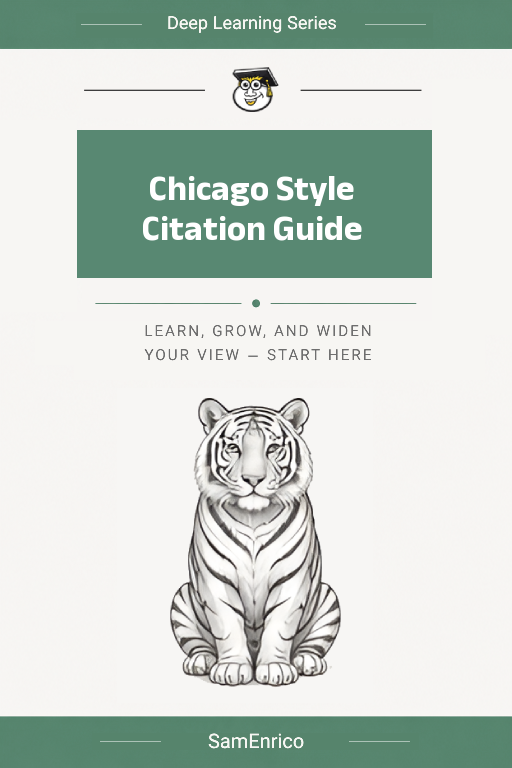
Non-FictionStudent's ShortcutChicago Style
Chicago Style Citation Guide
Master Chicago Manual of Style notes bibliography
Master Chicago Manual of Style notes bibliography and author date systems. Cite books journals and primary sources with proper formatting.
Formats
About this book
Free sample
Chapter 1: The Citation Compass...–- Every semester, thousands of students stare at their screen, cursor blinking, wondering the same thing: “Do I put the period before or after the parentheses?” They have written a brilliant paper—well-argued, well-researched, and insightful—but they are paralyzed by a single punctuation mark. Meanwhile, their professor, who has just finished grading forty-seven papers with forty-seven different citation styles, sighs in frustration. Somewhere in the middle of this common academic drama, the Chicago Manual of Style exists not as a tool for clarity, but as a source of anxiety. This book intends to change that permanently.Welcome to CMOS Mastery: The Complete Guide to the 18th Edition for Students, Researchers, and Editors. This is not a dry reference manual that you will shelve and forget.
It is a practical, conversational, and comprehensive guide designed to transform how you think about citations, formatting, and scholarly writing. Before we dive into the mechanics of footnotes, bibliographies, and parenthetical citations, we must first understand why Chicago style exists, what makes the 2024 18th Edition different from everything that came before, and—most importantly—how to choose between the two documentation systems that will define your writing life.The Hidden Logic of Scholarly Citation Citations are not bureaucratic hurdles designed to make your life difficult. They are the infrastructure of trust in academic writing. When you cite a source, you are doing three things simultaneously. First, you are giving credit to the scholars whose work has shaped your own thinking—an act of intellectual honesty and professional courtesy.
Second, you are providing a roadmap for your readers, allowing them to trace your research and verify your claims. Third, you are situating your work within an ongoing scholarly conversation, showing how your argument builds upon, challenges, or refines what others have said before you.The Chicago Manual of Style emerged from this need for standardization. First published in 1906 by the University of Chicago Press, CMOS began as a set of in-house rules for typesetters and editors. Over more than a century and eighteen editions, it has evolved into the definitive style…
This is the end of the free sample. Get the eBook to keep going. Buy now
Contents
- Chapter 1
- Chapter 2
- Chapter 3
- Chapter 4
- Chapter 5
- Chapter 6
- Chapter 7
- Chapter 8
- Chapter 9
- Chapter 10
- Chapter 11
- Chapter 12
Details
- Author
- Donnelly Frankie
- Publisher
- SamEnrico
- Language
- English
- Genre
- Non-Fiction, Student's Shortcut, Chicago Style
- Released
- 2026-06-01
- Pages (approx.)
- 144
- Available as
- eBook, Audiobook

Read better in the ZLOADR app
Your eBooks on your phone or tablet. Sign in with your SamEnrico account and start reading.
More by Donnelly Frankie
 Mental Health During Job Loss GuideDonnelly Frankie$11.99
 Chunking Study Information GuideDonnelly Frankie$11.99
 Recovery Rituals For ProfessionalsDonnelly Frankie$11.99
 Amber Frey Book ComparisonDonnelly Frankie$11.99
 Fiverr Buyer Persona PrimerDonnelly Frankie$11.99
 UK VAT Registration Backdating Rules ManualDonnelly Frankie$11.99
 Journaling for Couple StressDonnelly Frankie$11.99
 Citation Rules Active Recall WorkbookDonnelly Frankie$11.99
 Resentment Journal MethodDonnelly Frankie$11.99
 Operation Quantum Dawn: The Forgotten Architects of Atomic ScienceDonnelly Frankie$11.99
 Icebound Innovators: The Robots That Conquered AntarcticaDonnelly Frankie$11.99
 The Great Escape: How a 12-Year-Old Outsmarted the NazisDonnelly Frankie$11.99
You may also like
 Hong Kong Handover 1997Dunn Johnnie$11.99
 Zumba For Postnatal Recovery CourseNeal Christian$11.99
 Zumba for BeginnersLadner Nikia$11.99
 YouTube Comment Mining GuideHumes Pandora$12.99
 Worry Box MeditationCarlin Rudy$11.99
 Workplace Stress MeditationNguyen Lynn$11.99
 Workplace Stress and Sleep RepairHawley Ivory$11.99
 Workplace Perfectionism CureDelaney Jeffry$11.99
 Workplace Injustice Anger GuideWallen Isabelle$11.99
 Work Addiction and Burnout LinkGreenwood Ester$11.99
 Women in Yoga and WellnessBeattie Galina$11.99
 Women in Stand Up ComedyChun Evangeline$11.99