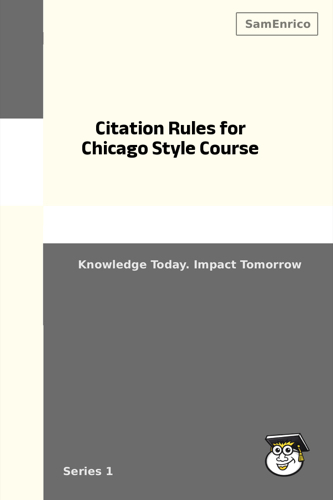
Chicago Citation Cheat Sheet
Use notes bibliography and author date systems for
by Charles Gail
Use notes bibliography and author date systems for history and publishing with real examples.
Formats
About this book
Free sample
Chapter 1: The Superscript Solution--–- You are sitting in a university library at 11:47 PM. Your laptop battery is at 12 percent. Your history paper is due in thirteen hours. You have written a brilliant argument about the French Revolution—but every claim needs a source. You type your first footnote.
You stare at the blinking cursor. Does the period go inside the quotation mark or outside? Do you put the publication city or just the publisher? What if the book has three authors? What if you found it online?
What if you cited the same source two pages ago—do you write out the whole thing again? Your palms are sweating. Your cursor blinks. The clock ticks.This chapter is written for you, at that exact moment, in that exact library.The notes-bibliography system—the one used by historians, literature scholars, philosophers, and art historians—can feel like a labyrinth of punctuation rules, formatting quirks, and arcane abbreviations. But at its heart, it has only one job: to send your reader from a superscript number in your text to a note that tells them exactly where you found your information.
That is it. Everything else is detail.This chapter strips away the anxiety and gives you the rules you actually need, with examples you can copy, and shortcuts that will save you hours of staring at a blinking cursor. By the end of this chapter, you will never again ask: "Where does the footnote number go?" You will know. And you will be finished with your paper before your laptop dies.What Is a Note (And Why Should You Care)?A note—either a footnote at the bottom of the page or an endnote grouped at the end of the chapter or document—is a numbered entry that tells your reader where you found a specific piece of information. Every time you quote a source, paraphrase an argument, or reference a fact that is not common knowledge, you insert a superscript number.
That number points to a note. That note points to a source.Why do historians love footnotes so much? Because they…
This is the end of the free sample. Get the eBook to keep going. Buy now
Contents
- Chapter 1
- Chapter 2
- Chapter 3
- Chapter 4
- Chapter 5
- Chapter 6
- Chapter 7
- Chapter 8
- Chapter 9
- Chapter 10
- Chapter 11
- Chapter 12
Details
- Author
- Charles Gail
- Publisher
- SamEnrico
- Language
- English
- Genre
- Non-Fiction, Student's Shortcut, Chicago Style
- Released
- 2026-06-01
- Pages (approx.)
- 127
- Available as
- eBook, Audiobook

Read better in the ZLOADR app
Your eBooks on your phone or tablet. Sign in with your SamEnrico account and start reading.
More by Charles Gail
 Michael Jackson ThrillerCharles Gail$11.99
 Spouse Heart Attack GriefCharles Gail$11.99
 Immigrant Food ManufacturerCharles Gail$11.99
 DoorDash Pizza Program GuideCharles Gail$11.99
 Processing Nightmares After InfidelityCharles Gail$11.99
 The Self Hypnosis for AnxietyCharles Gail$11.99
 Vaginal Ring GuideCharles Gail$11.99
 Public Speaking Coaching GuideCharles Gail$11.99
 Anansi and the Moon: A Spider’s Web of LoveCharles Gail$11.99
 The Last Oracle of Delphi: Voices from the AbyssCharles Gail$11.99
 How to Start a Emigration Agency (not of Foreign Government, Etc.) Business (Beginners Guide)Charles Gail$11.99
 How to Produce Oboe Cases and Gig BagsCharles Gail$11.99