
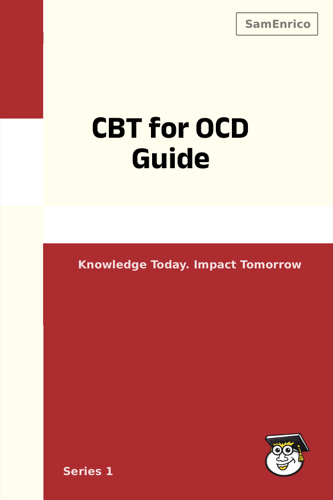
Non-FictionHealth & WellnessCBT OCD
CBT for OCD Guide eBook
Use cognitive behavioral therapy to challenge obse
Use cognitive behavioral therapy to challenge obsessive thoughts.
Formats
Free sample
Chapter 1: The Doubting Disease--–- The first time Sarah tried to leave her apartment for work, she checked the front door lock once. Then twice. Then seven more times. By the eighth check, her fingers were raw from rattling the deadbolt. By the eleventh, she was crying.
She knew the door was locked. She had watched herself lock it. She had felt the mechanism click into place. But a voice in her head—calm, reasonable, and absolutely merciless—whispered: "But what if you're wrong? What if you only dreamed that you locked it?
What if someone walks in while you're gone and takes everything? Can you live with that risk?"She couldn't. So she checked again.Sarah's story is not unusual. It is not extreme. It is, in fact, the everyday reality for nearly one in forty adults worldwide—over 250 million people.
You may be one of them. Or you may love someone who is. And if you are reading this book, you already know the central paradox that defines this condition: you know your fear is irrational, but you cannot stop acting as if it is real.This chapter is called "The Doubting Disease" because that is the oldest and most accurate name for what we now call Obsessive-Compulsive Disorder. The French called it folie du doute—the madness of doubt. Not the madness of handwashing, not the madness of organization, not the madness of checking.
The madness of doubt. And once you understand that doubt is the engine, everything else—the rituals, the rituals, the avoidance, the hours lost—makes sense.Before we go any further, let me make a promise to you. This book will not tell you to "just stop worrying." It will not suggest that you "think positive thoughts." It will not blame your childhood, your diet, or your posture. What this book will do is teach you the science of how your brain got stuck and the step-by-step behavioral technology—Cognitive Behavioral Therapy (CBT) with Exposure and Response Prevention (ERP)—that has been proven to unstick it. You will not be cured.
I cannot promise you cure because OCD is not a broken bone that heals and disappears. But I can promise you something better: remission. Remission means you will still have intrusive thoughts—every human does—but they will no longer control your hands, your hours, or your life.Let me show you what that looks like.The Stereotype That Kills Help-Seeking When most people hear "OCD," they picture a neat freak. A handwasher. A person who lines up pens symmetrically on a desk.
Television shows and movies have done enormous damage here, reducing a crippling neurological condition to a quirky personality trait. The result is that millions of people with OCD do not recognize themselves in the stereotype—and never seek help.Here is what the stereotype misses entirely. People with OCD do not enjoy order. They are not proud of their cleanliness. They are exhausted, ashamed, and terrified.
The person who washes their hands forty times a day is not thinking, "How wonderful that my hands are so clean." They are thinking, "If I do not wash exactly seven times, exactly in this order, exactly with hot water, my children will get sick and die." That is not a quirk. That is a nightmare.And then there are the people whose OCD has nothing to do with cleanliness or order. The person who cannot hold a knife because their brain screams, "You will stab someone." The person who cannot pray because their brain inserts blasphemous words into every holy phrase. The person who cannot look at their partner without thinking, "You don't really love them. You are lying to them.
You should leave." These people do not appear in television stereotypes. They suffer in silence, convinced they are monsters.You are not a monster. You have a brain whose alarm system has been miswired. And that is something we can work with.The 4 Ds: Is It OCD or Just Anxiety?Not every intrusive thought is OCD. Not every checking behavior is a compulsion.
So how do you know if what you are experiencing is clinical OCD or simply the normal human experience of worry and habit?Clinicians use a simple framework called the 4 Ds. Let me walk you through each one.Doubt. The hallmark of OCD is pathological doubt. Not ordinary uncertainty ("Did I remember to buy milk?") but a profound, gnawing inability to trust your own senses, memory, or judgment. The person with OCD can see the locked door, feel the locked door, remember locking the door, and still think, "But what if my memory is wrong?" This is not philosophical curiosity.
This is doubt that functions as a torture device.Distress. The intrusive thoughts of OCD are not mildly annoying. They are terrifying, disgusting, or shameful to a degree that is disproportionate to the actual trigger. A speck of dust on a counter does not warrant a panic attack—unless your brain has labeled that speck as a lethal threat. The distress in OCD is intense, often accompanied by physical symptoms: racing heart, sweating, trembling, nausea.Dysfunction.
Everyone has quirks. The question is whether your quirks are disrupting your life. Do you miss work because you cannot stop checking? Do you avoid social situations because you cannot stop ruminating? Do you spend hours each day performing rituals that you would rather not perform?
If your symptoms are costing you relationships, opportunities, or hours of your life, you have crossed the line from quirk to disorder.Duration. The final criterion is time. Clinically significant OCD typically consumes at least one hour per day, though many sufferers lose four, six, or even ten hours daily to rituals and rumination. Add up the minutes spent checking, washing, counting, reviewing, neutralizing, and avoiding. If the total exceeds one hour per day, and if you have tried and failed to reduce it, you are likely dealing with clinical OCD.If these four criteria sound familiar, you are in the right place.The Brain Lock: Why You Can't Just "Stop Thinking About It"One of the most painful experiences for people with OCD is being told to "just stop worrying." Well-meaning friends, family members, and even some therapists offer this advice.
It does not work. It cannot work. And understanding why requires a brief journey into your neurobiology.Your brain has a built-in error detection circuit centered in a region called the orbitofrontal cortex (OFC). This circuit's job is to scan the environment for things that are wrong, dangerous, or out of place. When it detects a problem—say, a car speeding toward you—it fires an alarm that produces anxiety, which motivates you to take action.
That is a good system. It keeps you alive.In OCD, this circuit gets stuck. The OFC fires the alarm even when there is no real threat. Worse, it keeps firing. The alarm does not turn off.
You are left with a persistent, agonizing sense that something is wrong even when you know—intellectually, rationally, absolutely—that nothing is wrong.This is what Dr. Jeffrey Schwartz, in his classic book Brain Lock, called "brain lock." The gear is stuck. The error…
This is the end of the free sample. Get the eBook to keep going. Buy now
About this book
Details
- Author
- Bustamante Marti
- Publisher
- SamEnrico
- Language
- English
- Genre
- Non-Fiction, Health & Wellness, CBT OCD
- Released
- 2026-06-06
- Pages (approx.)
- 135
- Available as
- eBook, Audiobook

Read better in the ZLOADR app
Your eBooks on your phone or tablet. Sign in with your SamEnrico account and start reading.
More by Bustamante Marti
 Weekly Meal Prep BlueprintBustamante Marti$11.99
 Sleepy Meadow RelaxationBustamante Marti$11.99
 Menopause And Burning MouthBustamante Marti$11.99
 EMDR for Numbness GuideBustamante Marti$11.99
 B 1B Lancer PilotBustamante Marti$11.99
 The Immigrant Merger MasterBustamante Marti$11.99
 Fear of Failure for TruckersBustamante Marti$11.99
 The Nobel Crown: Black Geniuses Who Shaped the SciencesBustamante Marti$11.99
 The War of the Cities: Tehran and Baghdad's Desperate Struggle (1980-1988)Bustamante Marti$11.99
 How to Produce Vehicle Water Sport Board RacksBustamante Marti$11.99
 Service Providers Guide to Internet ConsultantsBustamante Marti$11.99
 Income Substitution EffectBustamante Marti$12.99
You may also like
 Hong Kong Handover 1997Dunn Johnnie$11.99
 Zumba For Postnatal Recovery CourseNeal Christian$11.99
 Zumba for BeginnersLadner Nikia$11.99
 YouTube Comment Mining GuideHumes Pandora$12.99
 Worry Box MeditationCarlin Rudy$11.99
 Workplace Stress MeditationNguyen Lynn$11.99
 Workplace Stress and Sleep RepairHawley Ivory$11.99
 Workplace Perfectionism CureDelaney Jeffry$11.99
 Workplace Injustice Anger GuideWallen Isabelle$11.99
 Work Addiction and Burnout LinkGreenwood Ester$11.99
 Women in Yoga and WellnessBeattie Galina$11.99
 Women in Stand Up ComedyChun Evangeline$11.99