
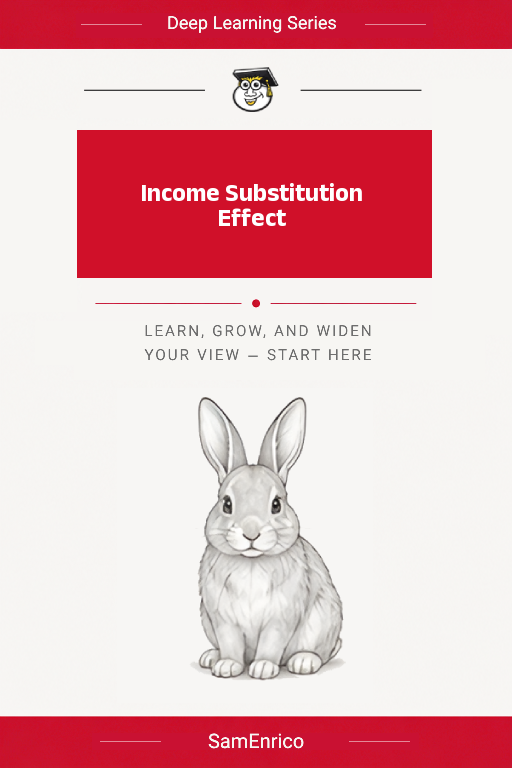
Non-FictionStudent's ShortcutEffects
Income Substitution Effect
Decompose price changes into income and substituti
Decompose price changes into income and substitution effects using Excel calculations.
Formats
About this book
Free sample
Chapter 1: The $10 Billion Blindspot--–- In 2018, the world’s largest retailer made a decision that cost them nearly two billion dollars in a single quarter. Their crime? They raised the price of a single category of household goods by an average of 4.7 percent. Their analysts had run the numbers. They knew that demand was “inelastic” – meaning customers would keep buying even at higher prices.
They were right about that part. What they didn’t know was why their total revenue collapsed across three adjacent categories they hadn’t touched. The story didn’t make headlines. No executive was fired publicly. But buried in the earnings call transcript was a revealing confession: “We underestimated how customers would reallocate their total spending across departments.” Translation: They had ignored the two-headed monster that every price change creates.The Two-Headed Monster Every time a price changes – whether it goes up or down – consumers react for two fundamentally different reasons.
Most businesses, most policy analysts, and even most economists-in-training treat these two reasons as one. That is a $10 billion mistake, repeated daily across every industry and every government treasury on earth.Reason number one: The substitution effect. When the price of something changes, it becomes either cheaper or more expensive relative to other things. If your favorite coffee shop raises prices by a dollar, suddenly the tea shop next door looks more attractive. You substitute away.
This effect is about comparison – your brain doing a rapid-fire calculation of alternatives.Reason number two: The income effect. When the price of something changes, your real purchasing power changes. If coffee gets more expensive, you’re effectively poorer – not officially, but practically. That same twenty-dollar bill now buys less coffee. So you might cut back on coffee, sure.
But you might also cut back on pastries, or Uber rides, or that streaming subscription you barely use. The income effect spills across everything you buy. It doesn’t respect category boundaries.Here is the dangerous part: these two effects can pull in the same direction or in opposite directions. They can amplify each other or cancel each other out. And unless…
This is the end of the free sample. Get the eBook to keep going. Buy now
Contents
- Chapter 1
- Chapter 2
- Chapter 3
- Chapter 4
- Chapter 5
- Chapter 6
- Chapter 7
- Chapter 8
- Chapter 9
- Chapter 10
- Chapter 11
- Chapter 12
Details
- Author
- Bustamante Marti
- Publisher
- SamEnrico
- Language
- English
- Genre
- Non-Fiction, Student's Shortcut, Effects
- Released
- 2026-05-30
- Pages (approx.)
- 145
- Available as
- eBook, Audiobook

Read better in the ZLOADR app
Your eBooks on your phone or tablet. Sign in with your SamEnrico account and start reading.
More by Bustamante Marti
 Weekly Meal Prep BlueprintBustamante Marti$11.99
 Sleepy Meadow RelaxationBustamante Marti$11.99
 Menopause And Burning MouthBustamante Marti$11.99
 EMDR for Numbness GuideBustamante Marti$11.99
 B 1B Lancer PilotBustamante Marti$11.99
 The Immigrant Merger MasterBustamante Marti$11.99
 CBT for OCD GuideBustamante Marti$11.99
 Fear of Failure for TruckersBustamante Marti$11.99
 The Nobel Crown: Black Geniuses Who Shaped the SciencesBustamante Marti$11.99
 The War of the Cities: Tehran and Baghdad's Desperate Struggle (1980-1988)Bustamante Marti$11.99
 How to Produce Vehicle Water Sport Board RacksBustamante Marti$11.99
 Service Providers Guide to Internet ConsultantsBustamante Marti$11.99
You may also like
 Hong Kong Handover 1997Dunn Johnnie$11.99
 Zumba For Postnatal Recovery CourseNeal Christian$11.99
 Zumba for BeginnersLadner Nikia$11.99
 YouTube Comment Mining GuideHumes Pandora$12.99
 Worry Box MeditationCarlin Rudy$11.99
 Workplace Stress MeditationNguyen Lynn$11.99
 Workplace Stress and Sleep RepairHawley Ivory$11.99
 Workplace Perfectionism CureDelaney Jeffry$11.99
 Workplace Injustice Anger GuideWallen Isabelle$11.99
 Work Addiction and Burnout LinkGreenwood Ester$11.99
 Women in Yoga and WellnessBeattie Galina$11.99
 Women in Stand Up ComedyChun Evangeline$11.99