
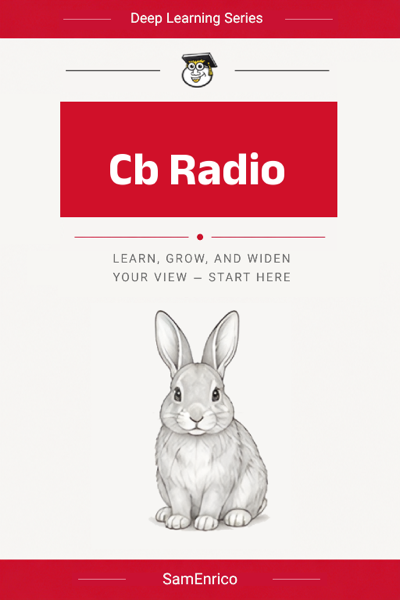
Non-FictionInformativeEducational
Cb Radio eBook
A Coursebook on Cb Radio
A Coursebook on Cb Radio
Formats
Free sample
Chapter 1: The Hidden Language...--– In a storage unit outside of Tulsa, Oklahoma, wrapped in a faded moving blanket and tucked behind a broken treadmill, sits a CB radio that hasn’t been powered on since 1983. Its face is yellowed plastic. Its microphone cord is cracked. Its channel knob turns with the gritty friction of decades-old grease. To anyone walking past, it looks like junk.
But to the man who stored it there—a retired long-haul trucker named Vernon—that radio contains the ghosts of a thousand conversations. It remembers the voice of a driver who never made it home. It remembers the warning that saved Vernon from a speeding ticket that would have cost him his job. It remembers the night a blizzard shut down Interstate 40 and a convoy of strangers kept each other awake and alive until dawn.Vernon’s radio is not special because of its circuitry or its brand or its age. It is special because of what it represents: a hidden language, an invisible community, a parallel world that exists just beyond the reach of cell towers and fiber optics.
That world is called the Citizens Band. And despite what you may have heard, it is very much alive.The phrase "hidden language" is not hyperbole. CB radio developed its own vocabulary, its own grammar, its own rules of engagement. A newcomer listening to Channel 19 for the first time might hear something like this: "Eastbound, eastbound, you got a smokey at the one-forty-two with a customer. He's parked on the shoulder.
Looks like he's writing paper. Ten-four back." To the uninitiated, that string of words is almost unintelligible. To a trucker, it means: "Drivers traveling eastbound, there is a police officer at mile marker 142 who has pulled someone over. He is writing a ticket. I have finished my transmission and acknowledge your response."This language did not emerge from a committee or a textbook.
It evolved organically, through millions of conversations, across millions of miles of highway. It borrowed from law enforcement jargon, military radio procedure, truck stop slang, and the simple human need to say more with fewer words. It was shaped by the constraints of the medium: low power, high noise, and the constant threat of being stepped on by another transmission. Clarity mattered. Brevity mattered.
And somewhere along the way, it became a kind of poetry.But the hidden language of CB is more than just vocabulary. It is a code of conduct. It is a way of signaling whether you are open to conversation or just listening for emergencies. It is a system of respect, where you do not interrupt, you do not monopolize the channel, and you always—always—acknowledge someone who has helped you. When a driver says "thank you" on CB, it is not just politeness.
It is a binding ritual that says: I see you. I owe you one. The favor will be returned.This chapter is about that hidden language and the world it describes. It is about why people talk on CB radio when they could just as easily text, call, or use a satellite messenger. It is about what happens when you strip away the filters of social media, the curation of your online persona, and the safety of a private conversation.
On CB, you are your voice. There is no profile picture, no like button, no block function. If you are kind, people remember. If you are rude, people remember that too. And unlike the internet, where rudeness is often anonymous and consequence-free, CB is a small world.
The guy you insulted on Channel 19 tonight might be the guy you need to pull you out of a ditch tomorrow morning.The Birth of a Hidden Language To understand the language of CB, you must first understand the conditions in which it was born. In the late 1960s and early 1970s, the truckers who adopted CB were not hobbyists. They were working people trying to survive on the road. Their radios were often low-quality, their antennas were often damaged, and their working environment was a steel cab filled with engine noise, wind noise, and the drone of tires on asphalt. The signal faded in and out.
Other truckers keyed up without warning. The channel was shared by dozens, sometimes hundreds, of drivers within a 20-mile radius.In that environment, every word had to earn its place. The phonetic alphabet—Alpha, Bravo, Charlie—helped distinguish similar-sounding letters. But the truckers went further. They developed a numerical code that condensed common phrases into two-digit shorthand.
The "10-codes" were not invented by truckers; they were borrowed from law enforcement and adapted for civilians. But the truckers made them famous. Who hasn't heard "10-4" used to mean "message received" or "10-20" to ask for a location?The 10-codes served several purposes. First, they saved time. In a noisy environment, saying "10-20" is faster and clearer than saying "What is your location?" Second, they provided a degree of privacy.
A casual scanner listener might not know that "10-100" means a restroom break, but another trucker would. Third, they created a sense of belonging. Knowing the codes meant you were part of the tribe. Not knowing them marked you as an outsider.But the 10-codes were only the beginning. The true hidden language of CB emerged through slang.
Some of it was borrowed from truck stop culture: a "chicken coop" was a weigh station, a "pickle park" was a truck stop, a "lot lizard" was a less savory aspect of overnight parking. Some of it was playful: a police radar gun was a "Kojak with a Kodak," a reference to a popular TV detective and the Kodak camera company. Some of it was practical: a "bear with ears" was a police officer using a radar detector, while a "bear in the air" was a police aircraft. Some of it was purely expressive: "hammer down" meant full speed, "double nickel" meant 55 miles per hour, and "parking lot" meant heavy traffic.What made this language truly hidden was not obscurity but context. The same words could mean different things depending on who was speaking and when they were speaking.
A trucker asking for a "bear report" was not interested in zoology. A driver announcing "I've got my ears on" was not discussing anatomy. The language was encrypted by shared experience. You could not learn it from a dictionary. You had to live it.The Golden Age of CB Slang The period from roughly 1975 to 1979 was the golden age of CB slang.
This was when the fad was at its peak, when millions of Americans bought radios, when the language crossed over from trucker subculture into mainstream pop culture. Songs like "Convoy" and movies like Smokey and the Bandit introduced CB slang to people who had never touched a microphone. Kids on school playgrounds said "10-4, good buddy" even if they had no idea what a "good buddy" actually was. The language became a fad, and like all fads, it was overexposed, misunderstood, and eventually ridiculed.But behind the fad, the real language continued to evolve. Some terms faded away.
"Good buddy," for example, became associated with certain stereotypes and fell out of favor among serious users. Other terms took…
This is the end of the free sample. Get the eBook to keep going. Buy now
About this book
Details
- Author
- Tanner Mirella
- Publisher
- SamEnrico
- Language
- English
- Genre
- Non-Fiction, Informative, Educational
- Released
- 2026-05-06
- Pages (approx.)
- 137
- Available as
- eBook, Audiobook

Read better in the ZLOADR app
Your eBooks on your phone or tablet. Sign in with your SamEnrico account and start reading.
More by Tanner Mirella
 Interpersonal Emotion ManagementTanner Mirella$11.99
 Loneliness After Moving HouseTanner Mirella$11.99
 Solar Temple Second Generation Survivors CourseTanner Mirella$11.99
 Mindfulness for Veterans PTSDTanner Mirella$11.99
 Free Creator Batch Recording StackTanner Mirella$11.99
 The Great Train Heist: How a Gang Outsmarted the Law in Broad DaylightTanner Mirella$11.99
 Frozen Echoes: The Lost Flight of KLM 867Tanner Mirella$11.99
 Packing For Dubai GuideTanner Mirella$12.99
 ESG Performance Human Rights GuideTanner Mirella$12.99
 10 Ways to Use Caviar (Recipe Book)Tanner Mirella$11.99
 Understanding Cerebral HypoxiaTanner Mirella$17.99
You may also like
 Hong Kong Handover 1997Dunn Johnnie$11.99
 Zumba For Postnatal Recovery CourseNeal Christian$11.99
 Zumba for BeginnersLadner Nikia$11.99
 YouTube Comment Mining GuideHumes Pandora$12.99
 Worry Box MeditationCarlin Rudy$11.99
 Workplace Stress MeditationNguyen Lynn$11.99
 Workplace Stress and Sleep RepairHawley Ivory$11.99
 Workplace Perfectionism CureDelaney Jeffry$11.99
 Workplace Injustice Anger GuideWallen Isabelle$11.99
 Work Addiction and Burnout LinkGreenwood Ester$11.99
 Women in Yoga and WellnessBeattie Galina$11.99
 Women in Stand Up ComedyChun Evangeline$11.99