
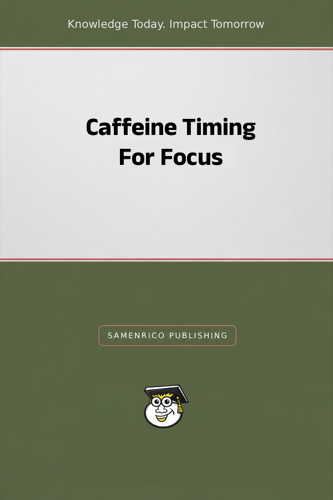
Non-FictionSelf-HelpNootropics
Caffeine Timing For Focus eBook
Avoids jitters and crash cycles.
Avoids jitters and crash cycles.
Formats
Free sample
Chapter 1: The Debt Cycle--For most people, the first conscious act of the day is not opening their eyes. It is not stretching, not checking the time, not thinking about the day ahead. It is reaching for caffeine. The hand moves before the mind is fully online. The coffee maker was programmed the night before.
The pod is already in the machine. The kettle was filled in anticipation. By the time you can form a coherent thought, the first sip has already crossed your lips.This is not a habit. This is an instinct. And like all instincts, it was not designed for the world you live in.Your morning coffee ritual feels harmless, even virtuous.
You have been told that caffeine is a performance enhancer, a cognitive edge, a legal and safe way to jumpstart your day. Billions of people cannot be wrong, can they? The global coffee market is worth over $200 billion. Tea adds another $50 billion. Energy drinks are a $60 billion industry.
If caffeine were truly the problem, surely someone would have noticed by now.The problem is not caffeine. The problem is timing. And the evidence of this problem is sitting in your own body every single afternoon, right around two o'clock.You know the feeling. The clock hits somewhere between 1:30 and 3:00 PM, and the wall arrives. Your eyelids grow heavy.
Your thoughts become syrupy. The email you were writing now requires three times as long to finish. You read the same sentence four times and still do not understand it. Your head feels like it is full of wet sand. You reach for another coffee.
You tell yourself this is just the post-lunch dip, that everyone experiences it, that another cup is the solution.This is the lie that has been sold to you by every caffeine marketing campaign you have ever absorbed. The second cup is not the solution. It is the anchor.What you are about to learn in this book is that your afternoon collapse is not a mystery, not a personal failing, and not something you must accept as inevitable. It is a predictable, avoidable, and reversible consequence of timing errors you are making every single morning. The good news is that fixing these errors does not require quitting caffeine.
It does not require willpower. It requires only one thing: understanding the difference between two completely different kinds of energy crashes, and learning to work with your biology instead of against it.The Two Crashes Most people believe they experience one kind of afternoon energy crash. They are wrong. There are two distinct physiological events that occur in the afternoon, and confusing them is the primary reason caffeine users remain stuck in the wake-coffee-crash-more-coffee loop for years, even decades.Crash Type One: The Rebound Crash The first type of crash is caused directly by caffeine itself. It occurs three to five hours after you consume caffeine, and it is the inevitable consequence of how caffeine works in your brain.
We will explore the neuroscience in detail in Chapter 2, but the short version is this: caffeine does not give you energy. It borrows energy from your future self, and when the loan comes due, the interest rate is brutal. You feel worse than you would have felt if you had never touched the coffee at all.This is the rebound crash. It is biochemical, predictable, and entirely dose-dependent. The more caffeine you consume, the harder the rebound.
The closer together you space your cups, the more you stack these rebounds on top of each other. By four o'clock, you are not tired. You are chemically indebted.Crash Type Two: The Circadian Trough The second type of crash has nothing to do with caffeine. It is a natural feature of human biology, programmed into your body by millions of years of evolution. It is called the circadian trough, and it occurs approximately six to eight hours after your natural wake-up time.
If you wake at six in the morning, your circadian trough will arrive between noon and two o'clock. If you wake at eight, it will arrive between two and four.This trough is not a sign of fatigue, disease, or laziness. It is simply your body's internal clock dipping into a lower gear for sixty to ninety minutes, just as it does every single day. Every mammal on earth experiences this. Your ancestors took a siesta.
Your dog takes a nap. Your body is asking for a brief period of lower arousal, not because anything is wrong, but because everything is working exactly as designed.Here is where the disaster occurs. Most people mistake the circadian trough for a caffeine rebound crash. They feel the afternoon dip and assume they need more caffeine. They pour a second or third cup.
That caffeine hits their system just as their body is naturally rising out of the trough, creating a spike of false energy that feels productive but comes at a tremendous cost. The cost is sleep disruption, which leads to worse mornings, which leads to more caffeine, which leads to deeper crashes. The cycle feeds itself.By the end of this chapter, you will be able to distinguish these two crashes in your own body. You will know whether your 2 PM collapse is a rebound or a trough. And you will take the first step toward breaking the cycle.The Autopilot Problem Let us perform a small experiment together.
Think back to your most recent cup of coffee. Not your favorite cup, not the one you savored on a Sunday morning. Think about the cup you drank on a normal workday, the one you consumed while doing something else. Were you driving? Reading emails?
Scrolling your phone? Making breakfast? Getting dressed?If you are like ninety percent of caffeine users, you cannot remember the taste of that coffee. You cannot remember finishing it. You cannot remember making the decision to drink it.
This is because you did not make a decision. You were on autopilot.The autopilot problem is the single greatest obstacle to effective caffeine timing. Your brain has learned that the sequence of waking up and drinking caffeine is paired together so tightly that the first action triggers the second without any conscious thought. You do not decide to have coffee. You wake up, and coffee happens.This automation serves a purpose.
It saves mental energy. But it also blinds you to the consequences of your timing. When a behavior is automatic, you stop evaluating its outcomes. You stop asking whether that first cup actually helped. You stop noticing that you feel worse three hours later.
The reward of immediate alertness overwrites the memory of the subsequent crash.This book is designed to interrupt that autopilot. Not by asking you to quit caffeine, but by asking you to pay attention to when you consume it. The difference between a productive relationship with caffeine and a destructive one is not the substance. It is the clock.The Energy Accounting Principle Here is the single most important concept in this entire book, the one that everything else builds upon. Write it down.
Put it on your refrigerator. Make it your screensaver.Caffeine is not a deposit. It is a loan.When you drink caffeine…
This is the end of the free sample. Get the eBook to keep going. Buy now
About this book
Details
- Author
- Spradlin Latonya
- Publisher
- SamEnrico
- Language
- English
- Genre
- Non-Fiction, Self-Help, Nootropics
- Released
- 2026-06-10
- Pages (approx.)
- 143
- Available as
- eBook, Audiobook

Read better in the ZLOADR app
Your eBooks on your phone or tablet. Sign in with your SamEnrico account and start reading.
More by Spradlin Latonya
 Paleo Meal Prep GuideSpradlin Latonya$11.99
 EC 130 Commando SoloSpradlin Latonya$11.99
 The Immigrant FinTech FounderSpradlin Latonya$11.99
 Miracle Morning MethodSpradlin Latonya$11.99
 Santorini Sunset GuideSpradlin Latonya$11.99
 TMS for Apathy GuideSpradlin Latonya$11.99Miracle Morning MethodSpradlin Latonya$11.99
 Resilience for ParentsSpradlin Latonya$11.99
 The Siege of Eger: Hungary's Defiant Stand Against the OttomansSpradlin Latonya$11.99
 The Mastermind of the Pink Panthers: The Rise and Fall of a Global Diamond Heist SyndicateSpradlin Latonya$11.99
 Service Providers Guide to Craft Supplies CatalogsSpradlin Latonya$11.99
 Excel Shortcuts for ExamsSpradlin Latonya$12.99
You may also like
 Hong Kong Handover 1997Dunn Johnnie$11.99
 Zumba For Postnatal Recovery CourseNeal Christian$11.99
 Zumba for BeginnersLadner Nikia$11.99
 YouTube Comment Mining GuideHumes Pandora$12.99
 Worry Box MeditationCarlin Rudy$11.99
 Workplace Stress MeditationNguyen Lynn$11.99
 Workplace Stress and Sleep RepairHawley Ivory$11.99
 Workplace Perfectionism CureDelaney Jeffry$11.99
 Workplace Injustice Anger GuideWallen Isabelle$11.99
 Work Addiction and Burnout LinkGreenwood Ester$11.99
 Women in Yoga and WellnessBeattie Galina$11.99
 Women in Stand Up ComedyChun Evangeline$11.99