
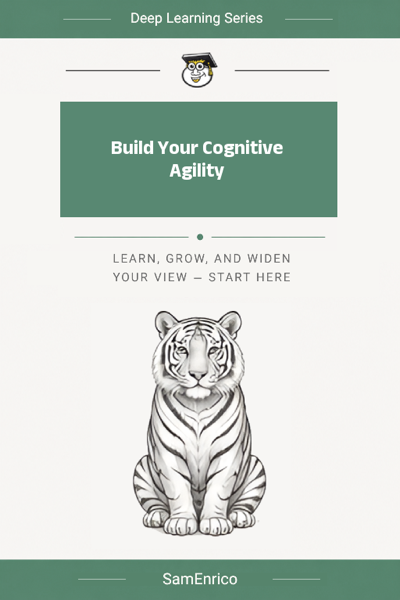
Non-FictionInformativeEducational
Build Your Cognitive Agility eBook
A Coursebook on Build Your Cognitive Agility
A Coursebook on Build Your Cognitive Agility
Formats
Free sample
Chapter 1: The Silent Saboteur--– Your brain is lying to you right now. Not because it is malicious, and not because something is broken. It is lying because it is doing exactly what evolution designed it to do: conserve energy, avoid danger, and find the quickest path to a reward. The problem is that the shortcuts that kept your ancestors alive on the savanna are the same shortcuts that keep you stuck in dead-end arguments, predictable mistakes, and the sinking feeling that you just made the same error for the tenth time.This chapter is about the silent saboteur that lives inside every human skull. It has many names: the automatic pilot, the fast brain, the intuitive mind, the reactive self.
In this book, we will call it the Reflexive Mind. And until you learn to see it in action, it will continue to make decisions for you while your deliberate, thoughtful self sits quietly in the passenger seat, convinced it is holding the steering wheel.I am going to show you exactly how the Reflexive Mind works, why it keeps making the same predictable errors, and how to catch it in the act before it leads you somewhere you do not want to go. By the end of this chapter, you will have completed your first real exercise in cognitive agility, and you will never look at your own reactions the same way again.The Three Seconds That Change Everything Let us start with a story. Not a hypothetical, but a composite of hundreds of real moments drawn from research, coaching sessions, and the private confessions of people who thought they were alone in their struggle.Sarah is a senior marketing director at a mid-sized tech company. She is good at her job.
She is smart, experienced, and well-liked. But she has a pattern, and she knows it. When someone challenges her work in a meeting, something happens inside her that she cannot control. Her face gets hot. Her chest tightens.
Words come out of her mouth that she regrets before she has finished saying them. Sometimes she gets defensive. Sometimes she deflects blame. Sometimes she attacks the person who offered the feedback. Always, she walks away thinking, "Why did I just do that?
That is not who I want to be."Sarah has tried everything to stop this pattern. She has promised herself she will do better. She has practiced calm responses in the mirror. She has even gone to therapy. And yet, when the moment comes, the same thing happens.
It is like something takes over.Here is the truth that transformed Sarah's life: something does take over. That something is the Reflexive Mind, and it is not weak or broken to be controlled by it. It is human.The Reflexive Mind operates on a timescale measured in milliseconds. It scans your environment for threats, opportunities, and social cues before your conscious mind even knows there is a decision to be made. By the time you feel your face flush, the Reflexive Mind has already:Detected a potential threat to your status, competence, or belonging Assessed the severity of that threat based on past experiences Triggered a physiological response (increased heart rate, hormone release, muscle tension)Retrieved a pre-programmed response from your mental library of past reactions Begun executing that response All of this happens in less than three seconds.
Three seconds from "my boss is giving me feedback" to "I am defending myself." Your conscious mind, the part of you that makes thoughtful decisions, does not even get a vote unless you have trained yourself to notice the hijack in progress.Cognitive rigidity is what happens when the Reflexive Mind runs your life without your permission. Cognitive agility is what happens when you learn to see the hijack coming, pause for just long enough to engage your thoughtful mind, and choose a response instead of reacting automatically.Meet Your Two Minds To build cognitive agility, you need to understand the fundamental architecture of human thinking. Psychologists have studied this for decades, and while different researchers use different names, the consensus is clear: you have two distinct cognitive systems, and they are not equally reliable.The Reflexive Mind (What Researchers Call System 1)The Reflexive Mind is your brain's default mode. It is always on, always scanning, always ready to respond. Here is what you need to know about it.It is incredibly fast.
The Reflexive Mind can recognize a face, detect anger in a voice, and decide whether to approach or avoid in a fraction of a second. It answers questions like "Is that dangerous?" and "Do I like this person?" before you can even form the words.It runs on autopilot. You do not have to think about breathing, blinking, or balancing while you walk because the Reflexive Mind handles it. The same is true for routine decisions: what to eat for breakfast, which route to drive, how to greet a colleague. These decisions happen without conscious effort, which frees up mental energy for harder problems.It is emotional.
The Reflexive Mind is the source of your gut feelings. That sense of unease you get in a certain situation? That inexplicable attraction to someone you just met? That flash of anger when you feel disrespected? All Reflexive Mind.
These emotions are not irrational—they contain real information about your past experiences and evolutionary priorities. But they are also raw, unprocessed, and often disproportionate to the situation.It is pattern-hungry. The Reflexive Mind loves stories. It will find a pattern in noise, a cause for every effect, and a narrative for every random sequence of events. This is why conspiracy theories are so compelling, why stereotypes are so sticky, and why you can convince yourself that a losing stock is about to turn around.
The Reflexive Mind would rather have a wrong answer that feels coherent than an uncertain answer that feels messy.It is energy-efficient. The brain consumes about twenty percent of your daily calories even though it is only two percent of your body weight. The Reflexive Mind is the economy mode of thinking—it uses very little glucose to do its job. This is a feature, not a bug. If you had to think deliberately about every single decision, you would be exhausted by ten in the morning.
The Reflexive Mind handles the routine so your deliberate mind can handle the exceptions.And here is the most important thing to know about the Reflexive Mind: it is biased. Not occasionally, not in some people, but systematically and predictably. The shortcuts it takes are not random errors—they are built into its design. The same design that helps you catch a falling glass before you consciously register it is the design that makes you overvalue the first number you hear in a negotiation. You cannot eliminate these biases.
But you can learn to recognize them.The Reflective Mind (What Researchers Call System 2)The Reflective Mind is the part of your brain that you think of as "you." It is the voice that reads this sentence, the decision-maker that chooses what to have for dinner, the planner that maps out your week. Here is what you need to…
This is the end of the free sample. Get the eBook to keep going. Buy now
About this book
Details
- Author
- Dawkins Ester
- Publisher
- SamEnrico
- Language
- English
- Genre
- Non-Fiction, Informative, Educational
- Released
- 2026-05-04
- Pages (approx.)
- 154
- Available as
- eBook, Audiobook

Read better in the ZLOADR app
Your eBooks on your phone or tablet. Sign in with your SamEnrico account and start reading.
More by Dawkins Ester
 TM School Curriculum GuideDawkins Ester$11.99
 Norwegian Green Incentives ManualDawkins Ester$11.99
 Slow Carb Sustainable Loss PlanDawkins Ester$11.99
 Nap Transition Strategies GuideDawkins Ester$11.99
 Stress Management for Customer Service RolesDawkins Ester$11.99
 The Trial That Split a Nation: The O.J. Simpson Civil Case RevisitedDawkins Ester$11.99
 The Gaia Hypothesis: Lovelock and the Living EarthDawkins Ester$11.99
 Understanding Chromosome 17, Trisomy 17p11 2Dawkins Ester$17.99
 How to Become a Calibration Laboratory TechnicianDawkins Ester$11.99
 Manitoba PNP for GraduatesDawkins Ester$12.99
 PDP Tracking DashboardDawkins Ester$12.99
You may also like
 Hong Kong Handover 1997Dunn Johnnie$11.99
 Zumba For Postnatal Recovery CourseNeal Christian$11.99
 Zumba for BeginnersLadner Nikia$11.99
 YouTube Comment Mining GuideHumes Pandora$12.99
 Worry Box MeditationCarlin Rudy$11.99
 Workplace Stress MeditationNguyen Lynn$11.99
 Workplace Stress and Sleep RepairHawley Ivory$11.99
 Workplace Perfectionism CureDelaney Jeffry$11.99
 Workplace Injustice Anger GuideWallen Isabelle$11.99
 Work Addiction and Burnout LinkGreenwood Ester$11.99
 Women in Yoga and WellnessBeattie Galina$11.99
 Women in Stand Up ComedyChun Evangeline$11.99