
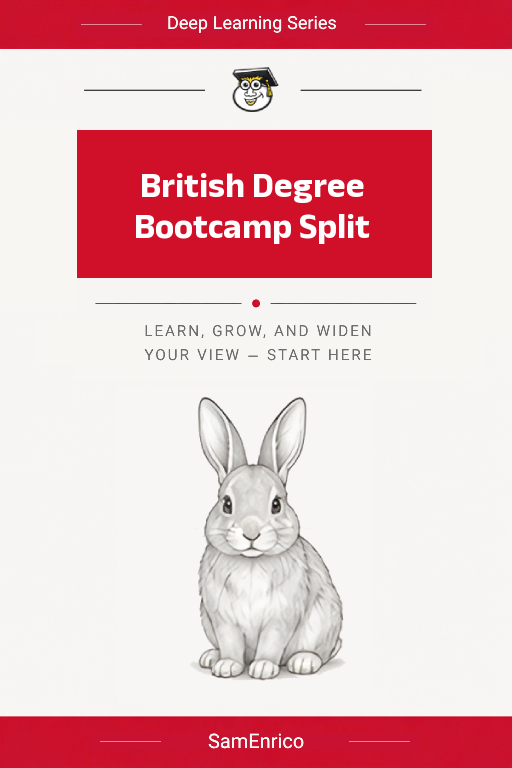
Non-FictionStudent's ShortcutBritish Education
British Degree Bootcamp Split eBook
Navigate UK apprenticeship degrees, conversion mas
by John Beatriz
Navigate UK apprenticeship degrees, conversion masters, and bootcamp pathways into London and Manchester tech scenes.
Formats
Free sample
Chapter 1: The £45k Mistake--–- The 22-year-old sat in a Shoreditch Pret a Manger, staring at her phone. Forty-seven applications. Zero offers. Her University of Manchester computer science degree – a 2:1, respectable by any measure – had cost £45,000 in tuition and living loans. Her mother had cried with pride at graduation.
Now she cried on the phone asking why her daughter couldn't even get an interview at a Fin Tech startup that had launched six months ago in someone's spare bedroom.Across town, a 20-year-old named Jordan was finishing his fourth coffee of the morning at the Co-op's headquarters in Manchester. He had started his Level 6 Digital & Technology Solutions apprenticeship two years ago, straight out of sixth form. His A-Levels were unremarkable – BCC in Business, ICT, and Media Studies – but he had built a small Discord bot in his spare time, and someone at the Co-op had noticed. Today, Jordan earns £28,000. He has zero debt.
He has two years of production experience on his CV. And last week, his line manager casually mentioned that when he completes the apprenticeship in two more years, his starting salary will be £45,000 minimum.The graduate in Shoreditch and the apprentice in Manchester are not anomalies. They are the new reality of the UK tech labour market. And the gap between them – in debt, in experience, in employability – is only going to widen over the next five years.This book exists because that gap should terrify you if you are currently holding a university offer, sitting in a lecture hall wondering if it's worth it, or trying to pivot into tech from a completely different career. The traditional three-year degree is no longer the gold standard for entry into London and Manchester's tech scenes.
It is, increasingly, a debt sentence. And the alternatives – degree apprenticeships, conversion masters, and government-funded bootcamps – are not inferior backups. For many roles, they are superior paths.But here is the problem that no one is talking about: parents, teachers, and career advisors are still operating on data from 2015. They still believe that a "red brick" university degree is the safest, most respectable route into a professional career. They are wrong.
The labour market has shifted beneath their feet, and thousands of young people are walking off a cliff because no one told them that the map had changed.This chapter is going to show you exactly how the map changed, why your degree (by itself) won't save you, and what the Trinity Method – the core framework of this book – will do instead.The Great Saturation: What the UCAS Data Doesn't Tell You Let us start with the numbers that universities do not want you to see. According to UCAS data analysed for the 2025-2026 admissions cycle, applications for computer science and related degrees have tripled in the last five years. In 2020, approximately 85,000 students applied for CS degrees in the UK. By 2025, that number had surged past 250,000. Every major university expanded its CS department.
New "data science" and "artificial intelligence" degrees proliferated like mushrooms after rain.Meanwhile, entry-level graduate roles in London and Manchester – specifically roles that require a degree and are aimed at new graduates – have grown by only 40 percent over the same period. Not tripled. Not doubled. Forty percent.The maths is brutal. For every graduate role that existed in 2020, there are now three graduates competing for it.
But the real problem is worse than simple supply and demand. Because many of those graduate roles are being eliminated entirely – not outsourced, not automated, but replaced by apprenticeships.Employers have discovered something that universities have been unwilling to admit: a graduate with a 2:1 and no work experience is often less valuable to them than an apprentice with two years of production experience and a partially completed degree. The apprentice has already learned how to navigate a codebase, attend stand-up meetings, manage their time across multiple projects, and take feedback from a senior engineer. The graduate has learned how to write essays and pass exams. One of these skills sets translates directly to business value.
The other does not.The 2024-2025 apprenticeship statistics are telling. According to the Department for Education, the number of Level 6 (degree-equivalent) apprenticeships in digital and technology solutions grew by 35 percent in a single year. Employers like the Co-op, BBC, Barclays, Fujitsu, and the DVLA are not offering these apprenticeships out of charity or corporate social responsibility. They are offering them because the apprenticeship model produces better employees than the university model.And here is the quiet part that no one says out loud: many of these employers have quietly stopped hiring traditional graduates for entry-level roles. They have moved their graduate hiring budgets into apprenticeship programmes instead.
The job that you thought you were applying for – the junior developer role at a London Fin Tech, the data analyst position at a Manchester scale-up – increasingly does not exist for traditional graduates. That job has been reclassified as an apprenticeship.The £30,000 Skills Gap Paradox Every year, organisations like Tech Nation and the UK Digital Skills Council release reports warning about a "digital skills crisis." Employers cannot find candidates with skills in cloud computing (AWS, Azure), Dev Ops, data engineering, cybersecurity, or artificial intelligence. The government announces new funding. The press runs worried headlines about Britain falling behind.Then those same employers reject 90 percent of the graduates who apply for their entry-level roles. Why?
Because the graduates lack "commercial experience."This is the £30,000 Skills Gap Paradox. Employers say there is a shortage of skilled workers. Then they define "skilled" in a way that almost no graduate can meet. A graduate with a first-class degree in computer science from a Russell Group university, with a dissertation in machine learning, is rejected because they have never deployed code to production. An apprentice with a partial degree but two years of deployment experience is hired.The gap is not education.
The gap is application. Universities teach theory, algorithms, and academic writing. Employers need people who can ship features, fix bugs, and collaborate on a codebase. These are not the same thing.Consider a typical CS degree curriculum: discrete mathematics, algorithms and data structures, operating systems, compilers, databases, software engineering theory, and a dissertation. All valuable topics in the abstract.
But how many of these modules require you to deploy a working application to a cloud server, manage user authentication, handle payments, or optimise a query that runs on real data? Very few.Meanwhile, a degree apprenticeship requires you to be in the office (or on Zoom) for four days a week, working on real tickets, fixing real bugs, attending real sprint planning meetings. By the time you finish your third year, you have deployed to production dozens of times. You have broken things and fixed them. You have asked stupid questions in front of senior engineers and learned not to ask them again.
You have built relationships with stakeholders who will later become your references.This is not an argument against theoretical computer science. Theory matters. But the best time to learn theory is alongside practice, not before it. A student who learns algorithms after they have already written buggy code for two years will understand why algorithms matter in a way that a pure…
This is the end of the free sample. Get the eBook to keep going. Buy now
About this book
Details
- Author
- John Beatriz
- Publisher
- SamEnrico
- Language
- English
- Genre
- Non-Fiction, Student's Shortcut, British Education
- Released
- 2026-05-29
- Pages (approx.)
- 141
- Available as
- eBook, Audiobook

Read better in the ZLOADR app
Your eBooks on your phone or tablet. Sign in with your SamEnrico account and start reading.
More by John Beatriz
 The Future of Work LocationJohn Beatriz$11.99
 Personal Ing For Success Brand AuditJohn Beatriz$11.99
 Mindful Discipline Without AngerJohn Beatriz$11.99
 Intuitive Eating Journal WorkbookJohn Beatriz$11.99
 Low Dose Naltrexone GuideJohn Beatriz$11.99
 The Alchemist of the Golden Sands: Unlocking the Secrets of Life in the Medieval Middle EastJohn Beatriz$11.99
 Code Blue: The Night the ER Became a WarzoneJohn Beatriz$11.99
 Successor Liability for Asset PurchasesJohn Beatriz$12.99
 Understanding Binswanger's DiseaseJohn Beatriz$17.99
 Satinspar (a Variety of Gypsum) MiningJohn Beatriz$11.99
 How to Start a Poultry Hatcheries BusinessJohn Beatriz$11.99
You may also like
 Hong Kong Handover 1997Dunn Johnnie$11.99
 Zumba For Postnatal Recovery CourseNeal Christian$11.99
 Zumba for BeginnersLadner Nikia$11.99
 YouTube Comment Mining GuideHumes Pandora$12.99
 Worry Box MeditationCarlin Rudy$11.99
 Workplace Stress MeditationNguyen Lynn$11.99
 Workplace Stress and Sleep RepairHawley Ivory$11.99
 Workplace Perfectionism CureDelaney Jeffry$11.99
 Workplace Injustice Anger GuideWallen Isabelle$11.99
 Work Addiction and Burnout LinkGreenwood Ester$11.99
 Women in Yoga and WellnessBeattie Galina$11.99
 Women in Stand Up ComedyChun Evangeline$11.99