
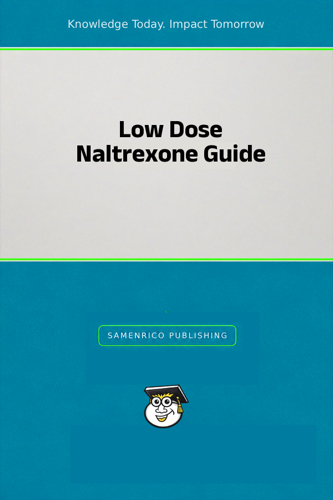
Non-FictionHealth & WellnessImmunomodulation
Low Dose Naltrexone Guide
Microdosing opioid antagonist for fibromyalgia and
by John Beatriz
Microdosing opioid antagonist for fibromyalgia and Crohn's disease pain.
Formats
About this book
Free sample
Chapter 1: The Paradox Pill--–- In 1984, the United States Food and Drug Administration approved a new drug called naltrexone for one of the most devastating public health crises of the era: opioid addiction. The drug worked simply and brutally. It sat on the brain’s opioid receptors like a cold, metal lock with no key. When a person who had taken naltrexone injected heroin or morphine, nothing happened. No rush.
No euphoria. No escape. The drug was an antagonist—a blocker—and at the standard dose of 50 milligrams, it was highly effective at preventing relapse. Pharmaceutical companies marketed it under the names Re Via and Depade, and later in a extended-release formulation called Vivitrol. For addicts trying to rebuild their lives, naltrexone was a lifeline, a chemical barrier between them and the oblivion they craved.But then something strange happened.
Something that should have been impossible. Something that defied everything pharmacologists thought they knew about this molecule.In the late 1980s, a brilliant and unconventional physician named Dr. Bernard Bihari was treating patients with HIV/AIDS in New York City. These were the darkest years of the epidemic, before protease inhibitors, before effective antiretroviral therapy. Bihari was desperate.
His patients were dying, their immune systems decimated by the virus. He began experimenting with anything that might boost immune function, including a long list of off-label drugs. One day, he decided to try naltrexone—but at a dose so small it seemed almost homeopathic. Instead of 50 milligrams, he gave his patients 3 milligrams. Then 4.5 milligrams.
He called it Low Dose Naltrexone, or LDN.The results were astonishing. His patients’ immune markers improved. Their energy returned. Infections that had been relentless began to recede. Bihari published his findings in small journals and presented at conferences, but the medical establishment largely ignored him.
After all, how could a drug that blocks opioid receptors at high doses possibly help the immune system at low doses? It made no sense. It was a paradox.Decades later, that paradox has become the foundation of a quiet revolution in the treatment of chronic pain and autoimmune disease. Today, thousands…
This is the end of the free sample. Get the eBook to keep going. Buy now
Contents
- Chapter 1
- Chapter 2
- Chapter 3
- Chapter 4
- Chapter 5
- Chapter 6
- Chapter 7
- Chapter 8
- Chapter 9
- Chapter 10
- Chapter 11
- Chapter 12
Details
- Author
- John Beatriz
- Publisher
- SamEnrico
- Language
- English
- Genre
- Non-Fiction, Health & Wellness, Immunomodulation
- Released
- 2026-06-07
- Pages (approx.)
- 156
- Available as
- eBook, Audiobook

Read better in the ZLOADR app
Your eBooks on your phone or tablet. Sign in with your SamEnrico account and start reading.
More by John Beatriz
 The Future of Work LocationJohn Beatriz$11.99
 Personal Ing For Success Brand AuditJohn Beatriz$11.99
 Mindful Discipline Without AngerJohn Beatriz$11.99
 Intuitive Eating Journal WorkbookJohn Beatriz$11.99
 The Alchemist of the Golden Sands: Unlocking the Secrets of Life in the Medieval Middle EastJohn Beatriz$11.99
 Code Blue: The Night the ER Became a WarzoneJohn Beatriz$11.99
 Successor Liability for Asset PurchasesJohn Beatriz$12.99
 British Degree Bootcamp SplitJohn Beatriz$12.99
 Understanding Binswanger's DiseaseJohn Beatriz$17.99
 Satinspar (a Variety of Gypsum) MiningJohn Beatriz$11.99
 How to Start a Poultry Hatcheries BusinessJohn Beatriz$11.99
You may also like
 Hong Kong Handover 1997Dunn Johnnie$11.99
 Zumba For Postnatal Recovery CourseNeal Christian$11.99
 Zumba for BeginnersLadner Nikia$11.99
 YouTube Comment Mining GuideHumes Pandora$12.99
 Worry Box MeditationCarlin Rudy$11.99
 Workplace Stress MeditationNguyen Lynn$11.99
 Workplace Stress and Sleep RepairHawley Ivory$11.99
 Workplace Perfectionism CureDelaney Jeffry$11.99
 Workplace Injustice Anger GuideWallen Isabelle$11.99
 Work Addiction and Burnout LinkGreenwood Ester$11.99
 Women in Yoga and WellnessBeattie Galina$11.99
 Women in Stand Up ComedyChun Evangeline$11.99