
Non-FictionBiographyPositive Parenting
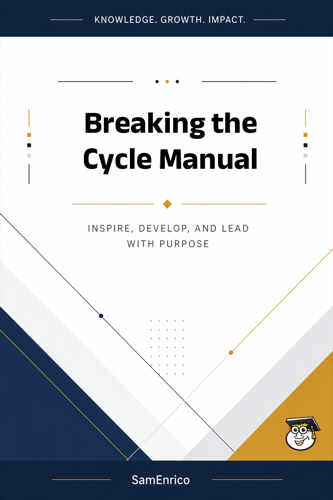
Breaking the Cycle Manual eBook
Stops intergenerational transmission of abuse with
Stops intergenerational transmission of abuse with parenting skills.
Formats
Free sample
Chapter 1: The Mirror Test...--–- You are holding this book for one of two reasons. Either you have already done something that haunts you—a hand raised too fast, a word too sharp, a look that made your child flinch—or you are terrified that you might. Perhaps both. The fear that you have become your parents is a special kind of dread, because it attacks not just what you do but who you believe yourself to be. Every parent who grew up in an abusive or neglectful home carries a secret calculation: I will be different.
I will never make my child feel the way I felt. And then one day, in a moment of exhaustion or anger or simple overwhelm, you hear it—your mother's voice coming out of your mouth, your father's silence settling over the room like a fog. This chapter is called The Mirror Test because it asks you to do the hardest thing any parent can do: look directly at what you inherited, without flinching, without making excuses, and without letting shame convince you that change is impossible.The truth that most parenting books avoid is that you cannot teach what you do not possess. A parent who never learned emotional regulation cannot simply decide to be calm. A parent who was never shown unconditional love cannot manufacture it from willpower alone.
The patterns that created your childhood are not just memories—they are neural pathways, autonomic responses, and deeply embedded scripts that play out automatically when your nervous system detects threat. This is not a moral failing. It is biology. And the first step to changing it is to understand precisely how it works.The Ghosts You Didn't Invite The concept of "ghosts in the nursery" comes from the work of psychoanalyst Selma Fraiberg, who noticed that parents who had experienced early trauma often responded to their children not as separate individuals but as stand-ins for figures from their own past. A baby's cry becomes not a signal of hunger or fatigue but an accusation.
A toddler's defiance becomes not a developmental milestone but a personal attack. The parent is no longer responding to the child in front of them; they are responding to the child they used to be, and the adults who failed them.Consider this scenario: Your four-year-old spills milk at the dinner table. A parent without a trauma history might say, "Oops, let's clean that up." A parent who was screamed at for small mistakes might feel their chest tighten, their jaw clench, and a surge of rage that seems wildly disproportionate to the event. That rage is not about the milk. The milk is a trigger—a sensory key that unlocks a door to an old room.
Inside that room is every time you were punished for being a normal, messy, imperfect child. Your nervous system does not know that you are now an adult. It only knows that milk on the floor once preceded danger, and it is preparing you to fight, flee, or freeze.This is the central mechanism of intergenerational transmission. Abuse and neglect are not passed down through conscious choice. They are passed down through the body's exquisite, overefficient threat-detection system.
Your child's normal behavior activates your old survival responses. Your survival responses look like abuse. And then you hate yourself for it, which makes you more dysregulated, which makes it more likely to happen again.The Intergenerational Family Map Before you can change a pattern, you have to see it. The Intergenerational Family Map is a tool for tracing specific behaviors across three generations: your grandparents, your parents, and you. This is not about blame.
Your grandparents were likely shaped by forces beyond their control—poverty, war, displacement, untreated mental illness, addiction, or their own abusive childhoods. Your parents were shaped by that inheritance. And you were shaped by theirs. The goal is not to assign fault but to see the riverbed that the water has been flowing through. Once you see it, you can begin to dig a new channel.Take out a piece of paper or open a new document.
Draw three horizontal lines, creating four rows. Label them: Great-Grandparents (if known), Grandparents, Parents, You. Then list the following behaviors in each generation, as honestly as you can: hitting or physical punishment, yelling or verbal aggression, silent treatment or withdrawal, shaming or belittling, blaming the child for adult emotions, neglect (physical or emotional), substance use as coping, and any other pattern that feels significant.Do not censor yourself. Do not soften. If your parent hit you, write it down.
If your grandparent was an alcoholic, write it down. If you have screamed at your child until they cried, write it down. This document is for your eyes only. Its purpose is not to shame you but to reveal the architecture of what you are trying to dismantle.When you have completed your map, look for patterns. Do you see a behavior that appears in every generation?
That is your deepest groove—the pattern most likely to repeat unconsciously. Do you see a behavior that stopped with your parents but started with you? That is worth examining. Do you see a behavior that you have never engaged in, despite it being present in previous generations? That is a point of resilience—a place where the cycle has already been weakened.The Separation Move: You Are Not Your History The single most important cognitive skill in this entire book is what we will call The Separation Move.
It is the practice of distinguishing between identity and history, between who you are and what you learned. This sounds simple, but it is profoundly difficult for anyone who grew up in an abusive environment, because abuse often teaches children to equate their behavior with their worth. "You are bad" becomes "I am bad." "You are selfish" becomes "I am selfish." The boundary between action and identity dissolves.The Separation Move rebuilds that boundary. Every time you catch yourself in a shame spiral—"I am a terrible parent, I am just like my father, I am broken"—you pause and ask one question: Is this a statement about who I am, or a statement about what I learned to do? If you can honestly answer that you learned a behavior, then the behavior can be unlearned.
Identities feel permanent. Learned behaviors do not.Let us apply The Separation Move to the three most common shame statements parents in your situation make:Shame statement: "I am an angry person."Separation Move: "I learned to express anger through yelling because that was the model I had. I can learn a different model."Shame statement: "I am cold and unaffectionate."Separation Move: "I learned to withdraw when overwhelmed because expressing need was unsafe in my home. I can practice safe connection."Shame statement: "I am a monster."Separation Move: "I did a monstrous thing. That is different from being a monster.
A monster does not feel guilt. I feel guilt, which means I am already different from the people who hurt me."This last point is crucial. The fact that you are reading this book, that you feel distress…
This is the end of the free sample. Get the eBook to keep going. Buy now
About this book
Details
- Author
- Mcewen Anibal
- Publisher
- SamEnrico
- Language
- English
- Genre
- Non-Fiction, Biography, Positive Parenting
- Released
- 2026-06-09
- Pages (approx.)
- 141
- Available as
- eBook, Audiobook

Read better in the ZLOADR app
Your eBooks on your phone or tablet. Sign in with your SamEnrico account and start reading.
More by Mcewen Anibal
 Body Image For DancersMcewen Anibal$11.99
 Commercial Real Estate Water RightsMcewen Anibal$11.99
 Reign Of Terror History HandbookMcewen Anibal$11.99
 Pattern Recognition for MindfulnessMcewen Anibal$11.99
 Pelvic Floor for MenMcewen Anibal$11.99
 Living Abroad in Spain ArbitrageMcewen Anibal$11.99
 Physical Anger Release GuideMcewen Anibal$11.99
 Meth Recovery Social Reconnection CourseMcewen Anibal$11.99
 The Vanishing of Flight 19: Lost in the Bermuda TriangleMcewen Anibal$11.99
 The Tides of Infinity: How Calculus Charted the Atlantic’s UnknownMcewen Anibal$11.99
 The Hollow Echo of the Vanishing IslandMcewen Anibal$11.99
 Understanding AmelogenesisMcewen Anibal$17.99
You may also like
 Hong Kong Handover 1997Dunn Johnnie$11.99
 Zumba For Postnatal Recovery CourseNeal Christian$11.99
 Zumba for BeginnersLadner Nikia$11.99
 YouTube Comment Mining GuideHumes Pandora$12.99
 Worry Box MeditationCarlin Rudy$11.99
 Workplace Stress MeditationNguyen Lynn$11.99
 Workplace Stress and Sleep RepairHawley Ivory$11.99
 Workplace Perfectionism CureDelaney Jeffry$11.99
 Workplace Injustice Anger GuideWallen Isabelle$11.99
 Work Addiction and Burnout LinkGreenwood Ester$11.99
 Women in Yoga and WellnessBeattie Galina$11.99
 Women in Stand Up ComedyChun Evangeline$11.99