
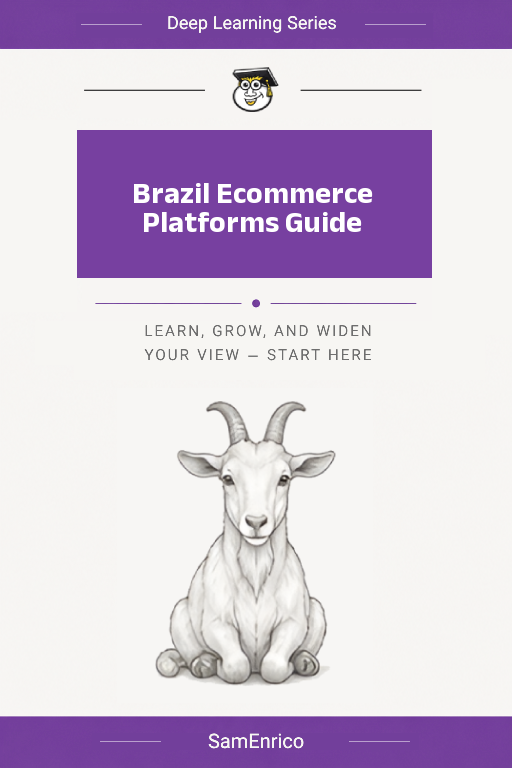
Non-FictionBusiness BriefLogistics Guide
Brazil Ecommerce Platforms Guide eBook
Sell to Brazil using Shopify, WooCommerce, or loca
by Schwab Dong
Sell to Brazil using Shopify, WooCommerce, or local platforms. Payment gateways for Brazilians.
Formats
Free sample
Chapter 1: The R$300 Billion Blindspot...--Most entrepreneurs who want to sell into Brazil make the same catastrophic mistake. They open a spreadsheet, calculate their product cost, add a standard 30% margin, and assume that number is their profit. Then they launch. Then they fail. Then they blame Brazil.The truth is simpler and more brutal.
Brazil is not a difficult market because of language barriers or bureaucracy, though those exist. Brazil is difficult because it operates on a completely different economic logic than the United States or Europe. The assumptions that make e-commerce profitable in New York or London will bankrupt you in São Paulo within six months.I have watched this happen forty-seven times. Not hypothetically. In real life, with real entrepreneurs who had real products and real dreams.
Forty-four of them failed for the same reason: they did not understand the hidden layers of the Brazilian market before they committed their capital. The three who succeeded did something different. They paused. They studied. They built a model that accounted for reality, not wishful thinking.This chapter is that pause.
Before we talk about platforms, payment gateways, or logistics, we must answer a single question with complete honesty: Is Brazil worth the effort? And if so, how do you enter without becoming another statistic?The answer to the first question is unequivocally yes. Brazil is the fifth largest e-commerce market on the planet, larger than the entire e-commerce economies of Canada, Australia, and Spain combined. It is growing at fifteen to twenty percent annually, driven by structural changes that are not going away. Over seventy percent of Brazilian adults now shop online regularly, and that number continues to rise.
The pandemic did not create Brazilian e-commerce; it accelerated a trend that was already in motion.But the answer to the second question is more nuanced. Brazil is not a market you enter. It is a market you commit to. The difference is everything.The Size of the Prize Let us start with numbers, because numbers do not lie. Brazilian e-commerce generated over three hundred billion reais in 2024, approximately sixty billion US dollars.
To put that in perspective, that is larger than the entire e-commerce market of India on a per capita basis. Brazilian consumers spend more online, more frequently, and on a wider variety of products than any other Latin American nation.More importantly, the growth is not speculative. Between 2020 and 2024, Brazilian e-commerce added nearly one hundred billion reais in new volume. The penetration rate rose from ten percent of retail to over fifteen percent. By 2028, industry analysts project the market will exceed five hundred billion reais.But size alone is not the opportunity.
The opportunity is the gap between what Brazilian consumers want and what they can currently access. Walk into any mall in São Paulo and you will see lines. Brazilians want convenience. They want selection. They want prices that do not include a thirty percent mall markup.
E-commerce delivers all of these, which is precisely why it is growing so fast.The Hidden Regional Complexity Here is where most guides get it wrong. They treat Brazil as a single market. It is not. Brazil is a continent disguised as a country.The Southeast region, comprising São Paulo, Rio de Janeiro, and Minas Gerais, accounts for over sixty percent of all online sales. São Paulo state alone generates nearly forty percent.
If you only sell to São Paulo, you are still in a market larger than Portugal or Greece. But you are also leaving money on the table.The Northeast region, including Bahia, Pernambuco, and Ceará, is the fastest-growing e-commerce frontier in the country. Year-over-year growth in the Northeast regularly exceeds twenty-five percent, significantly higher than the national average. Why? Because physical retail infrastructure in the Northeast has historically been underdeveloped.
Consumers there are leapfrogging directly to online shopping, just as they did with mobile banking.The South region, including Rio Grande do Sul, Santa Catarina, and Paraná, has the highest internet penetration and the most sophisticated online shoppers. Consumers there have higher average incomes and are more likely to buy cross-border from the United States or Europe. But they are also the most demanding, with return rates that can exceed fifteen percent.The North region, including Amazonas and Pará, is the frontier within the frontier. Logistics here are genuinely difficult. The Correios postal service is often the only option.
But competition is lower, and customer loyalty is higher. Sellers who solve the logistics puzzle in the North can build defensible moats.The lesson is not that you need to sell everywhere at once. The lesson is that you need to choose. A seller who targets only São Paulo and the Northeast can build a thriving business. A seller who tries to serve the entire country from day one will drown in complexity.The Jeitinho Brasileiro and What It Means for E-commerce You cannot understand Brazilian e-commerce without understanding the Jeitinho Brasileiro.
This phrase, which literally means the "little Brazilian way," describes a cultural approach to problem-solving that values flexibility, personal relationships, and creative workarounds over rigid rules and automated systems.In practice, this means that Brazilian consumers expect a level of personal attention that would be considered expensive or unnecessary in the United States. They will send a Whats App message to your store's number and expect a response within two hours. They will check your Reclame Aqui rating before they add an item to their cart. They will abandon a purchase if the checkout process feels too automated and impersonal.This is not a bug. It is a feature.
The sellers who succeed in Brazil are the ones who embrace the Jeitinho rather than fighting it. They hire Portuguese-speaking support teams that work Brazilian hours. They respond to messages on weekends. They treat every customer interaction as a relationship, not a transaction.The counterintuitive truth is that this personal approach reduces costs over time. Brazilian customers who feel personally attended to are far less likely to initiate chargebacks or disputes.
They become repeat buyers. They refer friends. In a market where customer acquisition costs are rising rapidly, retention is the hidden superpower.The Two Paths to Brazil Before you make any decisions about platforms, payments, or logistics, you must choose your path. There are only two viable ways to sell into Brazil as a foreign entrepreneur. They are not interchangeable.
Choosing the wrong path for your situation is a fatal error.Path A is the local entity path. You establish a Brazilian company, register for a CNPJ tax ID, open a Brazilian bank account, and operate as a domestic seller. This path takes two to three months and requires a local partner or a specialized accounting firm. The upfront costs are higher, typically five to fifteen thousand reais. But the per-transaction costs are lower, because you pay domestic tax rates and shipping rates.Path A is the right choice if you are committed to Brazil for the long term, plan to sell physical products in high volume, and have the patience to navigate the legal setup.
Most successful foreign sellers eventually migrate to Path A after testing with Path B.Path B is the cross-border path. You…
This is the end of the free sample. Get the eBook to keep going. Buy now
About this book
Details
- Author
- Schwab Dong
- Publisher
- SamEnrico
- Language
- English
- Genre
- Non-Fiction, Business Brief, Logistics Guide
- Released
- 2026-06-01
- Pages (approx.)
- 150
- Available as
- eBook, Audiobook

Read better in the ZLOADR app
Your eBooks on your phone or tablet. Sign in with your SamEnrico account and start reading.
More by Schwab Dong
 Medical Device ESG GuideSchwab Dong$11.99
 The Larry Youngblood ErrorSchwab Dong$11.99
 LGBTQ Pregnancy Loss Support WorkbookSchwab Dong$11.99
 Metta for InfertilitySchwab Dong$11.99
 The Podcast Guest NonverbalsSchwab Dong$11.99
 The Siege of Acre: Cannon Fire That Changed the Crusades (1291 AD)Schwab Dong$11.99
 Pony TrekkingSchwab Dong$11.99
 Recommendations for CredibilitySchwab Dong$12.99
 Understanding Schisis AssociationSchwab Dong$17.99
 10 Ways to Use Digitata Kelp/Oarweed (Recipe Book)Schwab Dong$11.99
You may also like
 Hong Kong Handover 1997Dunn Johnnie$11.99
 Zumba For Postnatal Recovery CourseNeal Christian$11.99
 Zumba for BeginnersLadner Nikia$11.99
 YouTube Comment Mining GuideHumes Pandora$12.99
 Worry Box MeditationCarlin Rudy$11.99
 Workplace Stress MeditationNguyen Lynn$11.99
 Workplace Stress and Sleep RepairHawley Ivory$11.99
 Workplace Perfectionism CureDelaney Jeffry$11.99
 Workplace Injustice Anger GuideWallen Isabelle$11.99
 Work Addiction and Burnout LinkGreenwood Ester$11.99
 Women in Yoga and WellnessBeattie Galina$11.99
 Women in Stand Up ComedyChun Evangeline$11.99