
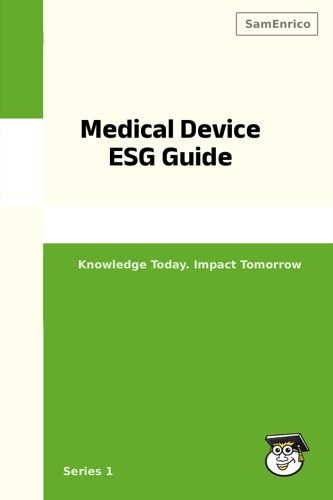
Non-FictionStrategic AtlasMedical Device ESG
Medical Device ESG Guide
Compare product stewardship and waste reduction am
by Schwab Dong
Compare product stewardship and waste reduction among surgical equipment manufacturers.
Formats
About this book
Free sample
Chapter 1: The Sterile Paradox---– The morning light filtered through the hospital’s tinted windows as Dr. Elena Vasquez scrubbed for her first laparoscopic cholecystectomy of the day. She had performed this procedure over a thousand times. But today, as the circulating nurse tore open the fourth layer of plastic packaging around a disposable trocar, Elena paused. She watched the cascade of blue wrap, clear blisters, and paper liners fall into the red biohazard bin.
That bin would be full before noon. By midnight, the hospital’s incinerator would have transformed its contents into dioxins, heavy metals, and carbon dioxide. Elena had never been taught to think about where her tools went after the patient healed. No one in medical school had mentioned that the operating room she stood in was, by weight, the single largest source of waste in the entire hospital.This chapter establishes the central problem driving this entire book. It does not begin with abstract theories or regulatory acronyms.
It begins with a scalpel, a plastic wrapper, and a question that few in healthcare have been trained to ask: What happens to all of this after I close the incision?The 14,000-Ton Truth Let us begin with a number that should stop every surgeon, hospital administrator, and medical device executive in their tracks: 14,000 tons. That is the weight of waste generated daily by U.S. healthcare facilities alone. To put this figure into a tangible context, 14,000 tons is roughly equivalent to the weight of 1,000 school buses. Every single day.
Over the course of a year, American healthcare produces more than 5 million tons of waste—enough to fill the Great Pyramid of Giza more than twelve times.Now drill deeper. The operating room occupies only 5 to 10 percent of a typical hospital’s physical footprint. Yet, according to multiple peer-reviewed studies and EPA-derived metrics, the OR generates between 20 and 30 percent of the hospital’s total waste. This disproportionate contribution means that the surgical suite is, by far, the most resource-intensive and waste-prolific environment in modern medicine. A single laparoscopic procedure—a routine, minimally invasive surgery—produces an average of 13.4…
This is the end of the free sample. Get the eBook to keep going. Buy now
Contents
- Chapter 1
- Chapter 2
- Chapter 3
- Chapter 4
- Chapter 5
- Chapter 6
- Chapter 7
- Chapter 8
- Chapter 9
- Chapter 10
- Chapter 11
- Chapter 12
Details
- Author
- Schwab Dong
- Publisher
- SamEnrico
- Language
- English
- Genre
- Non-Fiction, Strategic Atlas, Medical Device ESG
- Released
- 2026-06-10
- Pages (approx.)
- 145
- Available as
- eBook, Audiobook

Read better in the ZLOADR app
Your eBooks on your phone or tablet. Sign in with your SamEnrico account and start reading.
More by Schwab Dong
 The Larry Youngblood ErrorSchwab Dong$11.99
 LGBTQ Pregnancy Loss Support WorkbookSchwab Dong$11.99
 Metta for InfertilitySchwab Dong$11.99
 The Podcast Guest NonverbalsSchwab Dong$11.99
 The Siege of Acre: Cannon Fire That Changed the Crusades (1291 AD)Schwab Dong$11.99
 Pony TrekkingSchwab Dong$11.99
 Brazil Ecommerce Platforms GuideSchwab Dong$12.99
 Recommendations for CredibilitySchwab Dong$12.99
 Understanding Schisis AssociationSchwab Dong$17.99
 10 Ways to Use Digitata Kelp/Oarweed (Recipe Book)Schwab Dong$11.99
You may also like
 Hong Kong Handover 1997Dunn Johnnie$11.99
 Zumba For Postnatal Recovery CourseNeal Christian$11.99
 Zumba for BeginnersLadner Nikia$11.99
 YouTube Comment Mining GuideHumes Pandora$12.99
 Worry Box MeditationCarlin Rudy$11.99
 Workplace Stress MeditationNguyen Lynn$11.99
 Workplace Stress and Sleep RepairHawley Ivory$11.99
 Workplace Perfectionism CureDelaney Jeffry$11.99
 Workplace Injustice Anger GuideWallen Isabelle$11.99
 Work Addiction and Burnout LinkGreenwood Ester$11.99
 Women in Yoga and WellnessBeattie Galina$11.99
 Women in Stand Up ComedyChun Evangeline$11.99