
Non-FictionStudent's ShortcutQuotation Marks
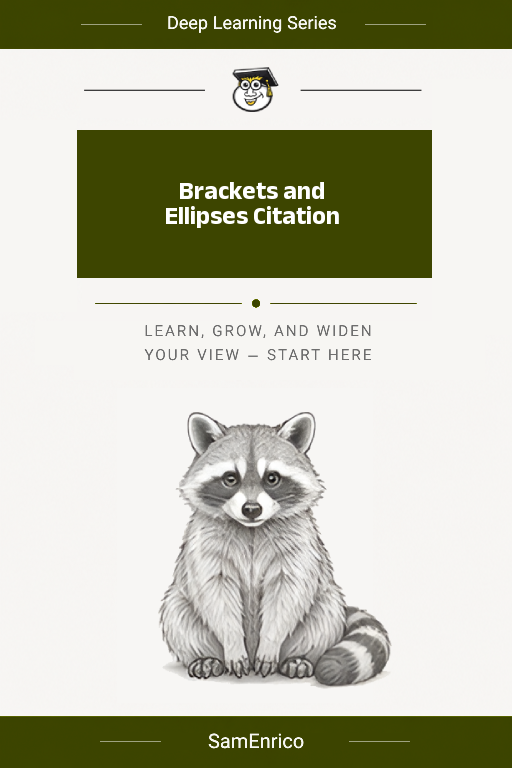
Brackets and Ellipses Citation eBook
Use square brackets for additions and ellipses for
by Segura Lina
Use square brackets for additions and ellipses for omissions in direct quotations correctly.
Formats
Free sample
Chapter 1: The Ghost Rule...--–- Every time you quote someone, you enter into a contract. The original author provides the words, and you provide the context. The reader, meanwhile, trusts that what appears between quotation marks is a faithful representation of what was actually said or written. That trust is fragile. Break it even once, and everything else you write becomes suspect.This chapter establishes the moral and practical foundation for everything that follows.
Before you learn the mechanical rules of brackets and ellipses—before you master the three-dot method or the four-dot method or the proper nesting of parentheses inside brackets—you must first understand why these punctuation marks exist at all. They are not decorative. They are not stylistic flourishes. They are legal instruments in the truest sense: tools that allow you to modify a direct quotation without violating the implicit contract between author, editor, and reader.The problem is that quoting someone perfectly is often impossible, and when it is possible, it is frequently unhelpful. Human beings do not speak in tidy sentences.
We begin clauses and abandon them. We use pronouns that refer back to nouns from three minutes ago. We make grammatical errors, repeat ourselves, and rely on gestures and tone to carry meaning that text cannot capture. Written language is cleaner but still imperfect: authors use ambiguous references, assume shared knowledge that you cannot assume, or embed their quotations inside grammatical structures that do not fit your sentence.Consider a typical example. A witness in a court deposition says: "When I saw him later that day, he told me, 'I didn't do it, and you can't prove that I did,' and then he walked away." If you are writing a legal brief, you might want to quote only the confession: "he told me, 'I didn't do it.'" But you cannot simply remove the surrounding words without indicating that you have done so.
That is what ellipses are for. Similarly, if the witness said "When I saw him later," but you need to clarify that "him" refers to the defendant, you must insert "[the defendant]" to avoid ambiguity. That is what brackets are for.The rules governing these modifications are not arbitrary. They emerge from a single, unifying principle that this chapter calls the Ghost Rule. Learn this rule, and you will never misuse brackets or ellipses again.
Ignore it, and you will eventually publish something that embarrasses you, misleads your readers, or damages your reputation.The Ghost Rule: Intent Over Letter The Ghost Rule is deceptively simple: The original author's intent must survive any editing process. You are permitted to change the letter of a quotation—its exact sequence of characters—only insofar as those changes preserve or clarify the original spirit. If your edits would cause the original author to say, "That is not what I meant," you have violated the rule, regardless of whether you followed every technical punctuation guideline.The name comes from a thought experiment. Imagine that the original author is a ghost standing behind your shoulder as you edit their words. You cannot see them, but they can see your work.
If they would nod in recognition—"Yes, even though you changed the capitalization and added that bracketed clarification, that is still what I was trying to say"—then you have succeeded. If they would groan in frustration, you have failed.This is not a metaphor. Professional editors and fact-checkers use exactly this kind of empathetic reasoning when evaluating quoted material. A good quote editor does not ask "Did I follow the style guide?" They ask "Would the source recognize this as their own statement?" If the answer is no, no amount of technically correct punctuation will save you.The Ghost Rule has three practical implications that appear throughout this book.First, you may never change the meaning of a quotation, even if you use brackets or ellipses to do so. This seems obvious, but it is violated constantly in political advertising, corporate communications, and even academic writing.
Consider a real-world example from a political attack ad. A candidate said in a speech: "I don't support tax cuts for the wealthiest Americans, but I do support middle-class tax relief." The opposing campaign quoted the candidate as saying: "I don't support... middle-class tax relief." By omitting the first half of the sentence and the word "do" before "support," they reversed the candidate's meaning entirely. The ellipsis was technically formatted correctly—three dots, spaces as required—but the Ghost Rule was shattered. The original author's intent was destroyed.Second, you must preserve the original author's voice and character, even when correcting grammar or clarifying references.
A formal academic paper should not be made to sound like a text message. A transcript of spoken testimony should not be polished into perfect prose. When you add brackets or remove text with ellipses, you should ask: Would the author recognize their own style in this edited version? If you strip away every hesitation, every repetition, every idiosyncrasy, you may end up with a grammatically perfect quotation that no human being would ever actually utter. That is a form of deception, even if the literal meaning remains unchanged.Third, you must disclose your edits in a way that the reader can reasonably understand.
Brackets and ellipses are disclosure mechanisms. They say to the reader: "I have changed something here. The original said something slightly different." If you hide your edits behind formatting that the reader is unlikely to notice or understand, you are violating the transparency that the Ghost Rule requires. This is why reputable style guides reject silent correction of anything beyond the most obvious typographical errors—a topic we explore in depth in Chapter 8 when comparing Chicago's permissive approach to APA and MLA's stricter standards.The Ghost Rule is not a restriction on your ability to write clearly. It is a liberation from the impossible demand of verbatim accuracy.
Without the Ghost Rule, you would be forced either to quote everything exactly as written (resulting in confusing, grammatically broken, or ambiguous text) or to paraphrase everything (losing the authority and precision of a direct quotation). The Ghost Rule gives you permission to edit, but it holds you accountable for the spirit of those edits.The Four Pillars of Ethical Quotation The Ghost Rule is the foundation. On top of that foundation rest four supporting pillars. Every time you quote someone, you should evaluate your work against these four criteria. If you fail any one of them, your quotation is unethical, regardless of whether you followed the mechanical rules of brackets and ellipses.Pillar One: Clarity The edited quote must be understandable to a reader who has not read the original source.
This sounds obvious, but it is routinely violated by writers who assume their audience shares their background knowledge.Consider a scientific paper that quotes a previous study: "The results were significant at the p < 0.05 level." If the original study tested multiple variables but the quote refers only to one of them, a reader might misunderstand which results were significant. You could add a bracketed clarification: "[The primary outcome] results were significant at the p < 0.05 level." This…
This is the end of the free sample. Get the eBook to keep going. Buy now
About this book
Details
- Author
- Segura Lina
- Publisher
- SamEnrico
- Language
- English
- Genre
- Non-Fiction, Student's Shortcut, Quotation Marks
- Released
- 2026-06-01
- Pages (approx.)
- 158
- Available as
- eBook, Audiobook

Read better in the ZLOADR app
Your eBooks on your phone or tablet. Sign in with your SamEnrico account and start reading.
More by Segura Lina
 Atomic Habits For Letting GoSegura Lina$11.99
 The Workplace Self Respect PrimerSegura Lina$11.99
 Dating First Date NonverbalSegura Lina$11.99
 Mobile Game Gacha AddictionSegura Lina$11.99
 Remote Work AffirmationsSegura Lina$11.99
 Wound Care Documentation LogSegura Lina$11.99
 Journey Method Locations GuideSegura Lina$11.99
 Alpha 2 Delta LigandsSegura Lina$11.99
 The Lost Queens of the Medieval Games: How Women Fought for Their Place in SportSegura Lina$11.99
 How to Produce Musical ToysSegura Lina$11.99
 How to Produce 100% Nylon YarnSegura Lina$11.99
 China to Ghana Shipping Times GuideSegura Lina$12.99
You may also like
 Hong Kong Handover 1997Dunn Johnnie$11.99
 Zumba For Postnatal Recovery CourseNeal Christian$11.99
 Zumba for BeginnersLadner Nikia$11.99
 YouTube Comment Mining GuideHumes Pandora$12.99
 Worry Box MeditationCarlin Rudy$11.99
 Workplace Stress MeditationNguyen Lynn$11.99
 Workplace Stress and Sleep RepairHawley Ivory$11.99
 Workplace Perfectionism CureDelaney Jeffry$11.99
 Workplace Injustice Anger GuideWallen Isabelle$11.99
 Work Addiction and Burnout LinkGreenwood Ester$11.99
 Women in Yoga and WellnessBeattie Galina$11.99
 Women in Stand Up ComedyChun Evangeline$11.99