
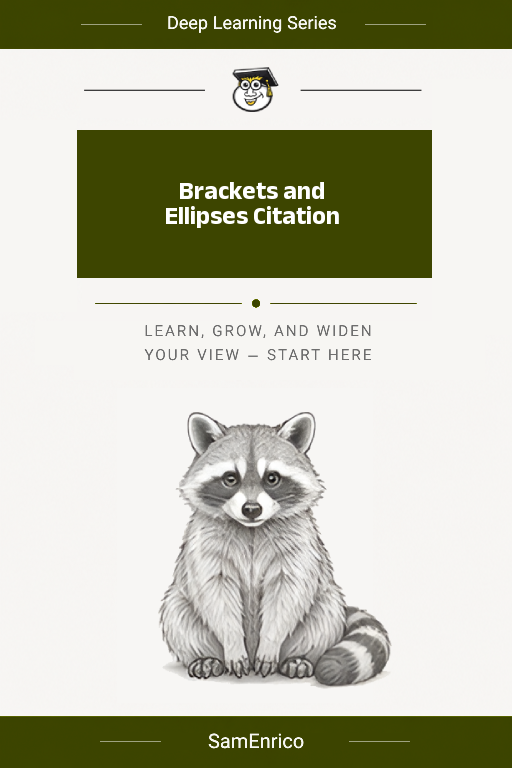
Non-FictionStudent's ShortcutQuotation Marks
Brackets and Ellipses Citation Audiobook
Use square brackets for additions and ellipses for
by Segura Lina
Use square brackets for additions and ellipses for omissions in direct quotations correctly.
Formats
Free sample
Chapter 1: The Ghost Rule...--–- Every time you quote someone, you enter into a contract. The original author provides the words, and you provide the context. The reader, meanwhile, trusts that what appears between quotation marks is a faithful representation of what was actually said or written. That trust is fragile. Break it even once, and everything else you write becomes suspect.This chapter establishes the moral and practical foundation for everything that follows.
Before you learn the mechanical rules of brackets and ellipses—before you master the three-dot method or the four-dot method or the proper nesting of parentheses inside brackets—you must first understand why these punctuation marks exist at all. They are not decorative. They are not stylistic flourishes. They are legal instruments in the truest sense: tools that allow you to modify a direct quotation without violating the implicit contract between author, editor, and reader.The problem is that quoting someone perfectly is often impossible, and when it is possible, it is frequently unhelpful. Human beings do not speak in tidy sentences.
We begin clauses and abandon them. We use pronouns that refer back to nouns from three minutes ago. We make grammatical errors, repeat ourselves, and rely on gestures and tone to carry meaning that text cannot capture. Written language is cleaner but still imperfect: authors use ambiguous references, assume shared knowledge that you cannot assume, or embed their quotations inside grammatical structures that do not fit your sentence.Consider a typical example. A witness in a court deposition says: "When I saw him later that day, he told me, 'I didn't do it, and you can't prove that I did,' and then he walked away." If you are writing a legal brief, you might want to quote only the confession: "he told me, 'I didn't do it.'" But you cannot simply remove the surrounding words without indicating that you have done so.
That is what ellipses are for. Similarly, if the witness said "When I saw him later," but you need to clarify that "him" refers to the defendant, you must insert "[the defendant]" to avoid ambiguity. That is what brackets are for.The rules governing these modifications are not arbitrary. They emerge from a single, unifying principle that this chapter calls the Ghost Rule. Learn this rule, and you will never misuse brackets or ellipses again.
Ignore it, and you will eventually publish something that embarrasses you, misleads your readers, or damages your reputation.The Ghost Rule…
This is the end of the free sample. Get the Audiobook to keep going. Buy now
About this book
Details
- Author
- Segura Lina
- Publisher
- SamEnrico
- Language
- English
- Genre
- Non-Fiction, Student's Shortcut, Quotation Marks
- Released
- 2026-06-01
- Pages (approx.)
- 158
- Available as
- eBook, Audiobook

Listen in the VoxFlicks app
Audiobooks and audio dramas wherever you go. Sign in with your SamEnrico account and press play.
More by Segura Lina
 Atomic Habits For Letting GoSegura Lina$11.99
 The Workplace Self Respect PrimerSegura Lina$11.99
 Dating First Date NonverbalSegura Lina$11.99
 Mobile Game Gacha AddictionSegura Lina$11.99
 Remote Work AffirmationsSegura Lina$11.99
 Wound Care Documentation LogSegura Lina$11.99
 Journey Method Locations GuideSegura Lina$11.99
 Alpha 2 Delta LigandsSegura Lina$11.99
 The Lost Queens of the Medieval Games: How Women Fought for Their Place in SportSegura Lina$11.99
 How to Produce Musical ToysSegura Lina$11.99
 How to Produce 100% Nylon YarnSegura Lina$11.99
 China to Ghana Shipping Times GuideSegura Lina$12.99
You may also like
 Hong Kong Handover 1997Dunn Johnnie$11.99
 Zumba For Postnatal Recovery CourseNeal Christian$11.99
 Zumba for BeginnersLadner Nikia$11.99
 YouTube Comment Mining GuideHumes Pandora$12.99
 Worry Box MeditationCarlin Rudy$11.99
 Workplace Stress MeditationNguyen Lynn$11.99
 Workplace Stress and Sleep RepairHawley Ivory$11.99
 Workplace Perfectionism CureDelaney Jeffry$11.99
 Workplace Injustice Anger GuideWallen Isabelle$11.99
 Work Addiction and Burnout LinkGreenwood Ester$11.99
 Women in Yoga and WellnessBeattie Galina$11.99
 Women in Stand Up ComedyChun Evangeline$11.99