

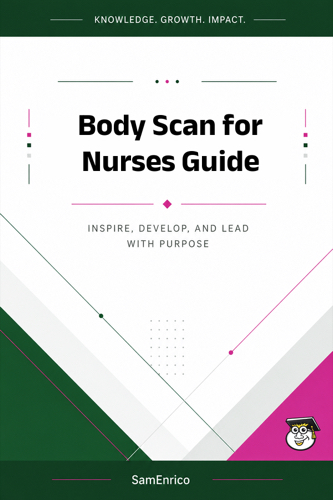
Body Scan for Nurses Guide eBook
Between patient reset technique.
Between patient reset technique.
Formats
Free sample
Chapter 1: The Sludge Effect--–- The door clicks shut behind you. The patient in Room 204B—the one with the new ostomy who hasn't stopped crying, whose family hasn't visited in three days, whose pain medication never seems to last long enough—is now safely on the other side of that door. You have exactly ninety seconds to document your assessment, update the whiteboard, and wash your hands before Room 206C's call light starts flashing. The patient in 206C has been waiting twenty minutes for a glass of water and a routine vital sign check. Nothing urgent.
Nothing dramatic. Just another task in a twelve-hour chain of tasks.But something is wrong. You feel it in your neck. In your jaw. In the way your shoulders have crept up toward your ears like a turtle retreating into its shell.
You take three steps down the hallway, and your gait feels off—stiffer than usual, your pelvis locked, your breath shallow and high in your chest. You glance at the chart for 206C. A seventy-three-year-old with controlled hypertension, scheduled for discharge tomorrow. Routine. Safe.
But when you push open the door, you're not fully present. You're still in 204B. Your body is still braced against the next wave of tears, still anticipating the next call light, still holding the tension of a patient whose suffering you couldn't fix.This is the Sludge Effect. And it is silently compromising your clinical judgment, your physical health, and your patient's safety—one invisible pound of tension at a time.The Hidden Accumulation Nursing literature has long recognized the psychological toll of patient care. Terms like "compassion fatigue," "burnout syndrome," and "secondary traumatic stress" fill the pages of best-selling books such as Coping with Caring and The Power and Pain of Nursing.
These concepts are real, they are dangerous, and they have driven countless talented nurses away from the bedside. But they suffer from a critical limitation: they are almost exclusively defined in emotional and cognitive terms. You feel tired. You feel numb. You feel like you have nothing left to give.What these models miss—what they have always missed—is the physical signature of emotional residue.The Sludge Effect is the term we will use throughout this book to describe the accumulation of neuromuscular tension that results from suppressed emotional responses during patient care.
Every time you bite back a frustrated response, every time you swallow grief because there is no time to cry, every time you suppress a flinch during a difficult procedure—your body stores that impulse as a micro-muscular contraction. These contractions are not imaginary. They are measurable. They change your posture, your gait, your heart rate variability, and even the way your eyes track across a cardiac monitor.Consider what happens during a typical difficult patient interaction. A patient is in pain, scared, or angry.
You remain professional—calm, empathetic, composed. But inside, your sympathetic nervous system is activating. Your heart rate increases. Your breathing becomes shallower. Your jaw clenches to hold back an unprofessional response.
Your shoulders elevate as your body prepares for a threat that never comes. Then the interaction ends. The patient is stable, medicated, or simply exhausted. You leave the room.And here is the critical error: you do nothing to discharge that physiological activation.The Activation Without Discharge Cycle In a healthy stress response, the body moves through three phases: alarm, resistance, and recovery. Alarm is the initial perception of threat.
Resistance is the mobilization of resources—increased heart rate, heightened alertness, muscle tension. Recovery is the return to baseline. In nature, recovery happens through action: the gazelle outruns the lion, then shakes, pants, and rests until its nervous system calms. The physical discharge of energy is essential to completing the stress cycle.Nurses cannot complete the stress cycle at the bedside. You cannot shake off the tension of a difficult family encounter while standing in front of them.
You cannot run laps around the unit after a code blue. You cannot cry out the grief of a patient's death while the next call light is already flashing. Professional composure requires suppression. And suppression, repeated hundreds of times per shift, becomes storage.That storage is the Sludge Effect.The sludge accumulates in predictable patterns. Research using surface electromyography (s EMG) on hospital nurses has identified four primary storage sites for emotional residue:First, the jaw.
The masseter and temporalis muscles are among the strongest in the human body relative to their size. They are designed for chewing, but they are also exquisitely sensitive to emotional suppression. When you bite back a frustrated comment, your jaw clenches. When you suppress a sob, your jaw clenches. When you force a calm expression during a chaotic resuscitation, your jaw clenches.
Over a twelve-hour shift, these micro-clenches summate into persistent, low-grade tension that you may not even notice—until you try to eat dinner at home and your temporomandibular joint aches.Second, the shoulders and upper back. The trapezius muscles, particularly the upper fibers, are the body's primary "threat response" muscles. They elevate the shoulders toward the ears—a vestigial flinch response left over from evolutionary ancestors who needed to protect their necks from predators. Every time you brace yourself for bad news, every time you lean over a bed in a position of care that is also a position of vulnerability, your upper traps contract. After hours of this, the shoulders become rounded forward (thoracic kyphosis), the neck protrudes (forward head posture), and the entire upper quarter becomes a tangled web of myofascial trigger points.Third, the breathing pattern.
When the sympathetic nervous system activates, the diaphragm—the primary muscle of respiration—takes a back seat to the accessory breathing muscles: the scalenes, sternocleidomastoid, and intercostals. These muscles lift the ribcage rather than drawing air deep into the lungs. The result is shallow, high-chest breathing. This pattern is adaptive during a genuine emergency, but when it becomes chronic—when you spend ten or twelve hours per day in shallow chest breathing—it perpetuates sympathetic activation. You cannot think clearly, make careful clinical decisions, or regulate your emotions effectively when your body is convinced it is under threat.Fourth, the pelvic floor and lower back.
This is the most overlooked storage site, and arguably the most consequential. The pelvic floor muscles respond to emotional suppression in ways that are not yet fully understood, but clinical observation and emerging research suggest a clear pattern. Fear, grief, and the "holding in" of strong emotions trigger a reflexive contraction of the pelvic floor. This is the body's way of "bracing" against perceived vulnerability. In nurses, particularly those working in high-acuity settings like the ICU, the pelvic floor can remain in a state of low-grade contraction for entire shifts.
The downstream effects include lower back pain (as the pelvic floor and lumbar multifidus muscles form a functional unit), altered gait mechanics, and even chronic pelvic pain syndromes.The Clinical Cost of Sludge The Sludge Effect is not merely a discomfort issue. It is a patient safety issue.In a simulation study conducted at a large academic medical center, forty-two experienced ICU nurses were asked to perform a routine patient assessment under two conditions. In…
This is the end of the free sample. Get the eBook to keep going. Buy now
About this book
Details
- Author
- Delvalle Angele
- Publisher
- SamEnrico
- Language
- English
- Genre
- Non-Fiction, Self-Help, Nursing
- Released
- 2026-06-05
- Pages (approx.)
- 151
- Available as
- eBook, Audiobook

Read better in the ZLOADR app
Your eBooks on your phone or tablet. Sign in with your SamEnrico account and start reading.
More by Delvalle Angele
 Walking Meditation For Teens GuideDelvalle Angele$11.99
 Learning Language Memory BoostDelvalle Angele$11.99
 Construction Trade Alcohol RecoveryDelvalle Angele$11.99
 The Forgiveness Chair TechniqueDelvalle Angele$11.99
 The Ballot Box Bombing: New Zealand's Forgotten Political AssassinationDelvalle Angele$11.99
 Understanding Occupational Asthma Animals, Insects and FungiDelvalle Angele$17.99
 Structural Design EngineerDelvalle Angele$11.99
 Heijunka Production Leveling HandbookDelvalle Angele$12.99
 German Academic Record RecognitionDelvalle Angele$12.99
 How to Start a Chimney Cleaning Business (Beginners Guide)Delvalle Angele$11.99
You may also like
 Hong Kong Handover 1997Dunn Johnnie$11.99
 Zumba For Postnatal Recovery CourseNeal Christian$11.99
 Zumba for BeginnersLadner Nikia$11.99
 YouTube Comment Mining GuideHumes Pandora$12.99
 Worry Box MeditationCarlin Rudy$11.99
 Workplace Stress MeditationNguyen Lynn$11.99
 Workplace Stress and Sleep RepairHawley Ivory$11.99
 Workplace Perfectionism CureDelaney Jeffry$11.99
 Workplace Injustice Anger GuideWallen Isabelle$11.99
 Work Addiction and Burnout LinkGreenwood Ester$11.99
 Women in Yoga and WellnessBeattie Galina$11.99
 Women in Stand Up ComedyChun Evangeline$11.99