
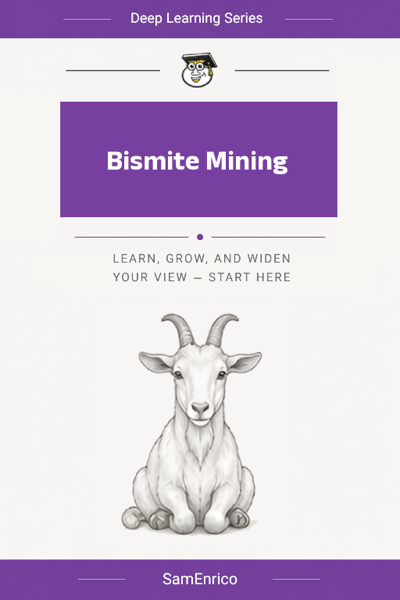
Bismite Mining eBook
A Coursebook on Bismite Mining
A Coursebook on Bismite Mining
Formats
Free sample
Chapter 1: The Yellow Earth...--The first mistake a prospector makes is walking past the yellow stain. They are looking for glitter—gold, silver, the flash of native copper. But bismuth, in its oxidized form as bismite, does not glitter. It stains. It leaves a pale yellow to greenish-yellow smear on fractured rock surfaces, like a mineral bruise.
That bruise, ignored by generations of miners chasing brighter metals, is the signature of one of the most chemically fascinating and commercially strategic metals on the periodic table. Understanding that yellow earth—what it is, where it came from, and why it matters—is the first step in becoming not just a miner, but a bismite specialist.This chapter establishes the foundational identity of bismite as both a mineral species and an economic commodity. It is not merely a catalog of physical properties. Rather, it is an origin story. We will trace bismuth from its accidental use by pre-Columbian metallurgists through its misidentification as tin or lead in medieval Europe, to its modern recognition as the "green" metal replacing lead in everything from shotgun shells to children's medicine.
We will define bismite (Bi₂O₃) with rigorous mineralogical precision: its crystal structures, its physical properties, and its paragenesis—the sequence of events that creates an economic concentration. Most critically, this chapter will distinguish bismite from its close relatives: native bismuth (the metallic form) and bismuthinite (the sulfide). These distinctions are not academic; they determine every subsequent decision in mining, processing, and marketing. A deposit of native bismuth requires a different extraction strategy than a deposit of bismite. A miner who cannot tell them apart in the field will lose money before the first tonne is crushed.Finally, we will survey the global geography of bismite deposits, from the high-altitude veins of Bolivia's Tasna district to the weathered granites of Australia's Mole River, from the tungsten skarns of China's Hunan Province to the by-product streams of Mexican lead smelters.
Along the way, we will establish the economic language of the trade: cutoff grades, tonnage thresholds, and the critical distinction between primary bismite mines and by-product recovery operations. By the end of this chapter, the reader will not merely know what bismite is. They will understand why it has been overlooked, how to recognize it, and when a yellow stain on a rock face becomes a bankable asset.1.1 The Accidental Metal: A History of Bismuth from the Incas to Green Chemistry Bismuth is one of the few metals that humanity has used for millennia without truly understanding what it was. The pre-Columbian Incas, working the rich polymetallic veins of the Andes, recognized a peculiar silvery-white metal with a pinkish tinge that appeared in their copper alloys. They called it by names lost to history, but archaeological evidence from the Tasna district of southern Bolivia shows that they deliberately added bismuth to copper to improve castability.
The resulting alloys were easier to pour into molds for ceremonial objects—a small metallurgical innovation that reveals an intuitive grasp of bismuth's low melting point long before thermometers existed.In medieval Europe, bismuth suffered an identity crisis. German miners in the Erzgebirge (Ore Mountains) encountered a metal that appeared similar to tin and lead but behaved differently. It was brittle where tin was malleable. It had a higher melting point than lead but a distinctive iridescent tarnish. They called it "wismut," from the Old German "wiss" (white) or perhaps "wiese" (meadow), referring to the meadows where bismuth-rich ores were found.
For centuries, bismuth was considered a variant of lead or tin—a "bastard metal" in the terminology of the time. Even the great Renaissance metallurgist Georgius Agricola, in his 1556 masterpiece De Re Metallica, treated bismuth as a distinct type of lead.The breakthrough came in 1753. Claude Geoffroy the Younger, a French chemist, systematically analyzed the "white metal" and proved that it was neither lead nor tin nor any known element's alloy. He published a definitive description of bismuth as a separate elemental species—one of the first new elements identified since antiquity. Geoffroy's work established bismuth's place in the periodic table (element 83, nestled between lead and polonium) and opened the door to understanding its oxide, bismite.The nineteenth century brought industrial applications.
Bismuth alloys with lead, tin, and cadmium produced exceptionally low melting points—some as low as 70°C, hot enough to melt in boiling water. These fusible alloys found use in fire sprinkler systems (the plug melts, releasing water), electrical fuses, and solders. Bismuth's diamagnetic property—it is the most diamagnetic of all metals, meaning it repels magnetic fields—made it useful for magnetic levitation demonstrations and sensitive instrumentation.But the twentieth century transformed bismuth from a curiosity into a strategic material. The discovery that bismuth subsalicylate (the active ingredient in Pepto-Bismol) effectively treats gastrointestinal disorders created a pharmaceutical market that now consumes nearly a third of global bismuth production. More significantly, the growing recognition of lead's neurotoxicity triggered a wave of regulations: lead in paint (banned in the US in 1978), lead in plumbing (1986), lead in wheel weights (phased out from 2005), and lead in ammunition (California ban effective 2020).
Bismuth, being non-toxic and non-bioaccumulating, emerged as lead's natural replacement. Lead-free shot for waterfowl hunting is now predominantly bismuth-tin alloy. Lead-free solder for electronics is increasingly bismuth-based. The "green metal" moniker, once marketing hyperbole, has become an accurate description of bismuth's environmental niche.This history is not merely decorative. It explains the market dynamics that drive bismite mining.
Unlike copper or iron, which have steady industrial demand, bismuth demand is driven by regulation and substitution. A bismite miner must understand that their market is not "all metal" but the specific fraction of applications where toxicity bans are phasing out lead. This makes bismuth prices volatile—ranging from 4/lbin2001and2015to4/lb in 2001 and 2015 to 4/lbin2001and2015to15/lb in 2006 and 2011—but also creates opportunities for agile producers who can time the market.1.2 Defining Bismite: Mineralogy, Crystal Chemistry, and Physical Properties Bismite is the naturally occurring oxide of bismuth, with the ideal formula Bi₂O₃. The name derives from the element plus the "-ite" suffix standard for minerals. It was first described from the Cerro Tazna mine in Bolivia in 1868 and formally recognized by the International Mineralogical Association as a distinct species.
To understand bismite is to understand bismuth's unusual chemistry: bismuth is a post-transition metal that behaves like a heavy metal but shares properties with both metals and non-metals. Its oxide reflects this duality.Crystal Structure: The Two Faces of Bismite Bismite is polymorphic—it can exist in multiple crystal structures depending on temperature. At ambient temperatures (below approximately 727°C), bismite adopts the monoclinic α-phase (space group P2₁/c). In this structure, bismuth atoms are coordinated to oxygen atoms in a distorted arrangement: five oxygen atoms surround each bismuth in a polyhedron that is neither perfectly octahedral nor pyramidal. The distortion arises from the presence of a stereochemically active lone pair of electrons on the bismuth atom—a concept that will reappear when we discuss flotation chemistry in Chapter 7.
This lone pair pushes the oxygen atoms asymmetrically, creating the layered, plate-like habit that characterizes many bismite crystals.At temperatures above 727°C, bismite transforms into the cubic δ-phase (space group Fm 3 m). In this…
This is the end of the free sample. Get the eBook to keep going. Buy now
About this book
Details
- Author
- Madsen Vernell
- Publisher
- SamEnrico
- Language
- English
- Genre
- Non-Fiction, Informative, Educational
- Released
- 2026-05-25
- Pages (approx.)
- 160
- Available as
- eBook, Audiobook

Read better in the ZLOADR app
Your eBooks on your phone or tablet. Sign in with your SamEnrico account and start reading.
More by Madsen Vernell
 The Remote Project ManagementMadsen Vernell$11.99
 Step Six Becoming ReadyMadsen Vernell$11.99
 Hair Loss After 60 GuideMadsen Vernell$11.99
 AED Error Messages GuideMadsen Vernell$11.99
 The Bear and the Eagle: Mikhail Gorbachev and the Soviet-Afghan WarMadsen Vernell$11.99
 How to Produce Blu-ray Disc Recordable MediaMadsen Vernell$11.99
 UK Business Credit IndustryMadsen Vernell$12.99
 How to Start a Benniseed Oil Refining Business (Beginners Guide)Madsen Vernell$11.99