
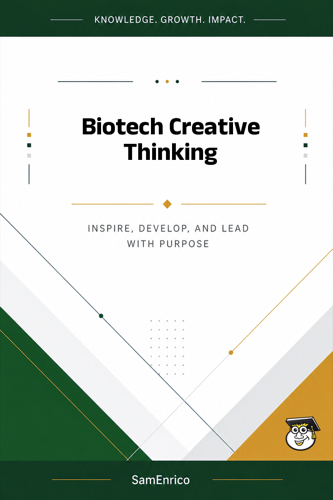
Non-FictionSelf-HelpBiotechnology Creativity
Biotech Creative Thinking eBook
Innovate in life sciences using this practical cre
Innovate in life sciences using this practical creativity guide for scientists.
Formats
Free sample
Chapter 1: Prepared Serendipity...–- The most creative scientists are not the luckiest. They are the ones who have trained themselves to recognize luck when it arrives.The story of modern biotechnology is usually told as a story of logic. We imagine a scientist at a whiteboard, drawing elegant pathways from hypothesis to experiment to conclusion. We picture clean data sets, tidy p-values, and a straight line from question to answer. This image is comforting.
It is also almost entirely wrong.Ask any working scientist over the age of forty, and they will tell you a different story. They will tell you about the experiment that failed in a way that opened an entirely new direction. They will tell you about the result they almost discarded because it didn't fit the protocol. They will tell you about the afternoon they noticed something strange, decided not to ignore it, and stumbled into the most interesting work of their careers.These stories are not confessions of incompetence. They are descriptions of how science actually works.
The published paper, with its clean narrative arc and its tidy conclusion, is a reconstruction. The real process is messy, non-linear, and deeply human. It is full of wrong turns, partial data, and moments of intuition that cannot be reduced to a formula. In short, it is creative.This book is built on a simple argument: scientific discovery is not a linear, logical deduction but a creative act of problem-finding and solution-building. The scientists who change their fields are not necessarily the most meticulous logicians.
They are the ones who have learned to harness uncertainty, to notice what others overlook, and to treat every experiment—especially the failed ones—as a source of new questions.This chapter begins where any creative journey must begin: by clearing away the myths that prevent scientists from seeing themselves as creative beings. Until you accept that creativity belongs in the laboratory as much as it belongs in the studio, you will continue to train yourself for incremental work while wondering why breakthroughs elude you.The Myth of the Objective Scientist The standard model of science is taught in every introductory methods course. It goes like this: formulate a hypothesis, design an experiment to test it, collect data, analyze results, draw a conclusion. This is the scientific method. It is logical, rigorous, and—if followed correctly—supposedly objective.There is nothing wrong with this model as a description of how to validate a finding.
It is an excellent tool for checking your work and convincing others that you have not fooled yourself. But as a description of how discoveries actually happen, it is a sanitized fiction.Consider the most famous story in the history of antibiotic discovery. In 1928, Alexander Fleming returned to his messy laboratory after a month-long vacation. He had left a stack of petri dishes containing Staphylococcus bacteria on his bench. When he returned, he noticed something strange: one of the dishes was contaminated with a mold, and the bacteria around the mold had been killed.The standard telling of this story emphasizes luck.
Fleming was lucky that a mold spore drifted into his lab. He was lucky that the temperature was right for the mold to grow but not for the bacteria to overrun it. He was lucky that he noticed at all.But luck is only half the story. Fleming was not the first person to see mold killing bacteria. Dozens of earlier scientists had observed similar phenomena and dismissed it as a nuisance.
What made Fleming different was that he had been trained as a bacteriologist, he was already interested in antibacterial agents, and—most importantly—he had cultivated the habit of paying attention to anything that deviated from expectation.Fleming's discovery was an accident of encounter—the mold spore landing on his plate was outside his control. But it was also a prepared perception—he noticed the zone of inhibition because his mind was primed to see anomalies. The accident was luck. The perception was skill.This distinction is the foundation of everything that follows in this book. You cannot control when a mold spore lands on your plate.
But you can control whether you notice it, whether you follow it, and whether you turn it into a discovery.The Problem-Finding Hierarchy Most scientific training focuses on a single skill: solving problems that someone else has already identified. You are given a research question—often by your advisor, a grant agency, or the existing literature—and you design experiments to answer it. This is valuable. It is also the lowest level of scientific creativity.The chapter introduces a three-level hierarchy of scientific work. Understanding where you currently operate is the first step toward moving upward.Level 1: Problem-Solving At this level, the problem is given to you.
Your advisor says, "We need to know whether protein X binds to protein Y." Or a grant says, "Develop a CRISPR-based diagnostic for Zika virus." Your job is to execute the experiments efficiently and correctly. This is what most Ph D students do for their first few years. It is essential training, but it is not breakthrough science. You are a highly skilled technician operating within someone else's frame.Level 2: Problem-Reframing At this level, you take a known problem and ask whether it has been framed correctly. Perhaps protein X binds to protein Y only under conditions that no one has considered.
Perhaps the diagnostic for Zika virus would be more useful if it distinguished between active and past infection. You are no longer simply executing; you are questioning the assumptions behind the question. This is what good postdocs do. It is the difference between a competent scientist and an innovative one.Level 3: Problem-Finding At this level, you discover a problem that no one knew existed. You notice an anomaly in a routine experiment and realize that it points to a gap in the field's understanding.
You observe a clinical frustration and realize that no technology exists to address it. You read outside your discipline and see an analogy that suggests an entirely new question. This is Nobel territory. Most scientists never operate here consistently, not because they lack intelligence, but because they have never been trained to see problem-finding as a skill that can be practiced.The goal of this book is to move you from Level 1 to Level 3. Not every experiment needs to be a breakthrough, and there is nothing wrong with doing solid incremental work.
But if you want to be a creative scientist—the kind who opens new fields rather than just publishing in them—you need to spend a meaningful portion of your time operating at Level 3.Prepared Serendipity: Designing for the Unexpected If problem-finding depends on noticing the unexpected, then the obvious question is: can you train yourself to notice more? The answer is yes. The skill is called prepared serendipity.Serendipity is often misunderstood as pure luck. In fact, the word was coined by Horace Walpole in 1754, based on a fairy tale called The Three Princes of Serendip. The princes, he wrote, "were always making discoveries, by accidents and sagacity, of things they were not in quest of." Notice the two components: accidents (the unexpected events)…
This is the end of the free sample. Get the eBook to keep going. Buy now
About this book
Details
- Author
- Flecha Luanne
- Publisher
- SamEnrico
- Language
- English
- Genre
- Non-Fiction, Self-Help, Biotechnology Creativity
- Released
- 2026-06-09
- Pages (approx.)
- 125
- Available as
- eBook, Audiobook

Read better in the ZLOADR app
Your eBooks on your phone or tablet. Sign in with your SamEnrico account and start reading.
More by Flecha Luanne
 Complicated Grief After Sibling LossFlecha Luanne$11.99
 Beginner Mindfulness for GriefFlecha Luanne$11.99
 Losing A Service DogFlecha Luanne$11.99
 The Wangari Maathai Green BeltFlecha Luanne$11.99
 The Last Healer of AtlantisFlecha Luanne$11.99
 Understanding Stoll–geraudel–chauvin SyndromeFlecha Luanne$17.99
 Clumber Spaniel BreedingFlecha Luanne$11.99
 Procurement KPIs and MetricsFlecha Luanne$12.99
 Free AI Accounting ToolsFlecha Luanne$12.99
 Ultimate Handbook Guide to Aguascalientes : (Mexico) Travel GuideFlecha Luanne$11.99
You may also like
 Hong Kong Handover 1997Dunn Johnnie$11.99
 Zumba For Postnatal Recovery CourseNeal Christian$11.99
 Zumba for BeginnersLadner Nikia$11.99
 YouTube Comment Mining GuideHumes Pandora$12.99
 Worry Box MeditationCarlin Rudy$11.99
 Workplace Stress MeditationNguyen Lynn$11.99
 Workplace Stress and Sleep RepairHawley Ivory$11.99
 Workplace Perfectionism CureDelaney Jeffry$11.99
 Workplace Injustice Anger GuideWallen Isabelle$11.99
 Work Addiction and Burnout LinkGreenwood Ester$11.99
 Women in Yoga and WellnessBeattie Galina$11.99
 Women in Stand Up ComedyChun Evangeline$11.99