
Non-FictionSelf-HelpBiotechnology Creativity
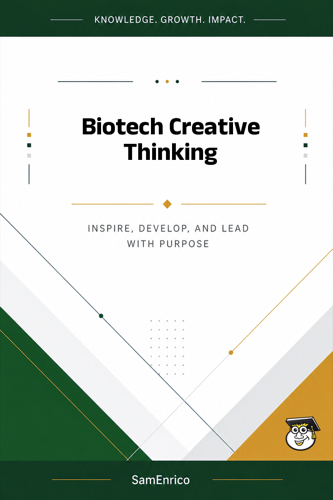
Biotech Creative Thinking Audiobook
Innovate in life sciences using this practical cre
Innovate in life sciences using this practical creativity guide for scientists.
Formats
Free sample
Chapter 1: Prepared Serendipity...–- The most creative scientists are not the luckiest. They are the ones who have trained themselves to recognize luck when it arrives.The story of modern biotechnology is usually told as a story of logic. We imagine a scientist at a whiteboard, drawing elegant pathways from hypothesis to experiment to conclusion. We picture clean data sets, tidy p-values, and a straight line from question to answer. This image is comforting.
It is also almost entirely wrong.Ask any working scientist over the age of forty, and they will tell you a different story. They will tell you about the experiment that failed in a way that opened an entirely new direction. They will tell you about the result they almost discarded because it didn't fit the protocol. They will tell you about the afternoon they noticed something strange, decided not to ignore it, and stumbled into the most interesting work of their careers.These stories are not confessions of incompetence. They are descriptions of how science actually works.
The published paper, with its clean narrative arc and its tidy conclusion, is a reconstruction. The real process is messy, non-linear, and deeply human. It is full of wrong turns, partial data, and moments of intuition that cannot be reduced to a formula. In short, it is creative.This book is built on a simple argument: scientific discovery is not a linear, logical deduction but a creative act of problem-finding and solution-building. The scientists who change their fields are not necessarily the most meticulous logicians.
They are the ones who have learned to harness uncertainty, to notice what others overlook, and to treat every experiment—especially the failed ones—as a source of new questions.This chapter begins where any creative journey must begin: by clearing away the myths that prevent scientists from seeing themselves as creative beings. Until you accept that creativity belongs in the laboratory as much as it belongs in the studio, you will continue to train yourself for incremental work while wondering why breakthroughs elude you.The Myth of the Objective Scientist The standard model of science is taught in every introductory methods course. It goes like this: formulate a hypothesis, design an experiment to test it, collect data, analyze results, draw a conclusion. This is the scientific method. It is logical, rigorous, and—if followed correctly—supposedly objective.There is nothing wrong with this model as a description of how…
This is the end of the free sample. Get the Audiobook to keep going. Buy now
About this book
Details
- Author
- Flecha Luanne
- Publisher
- SamEnrico
- Language
- English
- Genre
- Non-Fiction, Self-Help, Biotechnology Creativity
- Released
- 2026-06-09
- Pages (approx.)
- 125
- Available as
- eBook, Audiobook

Listen in the VoxFlicks app
Audiobooks and audio dramas wherever you go. Sign in with your SamEnrico account and press play.
More by Flecha Luanne
 Complicated Grief After Sibling LossFlecha Luanne$11.99
 Beginner Mindfulness for GriefFlecha Luanne$11.99
 Losing A Service DogFlecha Luanne$11.99
 The Wangari Maathai Green BeltFlecha Luanne$11.99
 The Last Healer of AtlantisFlecha Luanne$11.99
 Understanding Stoll–geraudel–chauvin SyndromeFlecha Luanne$17.99
 Clumber Spaniel BreedingFlecha Luanne$11.99
 Procurement KPIs and MetricsFlecha Luanne$12.99
 Free AI Accounting ToolsFlecha Luanne$12.99
 Ultimate Handbook Guide to Aguascalientes : (Mexico) Travel GuideFlecha Luanne$11.99
You may also like
 Hong Kong Handover 1997Dunn Johnnie$11.99
 Zumba For Postnatal Recovery CourseNeal Christian$11.99
 Zumba for BeginnersLadner Nikia$11.99
 YouTube Comment Mining GuideHumes Pandora$12.99
 Worry Box MeditationCarlin Rudy$11.99
 Workplace Stress MeditationNguyen Lynn$11.99
 Workplace Stress and Sleep RepairHawley Ivory$11.99
 Workplace Perfectionism CureDelaney Jeffry$11.99
 Workplace Injustice Anger GuideWallen Isabelle$11.99
 Work Addiction and Burnout LinkGreenwood Ester$11.99
 Women in Yoga and WellnessBeattie Galina$11.99
 Women in Stand Up ComedyChun Evangeline$11.99