
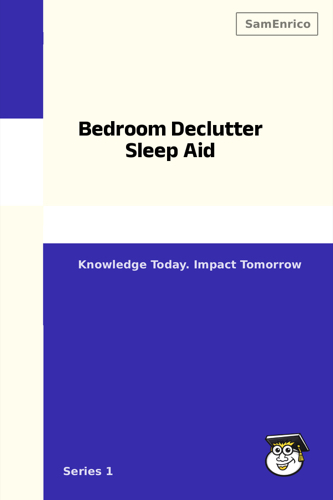
Non-FictionSelf-HelpDecluttering
Bedroom Declutter Sleep Aid eBook
Mental clearing and order for those overwhelmed by
Mental clearing and order for those overwhelmed by physical clutter.
Formats
Free sample
Chapter 1: The Cortisol Ceiling--–- You are lying in bed at 3:17 a.m. Your eyes are open. You are not thinking about work, or money, or the argument you had three days ago. You are thinking about the pile of clothes on the chair. You are thinking about the stack of books on the floor that you haven't touched in eight months.
You are thinking about the nightstand drawer that won't close because it is too full, and the half-empty water glass from three nights ago, and the phone charger cord that snakes across the floor like a pale gray question mark. Your heart is not racing in the way that means terror. It is racing in the way that means your body is preparing for a threat that does not exist. There is no intruder at your window. There is no fire in the hallway.
There is only stuff. And yet your nervous system cannot tell the difference.This is the opening scene of a life that millions of people are living right now, in every time zone, in every kind of home, across every income level. They are not lazy. They are not messy by choice. They are not hoarders or failures or people who simply "don't care about their environment." They are exhausted people who have tried to clean their bedrooms and failed, who have bought storage bins and organizational systems and matching hangers, who have watched the You Tube videos and pinned the Pinterest boards and bought the Marie Kondo book only to find that the book now sits on a pile of other unread books on the floor next to their bed.
They are people who have internalized the message that their clutter is a moral failing, and that if they just tried harder, cared more, woke up earlier, had more discipline, they would finally have the serene bedroom they see in magazines and Instagram reels. And because they have tried and failed, they have concluded that the problem is them.The problem is not them. The problem is that almost everything they have been told about decluttering is wrong for people who cannot sleep.This chapter will introduce you to a concept that does not appear in any mainstream decluttering book but that explains why your cluttered bedroom is actively harming your sleep, why traditional organizing advice often makes things worse, and why you are not broken for struggling with this. The concept is called the cortisol ceiling, and once you understand it, you will never look at a pile of laundry the same way again.The Neurological Cost of Visible Chaos To understand why clutter destroys sleep, you have to understand something about how your brain processes visual information. The human brain did not evolve in bedrooms.
It evolved on savannas and in forests, where visual input was primarily a tool for survival. A rustling bush might contain a predator. A change in light might signal an approaching storm. A pile of objects in your path might hide a snake. Your brain is not designed to ignore the things in your visual field.
It is designed to scan, assess, and categorize everything you can see, all the time, even when you are trying to rest.This is where the trouble begins. When your bedroom contains many visible objects, your brain treats each object as a data point that requires processing. The pile of clothes on the chair is not just fabric. It is a signal: "Unfinished task. Those clothes need to be folded, hung, or washed." The stack of books on the floor is not just paper.
It is a signal: "Unfinished task. Those books need to be shelved, donated, or read." The jumble of items on your nightstand is not just clutter. It is a cascade of signals: "Unfinished task. Unfinished task. Unfinished task." Your brain, still operating on savanna logic, cannot simply decide to stop seeing these signals.
It can only acknowledge them, file them, and attempt to set them aside. But setting them aside requires energy. And when there are dozens of unfinished-task signals in your visual field at bedtime, your brain never fully shifts into rest mode.Researchers call this phenomenon attentional residue. When your attention is pulled toward a task-relevant stimulus—even a stimulus you have no intention of acting on—your brain maintains a low level of arousal directed at that stimulus. The classic study on this phenomenon, published in the Journal of Neuroscience, found that the mere presence of task-irrelevant objects in a visual scene reduced participants' ability to disengage attention during rest periods.
In plain English: you cannot fully relax when your eyes can see things that look like they need to be done.Think about the last time you tried to fall asleep in a hotel room. Not a fancy hotel, necessarily—just a clean, neutral room that someone else was responsible for. The bed had sheets and pillows and nothing else. The floor was empty. The nightstand held a lamp, an alarm clock, and nothing more.
The closet was either empty or had a few hangers. There were no piles of mail, no laundry baskets, no children's artwork, no exercise equipment, no boxes of things you meant to return, no sentimental objects that triggered complicated feelings. How quickly did you fall asleep? For most people, the answer is "much faster than at home." And the reason is not that hotel beds are magic. The reason is that hotel rooms have an extremely low number of attentional-residue triggers.
Your brain had nothing to process except the decision to sleep.The cortisol ceiling is what happens when that attentional residue becomes chronic. Cortisol is your body's primary stress hormone, released by the adrenal glands in response to perceived threats or challenges. In small, time-limited doses, cortisol is helpful—it sharpens focus, mobilizes energy, and helps you respond to immediate demands. But when cortisol remains elevated over long periods, it becomes destructive. It disrupts sleep architecture, reduces melatonin production, impairs memory and concentration, weakens the immune system, and contributes to anxiety and depression.The link between clutter and cortisol is not theoretical.
A landmark study conducted by the UCLA Center on Everyday Lives and Families measured cortisol levels in women across a range of home environments. The researchers found that women who described their homes as cluttered or filled with unfinished projects had significantly higher diurnal cortisol levels than women who described their homes as restful and orderly. The difference was not small. It was clinically meaningful—the kind of difference associated with chronic stress and poor health outcomes. Even more striking, the researchers found that the women's subjective experience of their homes (whether they felt their homes were "restful" or "chaotic") predicted their cortisol levels more accurately than objective measures of clutter.
In other words, it was not just the amount of stuff that mattered. It was the woman's felt sense of being overwhelmed by that stuff.This is the cortisol ceiling. It is the invisible barrier above which your stress hormones rise when your bedroom contains too many visual reminders of unfinished business. And because cortisol directly inhibits melatonin (the hormone that tells your body…
This is the end of the free sample. Get the eBook to keep going. Buy now
About this book
Details
- Author
- Clevenger Julianna
- Publisher
- SamEnrico
- Language
- English
- Genre
- Non-Fiction, Self-Help, Decluttering
- Released
- 2026-06-11
- Pages (approx.)
- 133
- Available as
- eBook, Audiobook

Read better in the ZLOADR app
Your eBooks on your phone or tablet. Sign in with your SamEnrico account and start reading.
More by Clevenger Julianna
 Strength Training For BodybuildingClevenger Julianna$11.99
 Nobel Laureates In PhysiologyClevenger Julianna$11.99
 Values Based Eating GuideClevenger Julianna$11.99
 Mindful Walking for Anxiety ReliefClevenger Julianna$11.99
 The Last Transmission of the BeagleClevenger Julianna$11.99
 Titanic’s Forgotten Tycoon: The Man Who Built the Unsinkable DreamClevenger Julianna$11.99
 One Page Referral Program ManualClevenger Julianna$12.99
 Grant Peer Review GuideClevenger Julianna$12.99
 Understanding Gm2 Gangliosidosis, 0 VariantClevenger Julianna$17.99
 Parts RunnerClevenger Julianna$11.99
 How to Start a Hobby in PapermacheClevenger Julianna$11.99
You may also like
 Hong Kong Handover 1997Dunn Johnnie$11.99
 Zumba For Postnatal Recovery CourseNeal Christian$11.99
 Zumba for BeginnersLadner Nikia$11.99
 YouTube Comment Mining GuideHumes Pandora$12.99
 Worry Box MeditationCarlin Rudy$11.99
 Workplace Stress MeditationNguyen Lynn$11.99
 Workplace Stress and Sleep RepairHawley Ivory$11.99
 Workplace Perfectionism CureDelaney Jeffry$11.99
 Workplace Injustice Anger GuideWallen Isabelle$11.99
 Work Addiction and Burnout LinkGreenwood Ester$11.99
 Women in Yoga and WellnessBeattie Galina$11.99
 Women in Stand Up ComedyChun Evangeline$11.99