
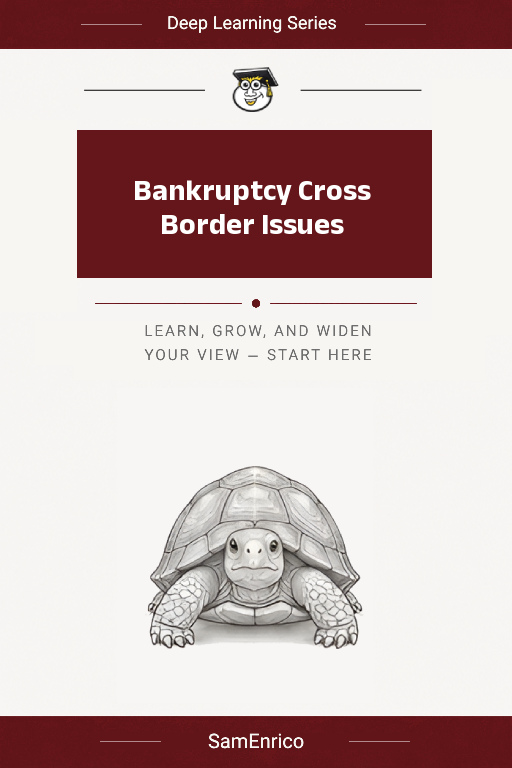
Non-FictionCrisis ManagementCross Border
Bankruptcy Cross Border Issues eBook
Handle multinational client bankruptcy with assets
Handle multinational client bankruptcy with assets in multiple countries under Chapter 15 recognition.
Formats
Free sample
Chapter 1: The Comity Paradox...--–- It was 3:00 PM on a Friday when the phone rang. The client on the line was a court-appointed liquidator from the Cayman Islands. He had just seized control of a multinational holding company with forty-seven subsidiaries across fourteen countries. The crown jewel—a Miami-based real estate portfolio worth $340 million—was sitting in a U.S. bank account, and a New York judgment creditor was preparing to levy it on Monday morning.
The liquidator had one question: "Can you stop them before the weekend ends?"The answer, as every seasoned bankruptcy practitioner eventually learns, is both yes and no. Yes, the United States has a robust legal framework for recognizing foreign insolvency proceedings and protecting multinational assets. No, that framework does not work the way most foreign representatives expect. And the difference between success and failure often comes down to understanding what this book calls the Comity Paradox: the more aggressively a foreign representative relies on American courts to protect assets, the more those courts will scrutinize whether the foreign proceeding deserves protection in the first place.This chapter introduces the philosophical and practical foundations of cross-border insolvency in the United States. It explains why domestic bankruptcy is no longer sufficient in a globalized economy, how the law shifted dramatically in 2005, and what that shift means for the foreign representative sitting with a ticking clock and a Miami bank account.
Most importantly, it establishes the core thesis of this entire book: Chapter 15 is not merely a recognition statute—it is a strategic chessboard, and success requires mastering the rules of engagement before the first move is made.The Territorialist Era: Every Nation for Itself Before 2005, cross-border insolvency in the United States operated under a framework that might generously be described as chaos. The old Section 304 of the Bankruptcy Code (repealed when Chapter 15 was adopted) gave U.S. courts broad, discretionary power to grant comity to foreign proceedings. The statute provided minimal guidance: a court "may" enjoin actions against the debtor's assets "as is appropriate" based on a list of vague factors including comity, fairness to creditors, and the just treatment of all claims.The result was unpredictability bordering on randomness. A foreign representative filing in the Southern District of New York might receive a warm welcome and a comprehensive stay.
The same representative filing in the Northern District of Texas might be told to try state court. A liquidation proceeding in London might be recognized as entitled to comity, while an identical proceeding in Hong Kong might be dismissed as insufficiently "judicial" in nature. Asset racing—the practice of creditors rushing to seize assets in whichever country could execute fastest—was not a bug of the system but a feature.Consider the case of In re Maxwell Communication Corporation (1991), a pre-Chapter 15 disaster that became a cautionary tale taught in bankruptcy courses for a generation. Maxwell was a British company with U.S. assets and creditors on both sides of the Atlantic.
When it collapsed, the English court appointed administrative receivers. The U.S. court, operating under Section 304, had to decide whether to enjoin American creditors from pursuing their claims in New York. The court eventually granted comity, but only after months of litigation, massive legal fees, and a near-total dissipation of the U.S. assets.
The lesson was brutal: under territorialism, the first creditor to the courthouse steps often won, regardless of the underlying fairness of the foreign proceeding.The old system suffered from three fatal flaws. First, it was discretionary rather than mandatory. A court could grant comity but was never required to do so, creating perverse incentives for creditors to forum-shop for hostile judges. Second, it offered no clear standard for determining which foreign proceeding deserved recognition. The term "comity" was used as a talisman rather than a test.
Third, it provided no mechanism for coordination between courts in different countries. Each judge operated in isolation, issuing orders that conflicted with orders issued elsewhere. The result was a legal version of the prisoner's dilemma: every jurisdiction acted in its perceived self-interest, and everyone lost as a result.The 2005 Revolution: Modified Universalism Arrives The Bankruptcy Abuse Prevention and Consumer Protection Act of 2005 (BAPCPA) was, for the most part, a deeply controversial piece of legislation that made life harder for consumer debtors. But buried within its dense provisions was a genuine innovation: the adoption of the UNCITRAL Model Law on Cross-Border Insolvency as new Chapter 15 of the Bankruptcy Code.The Model Law represented a fundamental philosophical shift from territorialism (each country grabs local assets) to what scholars call modified universalism. Under pure universalism, a single primary proceeding would control the debtor's entire global estate, with all other courts deferring completely.
This sounds efficient, but it is politically impossible because no country is willing to surrender control over assets within its borders. Under pure territorialism, each country administers assets within its jurisdiction independently. This is politically realistic but economically disastrous because it encourages asset racing and destroys going-concern value.Modified universalism is the pragmatic middle ground. One proceeding—typically where the debtor has its Center of Main Interests, or COMI—serves as the primary forum. Other countries, including the United States, agree to cooperate with that primary proceeding and to recognize its authority over the global estate.
But they retain the power to protect local creditors and to enforce local public policy. The U.S. version is "modified" because it includes a public policy exception (Section 1506) that allows a court to refuse recognition if doing so would be "manifestly contrary" to U.S. policy. As discussed later in this chapter, that exception has been rarely invoked—but rare does not mean never, and Chapter 12 of this book explores the emerging scenarios where it may become relevant.Chapter 15 replaced the old discretionary comity regime with a structured, predictable framework.
A foreign representative files a verified petition seeking recognition of a foreign proceeding. If the court grants recognition, the foreign representative receives defined statutory relief. There are two types of recognition: Foreign Main Proceeding (where the debtor has its COMI) receives automatic relief including the U.S. automatic stay; Foreign Non-Main Proceeding (where the debtor has only an "establishment") receives discretionary relief upon motion. The predictability of this framework is its greatest strength.The Public Policy Exception: Rare but Real Section 1506 states that nothing in Chapter 15 "prevents the court from refusing to take an action governed by this chapter if the action would be manifestly contrary to the public policy of the United States." On its face, this seems like a massive loophole.
A court could theoretically refuse recognition of any foreign proceeding that violates some aspect of U.S. policy. In practice, however, courts have interpreted Section 1506 extremely narrowly.The key word is "manifestly." Something is not manifestly contrary to public policy merely because it differs from U.S. practice or because a U.S. court might have reached a different result.
The foreign proceeding must violate a fundamental, deeply rooted principle of U.S. justice. In the nearly two decades since Chapter 15's enactment, courts have invoked Section 1506 to deny relief only a handful of times, and never in a way that would surprise a reasonable…
This is the end of the free sample. Get the eBook to keep going. Buy now
About this book
Details
- Author
- Orozco Deidra
- Publisher
- SamEnrico
- Language
- English
- Genre
- Non-Fiction, Crisis Management, Cross Border
- Released
- 2026-06-01
- Pages (approx.)
- 138
- Available as
- eBook, Audiobook

Read better in the ZLOADR app
Your eBooks on your phone or tablet. Sign in with your SamEnrico account and start reading.
More by Orozco Deidra
 CEO Stress and Decision FatigueOrozco Deidra$11.99
 Taganrog Criminal SyndicateOrozco Deidra$11.99
 Benzodiazepine DetoxOrozco Deidra$11.99
 Restaurant Kitchen Anger GuideOrozco Deidra$11.99
 Cross Industry AnalogiesOrozco Deidra$11.99
 TM History and OriginsOrozco Deidra$11.99
 Senior Sexuality EsteemOrozco Deidra$11.99
 Sigrid Undset: The Nobel Laureate Who Defied the NazisOrozco Deidra$11.99
 Goal Setting for StudentsOrozco Deidra$11.99
 Whispers of the Forgotten: The Lost Library of AlexandriaOrozco Deidra$11.99
 The Photographer's Guide to Street PhotographyOrozco Deidra$11.99
 How to Produce Prepared Appetizers and Side DishesOrozco Deidra$11.99
You may also like
 Hong Kong Handover 1997Dunn Johnnie$11.99
 Zumba For Postnatal Recovery CourseNeal Christian$11.99
 Zumba for BeginnersLadner Nikia$11.99
 YouTube Comment Mining GuideHumes Pandora$12.99
 Worry Box MeditationCarlin Rudy$11.99
 Workplace Stress MeditationNguyen Lynn$11.99
 Workplace Stress and Sleep RepairHawley Ivory$11.99
 Workplace Perfectionism CureDelaney Jeffry$11.99
 Workplace Injustice Anger GuideWallen Isabelle$11.99
 Work Addiction and Burnout LinkGreenwood Ester$11.99
 Women in Yoga and WellnessBeattie Galina$11.99
 Women in Stand Up ComedyChun Evangeline$11.99