
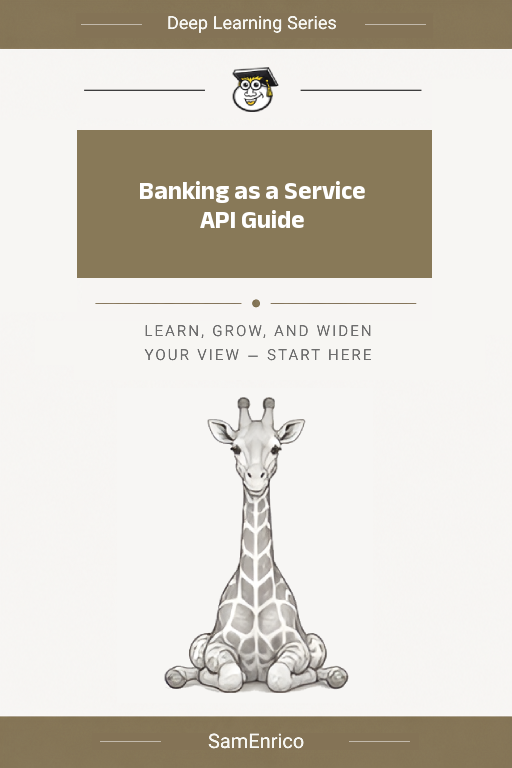
Non-FictionForecast & OutlookBaaS
Banking as a Service API Guide eBook
Explore how non-banks embed financial products thr
by Galvez Dian
Explore how non-banks embed financial products through API platforms offering white-labeled accounts, cards, and lending.
Formats
Free sample
Chapter 1: The $50 Million Mistake...--The fastest way to fail in Banking as a Service is to start by building a bank.I have watched this happen more than thirty times. A well-funded fintech founder, a seasoned Saa S executive, or a product leader at a major retailer decides that the path to embedded finance requires a bank charter. They raise capital. They hire compliance officers. They file applications with the OCC or their state banking department.
Eighteen months later, they have spent $50 million, they still do not have a live product, and their investors are asking uncomfortable questions.Meanwhile, a competitor who started with a sponsor bank and an API launched in eleven weeks.This chapter dismantles the single most expensive misconception in embedded finance: that you need to become a bank to offer banking products. You do not. The entire premise of Banking as a Service is that non-banks can embed financial products—accounts, cards, lending—through API platforms that sit atop regulated bank charters. The bank owns the license and the capital requirements. You own the customer and the experience.
The API is the contract between you.But here is where most founders get trapped. They confuse the what with the how. They understand that Baa S is possible, but they misunderstand which role they should play in the ecosystem. They read about Synapse and think "I need more control." They hear about sponsor bank terminations and think "I need my own license." They raise their Series B with a slide that says "Becoming a bank" as if that were a feature, not a funeral.This book exists because of that confusion. And it exists because of May 11, 2023—the day Synapse filed for bankruptcy and over one hundred fintechs discovered that their customers' money had vanished.
Not stolen. Not hacked. Vanished. The API returned "200 OK" on every transaction. The apps showed correct balances.
But the sponsor bank's ledger said something else entirely.The survivors of that collapse were not the ones with bank charters. They were the ones who understood the stack: where the bank ends, where the platform begins, and where the API actually lives. They had read the contracts. They had audited the reconciliation logic. They knew, with contractual certainty, who owned the customer, who held the funds, and who bore the liability when the numbers disagreed.This chapter gives you that same foundation.The Three-Word Test That Reveals Everything Before we go anywhere, I want you to answer one question about your business.
Write it down. Remember it. Because by the end of this chapter, you will either confirm your answer or realize you are about to make a $50 million mistake.The question is: Who is your customer?Not your user. Not your account holder. Your customer—the entity that pays you money, that you have a direct contractual relationship with, and that you would sue or be sued by if things went wrong.Here is why this question matters.
In Baa S, there are three distinct answers, and each one corresponds to a completely different business model, regulatory burden, and API architecture.Answer one: The end user is my customer. You are building a direct-to-consumer neobank. You collect KYC. You handle support. You own the brand relationship.
This is Chime, Current, Varo. You need a sponsor bank or a charter.Answer two: The business is my customer. You are building Baa S infrastructure. Your customers are fintechs and Saa S platforms. You provide the APIs that let them offer banking products.
This is Unit, Synctera, Treasury Prime. You are the middleware.Answer three: The platform is my customer, but my user is their user. You are a Saa S platform adding embedded finance. Your customer is the business paying for your Saa S. Their customers are the end users of the banking product.
This is Shopify Balance, Toast Capital, Lyft Direct. You are the distributor.If you cannot answer this question in one sentence, you are not ready to evaluate a single vendor, sign a single contract, or write a single line of API integration code.The entire structure of this book follows from your answer. If you are answer one (direct neobank), you will spend most of your time in Chapters 4 through 7, because your core competency is ledgering and card issuing. If you are answer two (Baa S infrastructure), you need to read Chapters 8 and 9 twice, because your compliance burden is existential. If you are answer three (Saa S platform adding embedded finance), start with Chapters 2 and 3, because your primary challenge is white-labeling a bank's compliance into your brand experience.But regardless of your answer, you must understand the full stack.
Because the $50 million mistake happens when you think you are answer one, you try to become answer two, and you end up as answer none.The Three Stakeholders: Who Does What Every Baa S arrangement has exactly three stakeholders. Not two. Not four. Three. If someone tries to sell you a "full stack solution" that claims to replace one of these roles, run.
They are either lying or about to go bankrupt.Stakeholder one: The Sponsor Bank. This is the regulated entity. It holds the bank charter, the capital reserves, and the ultimate legal liability for deposits. The sponsor bank owns the master ledger—the source of truth for every dollar in the system. It is responsible for FDIC pass-through insurance, for complying with anti-money laundering regulations, and for filing Suspicious Activity Reports with Fin CEN.
You cannot outsource this. You cannot API your way around this. The sponsor bank is the bank.Notable sponsor banks in Baa S include Evolve Bank & Trust (before Synapse), Blue Ridge Bank, Cross River Bank, and Webster Bank. Each has a different risk appetite, different fee structure, and different tolerance for fintech weirdness.Stakeholder two: The Baa S Platform. This is the API layer.
It connects the sponsor bank's core banking system (usually a mainframe running COBOL) to modern REST APIs. The Baa S platform may also hold funds in trust, manage sub-ledgers, and perform first-line compliance screening. But critically, the Baa S platform is not a bank. It does not have a charter. It does not have FDIC insurance.
It can—and in the case of Synapse, did—go bankrupt without triggering bank resolution procedures.The terminology here matters. In earlier drafts of this book, we used the word "middleware" to describe this role. That was imprecise. There are actually three distinct sub-roles, as we will cover in Chapter 2. For now, understand that the Baa S platform is the translation layer between modern software and ancient banking infrastructure.Stakeholder three: The Distributor.
This is the brand the customer actually sees. It might be a neobank like Mercury. It might be a Saa S platform like Shopify. It might be a retailer like Walmart. The distributor collects KYC information, handles customer support, designs the user experience, and owns the relationship.
The distributor is not a bank and should not pretend to be one. But the distributor is the entity that the customer trusts with their money.Here is the tension that drives the entire Baa S industry: the distributor wants to own the customer. The sponsor bank…
This is the end of the free sample. Get the eBook to keep going. Buy now
About this book
Details
- Author
- Galvez Dian
- Publisher
- SamEnrico
- Language
- English
- Genre
- Non-Fiction, Forecast & Outlook, BaaS
- Released
- 2026-06-01
- Pages (approx.)
- 147
- Available as
- eBook, Audiobook

Read better in the ZLOADR app
Your eBooks on your phone or tablet. Sign in with your SamEnrico account and start reading.
More by Galvez Dian
 Anger And Child's Social Media UseGalvez Dian$11.99
 Brand Ranking Emerging Market PulseGalvez Dian$11.99
 PNE for First RespondersGalvez Dian$11.99
 Self Care Time Blocking GuideGalvez Dian$11.99
 The Last Pharaoh's Gambit: Cleopatra’s Unseen Gambit in the Roman SenateGalvez Dian$11.99
 Water SkiGalvez Dian$11.99
 Benefits Gap Portfolio ManualGalvez Dian$12.99
 How to Become a Chemical-etching ProcessorGalvez Dian$11.99
 Understanding HyperoxaluriaGalvez Dian$17.99
You may also like
 Hong Kong Handover 1997Dunn Johnnie$11.99
 Zumba For Postnatal Recovery CourseNeal Christian$11.99
 Zumba for BeginnersLadner Nikia$11.99
 YouTube Comment Mining GuideHumes Pandora$12.99
 Worry Box MeditationCarlin Rudy$11.99
 Workplace Stress MeditationNguyen Lynn$11.99
 Workplace Stress and Sleep RepairHawley Ivory$11.99
 Workplace Perfectionism CureDelaney Jeffry$11.99
 Workplace Injustice Anger GuideWallen Isabelle$11.99
 Work Addiction and Burnout LinkGreenwood Ester$11.99
 Women in Yoga and WellnessBeattie Galina$11.99
 Women in Stand Up ComedyChun Evangeline$11.99