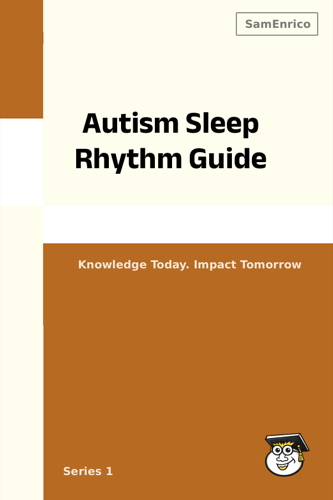
Autism Sleep Rhythm Guide
Manage circadian disruption common in autism spect
Manage circadian disruption common in autism spectrum disorders.
Formats
About this book
Free sample
Chapter 1: The 4 AM Puzzle--–- It is 4:17 in the morning. The house is silent except for the soft hum of the refrigerator and the distant thrum of a passing car. You have been awake for over an hour, not because of insomnia, but because your child is standing at the foot of your bed, fully dressed for school, carrying a stuffed animal, and asking for breakfast. Their eyes are wide open, not groggy, not confused—alert, present, and genuinely unaware that the rest of the world considers this the middle of the night. You check the clock again, hoping you misread it.
You did not. This is the fourth night this week. You are exhausted. Your child will be exhausted by 10 AM, leading to a cascade of meltdowns, sensory seeking, and rigid thinking that will make the school day nearly impossible. And yet, when you try to move bedtime earlier tonight, your child will lie in the dark, staring at the ceiling, unable to sleep until 1 or 2 AM.
The pediatrician called it "behavioral insomnia" and suggested stricter routines. The neurologist prescribed melatonin, which worked for three nights and then stopped. The behavioral therapist blamed anxiety. The school blamed inconsistent parenting. No one has given you a single answer that explains why this keeps happening, night after night, despite your best efforts.This book begins with that 4 AM moment because it is the most misunderstood experience in autism sleep medicine.
It is not defiance. It is not poor parenting. It is not anxiety alone. It is not even primarily insomnia in the way most doctors understand it. That 4 AM wakefulness—combined with the inability to fall asleep at a socially acceptable hour—is the signature of a broken internal clock.
And that broken clock is not a metaphor. It is a biological reality rooted in the neurobiology of autism spectrum disorder.For decades, the medical establishment treated sleep problems in autism as secondary to behavioral challenges, anxiety, or medical comorbidities like reflux or allergies. Parents were told to be more consistent, to use stricter boundaries, to eliminate screen time, to try lavender…
This is the end of the free sample. Get the eBook to keep going. Buy now
Contents
- Chapter 1
- Chapter 2
- Chapter 3
- Chapter 4
- Chapter 5
- Chapter 6
- Chapter 7
- Chapter 8
- Chapter 9
- Chapter 10
- Chapter 11
- Chapter 12
Details
- Author
- Courtney Trena
- Publisher
- SamEnrico
- Language
- English
- Genre
- Non-Fiction, Health & Wellness, Autism
- Released
- 2026-06-09
- Pages (approx.)
- 152
- Available as
- eBook, Audiobook

Read better in the ZLOADR app
Your eBooks on your phone or tablet. Sign in with your SamEnrico account and start reading.
More by Courtney Trena
 Unexpected Departure Social Media ResponseCourtney Trena$11.99
 Cannabis Use Disorder VeteransCourtney Trena$11.99
 Pre Talk Nutrition PlanCourtney Trena$11.99
 SAA Meeting Navigation GuideCourtney Trena$11.99
 Binge Eating In LGBTQ Community GuideCourtney Trena$11.99
 Medication Reduction MeditationCourtney Trena$11.99
 FTC Civil Penalty Adjustment GuideCourtney Trena$11.99
 Spouse Death and PTSDCourtney Trena$11.99
 The Silent Architect: How a Forgotten Woman Shaped the Modern WorldCourtney Trena$11.99
 The Battle of Kadesh: The First Great Clash of EmpiresCourtney Trena$11.99
 How to Produce BallastsCourtney Trena$11.99
 Growing ChamaedoreaCourtney Trena$11.99