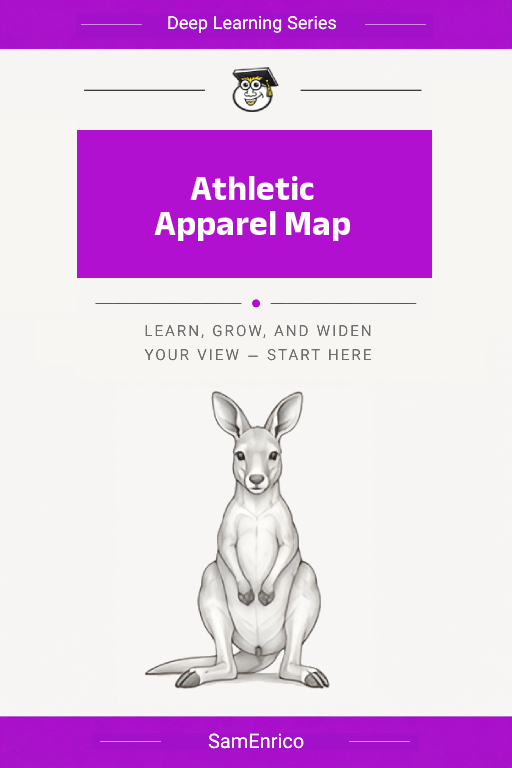
Athletic Apparel Map eBook
Plot Nike, Adidas, Lululemon, and Under Armour on
Plot Nike, Adidas, Lululemon, and Under Armour on performance technology versus lifestyle appeal.
Formats
Free sample
Chapter 1: The Swoosh Paradox...--–- Phil Knight, the co-founder of Nike, once said that the company’s greatest invention was not the waffle sole, the Air cushion, or even the Flyknit loom. It was the idea that a sneaker could be both a precision instrument and a cultural artifact. In 1972, when the first Nike shoes arrived from Japan in gray cardboard boxes, they were purely functional objects designed for runners who cared about ounces and heel counters. Fifty years later, the same brand sells a $40,000 pair of Air Jordans at auction—shoes that will never touch a basketball court, let alone a dusty driveway in Chicago. This transformation from tool to trophy is the central paradox of modern athletic apparel, and no brand embodies it more dramatically than Nike.The story of the sportswear industry is often told as a series of product innovations: the zipper, nylon, spandex, Gore-Tex, Dri-FIT, Boost, Zoom X.
But those are merely the visible surface of a much deeper current. Beneath the fabrics and foams lies a psychological engine that has quietly hijacked the global apparel market. Consumers no longer buy athletic clothing primarily for athletics. According to the 2025 Spend per Category data presented in the appendix of this book, sixty percent of all athletic apparel spending now goes toward lifestyle products—leggings worn to coffee shops, sneakers worn to office desks, hoodies worn to grocery stores. Only forty percent purchases true performance gear for actual training, running, or competition.This is not a market shift.
It is a market inversion.The four titans of the industry—Nike, Adidas, Lululemon, and Under Armour—have responded to this inversion in radically different ways. Nike has tried to be both everything and everywhere, spending over one billion dollars annually on research and development while simultaneously leaning into the retro sneaker market. Adidas has largely surrendered the performance war to focus on street culture, betting that the Samba and the Gazelle will outlive any carbon-plated marathon shoe. Lululemon has built an empire on the soft, quiet spaces between workouts, selling not leggings but a state of being. And Under Armour, the purest performance player of them all, has been left standing in the corner of the gym, holding the most advanced sweat-wicking fabric that no one wants to wear to brunch.This chapter is about the first of those four brands.
It is about the Swoosh Paradox: how the world's most valuable athletic brand became dependent on its own past, how it uses elite athletes as halo bearers to sell nostalgia, and whether this strategy can survive the rise of specialists like On and Hoka. The answer, as we will see, depends entirely on which tier of performance you are talking about.The Three Tiers of Athletic Performance Before we can understand Nike's position on the map, we must introduce a distinction that most industry analysis blurs beyond recognition. Athletic performance is not a single spectrum from "bad" to "good." It is a series of tiers, each with its own consumers, its own economics, and its own competitive dynamics. Confusing these tiers has led to countless strategic errors—including, as we will see in Chapter 4, the near-collapse of Under Armour.The first tier is Elite Performance. This is the world of world-record holders, Olympic medalists, professional athletes in the NFL, NBA, Premier League, and Serie A.
These consumers—if they can be called consumers at all, since they rarely pay for their gear—require the absolute pinnacle of materials science. A marathon shoe for Eliud Kipchoge must shave seconds off a two-hour race. A basketball shoe for Le Bron James must withstand forces equivalent to a car crash. The Elite tier is tiny in volume—perhaps a few thousand athletes globally—but enormous in symbolic value. When Nike signs Faith Kipyegon or Adidas signs Lionel Messi, they are not trying to sell shoes to those athletes.
They are buying a halo.The second tier is Serious Amateur Performance. This is the high school state champion, the weekend warrior training for a Boston Marathon qualifying time, the Cross Fit athlete who can actually do a muscle-up, the recreational soccer player who still wears shin guards. These consumers pay for their own gear, and they pay attention to technology. They read reviews on Runner's World. They watch You Tube breakdowns of carbon plate geometry.
They can tell you the difference between Nike's Zoom X foam and Adidas's Boost. This tier is small but influential—perhaps ten to fifteen million globally. And it is the tier where brand loyalty is most fragile.The third tier is Casual Performance. This is the person who goes to the gym twice a week, jogs a fifteen-minute mile, owns a pair of leggings that have never been washed on the delicate cycle, and wears a hoodie to the grocery store because it is comfortable. This tier is enormous—hundreds of millions globally—and it drives the sixty percent lifestyle spending figure cited earlier.
Casual consumers do not read reviews. They buy what looks good, what feels good, and what signals the identity they want to project.Here is the critical insight that most industry analysis misses: Nike dominates Elite and Casual performance but is losing Serious Amateur performance to On and Hoka. The threat to Nike is not that On will sign the next Kipyegon—elite athletes remain loyal to the Swoosh. The threat is that the serious amateurs, the influencers of the running world, are defecting. And when serious amateurs defect, casuals eventually follow.
The halo works both ways.The Billion-Dollar Paradox Nike spends over one billion dollars annually on research and development. That figure is not marketing hype—it is verifiable from public financial disclosures. A billion dollars buys a lot of engineering. It buys the "Anti-Gravity" midsole, Nike's code name for the next-generation Zoom X foam that returns more energy than any material in the company's history. It buys the Vomero Premium, a shoe that adapts cushioning in real-time to stride length, surface texture, and fatigue level.
It buys an entire building in Beaverton, Oregon, filled with Ph Ds in biomechanics, material science, and even neuroscience—because Nike now studies how the brain responds to different levels of cushioning.And yet.The company's most profitable products are retro sneakers. The Air Jordan 1, a design from 1985. The Dunk, a design from 1985. The Air Force 1, a design from 1982. These shoes cost Nike very little to develop—the R&D was amortized decades ago.
They cost very little to manufacture—the tooling is mature, the supply chains are optimized. And they sell for premium prices, often well above their original retail value on the secondary market. In 2024, a pair of 1985 Air Jordans in original packaging sold at Sotheby's for $40,000.This is the paradox: Nike is a technology company that makes most of its money selling the past.The retro strategy is not an accident. It is a deliberate choice, driven by the same financial logic that guides every public company. Retro sneakers have gross margins that exceed seventy percent—far higher than the fifty percent margins of performance running shoes.
Wall Street loves retro because retro generates cash. And cash, in the quarterly earnings game, is king.But retro has a…
This is the end of the free sample. Get the eBook to keep going. Buy now
About this book
Details
- Author
- Mayfield Philomena
- Publisher
- SamEnrico
- Language
- English
- Genre
- Non-Fiction, Strategic Atlas, Apparel
- Released
- 2026-05-30
- Pages (approx.)
- 144
- Available as
- eBook, Audiobook

Read better in the ZLOADR app
Your eBooks on your phone or tablet. Sign in with your SamEnrico account and start reading.
More by Mayfield Philomena
 The Assertiveness for Military Personnel GuideMayfield Philomena$11.99
 The Constraint CompassMayfield Philomena$11.99
 Walk Away Protocol GuideMayfield Philomena$11.99
 Morning Calm RitualMayfield Philomena$11.99
 The Postpartum Body Image WorkbookMayfield Philomena$11.99
 The Copycat Murders of Rotterdam: A City on EdgeMayfield Philomena$11.99
 Understanding PhenylalaninemiaMayfield Philomena$17.99
 Pivot Planning from One Page PlanMayfield Philomena$12.99
 The Women's Suffrage Movement: 100 Years LaterMayfield Philomena$11.99
 A Beginners Guide to Fictionary (related to the commercial Balderdash) (Volume 1)Mayfield Philomena$11.99