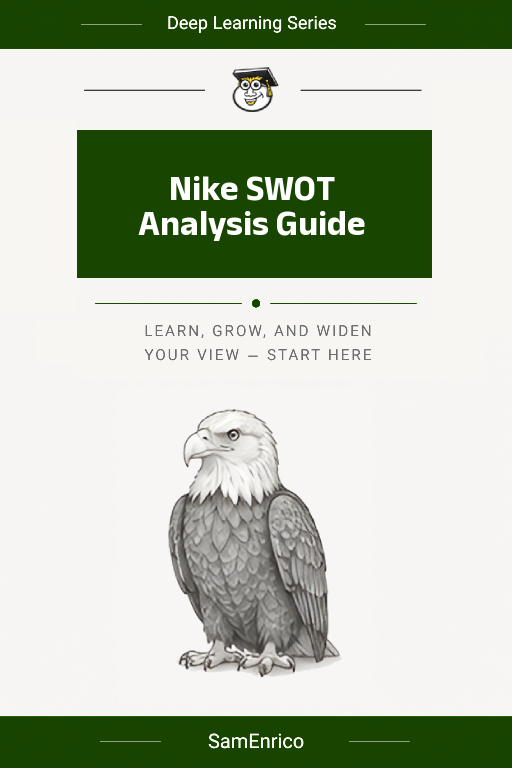
Nike SWOT Analysis Guide
Assess brand strength, direct-to-consumer shift, s
by Elliot Vena
Assess brand strength, direct-to-consumer shift, supply chain disruption, and competition from On and Hoka.
Formats
About this book
Free sample
Chapter 1: The $28 Billion Blindspot...--The news arrived like most bad news does: not with a bang, but with a spreadsheet.On December 20, 2021, Nike’s stock closed at an all-time high of 177.51pershare.Thecompanyhadjustreportedrecordrevenueof177.51 per share. The company had just reported record revenue of 177.51pershare.Thecompanyhadjustreportedrecordrevenueof44.5 billion for fiscal year 2021. The Swoosh seemed invincible. Analysts used words like “moat,” “juggernaut,” and “generational wealth compounder.” Phil Knight, the co-founder who had turned a $50 bet on Japanese running shoes into a global empire, was still celebrated as a visionary. Everything looked perfect.And yet, beneath that gleaming surface, the first cracks were already forming.By early 2025, Nike would lose approximately 28billioninmarketcapitalization.Thestockwouldtradebelow28 billion in market capitalization.
The stock would trade below 28billioninmarketcapitalization.Thestockwouldtradebelow100. The company would announce layoffs, inventory write-downs, and a dramatic strategic pivot under a new CEO. Meanwhile, two brands that barely existed in the American consciousness a decade earlier—Hoka and On—would be eating Nike’s lunch, stealing its shelf space, and, more painfully, its cultural relevance.This book is the story of that collapse. But it is not a story about sneakers.It is a story about how dominant brands break. Not quickly.
Not dramatically. Not because of a single disastrous product launch or a scandalous tweet. They break slowly, quietly, through a series of seemingly rational decisions that, when viewed in isolation, made perfect sense. Inventory management. Channel strategy.
Product mix optimization. These are the weapons of self-destruction, and Nike wielded them with surgical precision.This chapter establishes the foundation for everything that follows: the unified timeline of Nike’s fall, the three silent signals that the market saw before the headlines hit, and the structural distinction between a temporary slump and a permanent breakdown. If you understand this chapter, you will understand why the next eleven chapters matter—and why the lessons here apply far beyond the world of athletic footwear.The Anatomy of a Quiet Collapse Before we examine Nike’s specific missteps, we need a framework for understanding how dominant brands fail. This framework will recur throughout the book, so it is worth establishing it clearly here.Most people assume…
This is the end of the free sample. Get the eBook to keep going. Buy now
Contents
- Chapter 1
- Chapter 2
- Chapter 3
- Chapter 4
- Chapter 5
- Chapter 6
- Chapter 7
- Chapter 8
- Chapter 9
- Chapter 10
- Chapter 11
- Chapter 12
Details
- Author
- Elliot Vena
- Publisher
- SamEnrico
- Language
- English
- Genre
- Non-Fiction, Strategic Atlas, Apparel
- Released
- 2026-05-26
- Pages (approx.)
- 136
- Available as
- eBook, Audiobook

Read better in the ZLOADR app
Your eBooks on your phone or tablet. Sign in with your SamEnrico account and start reading.
More by Elliot Vena
 Senior Learning Esteem GuideElliot Vena$11.99
 Healthcare Professional EQElliot Vena$11.99
 Candle Flame FocusElliot Vena$11.99
 Measles Resurgence EpidemicElliot Vena$11.99
 Self Esteem for New Relationship AnxietyElliot Vena$11.99
 The Golden Equations: Black Nobel Laureates Who Shaped the SciencesElliot Vena$11.99
 Understanding Muscular Dystrophy Limb-girdle With Beta-sarcoglycan DeficiencyElliot Vena$17.99
 AI Financial Data Quality GuideElliot Vena$12.99
 How to Start a Central Sterile Supply Department (public Sector) Business (Beginners Guide)Elliot Vena$11.99
 Yard MarshalElliot Vena$11.99