
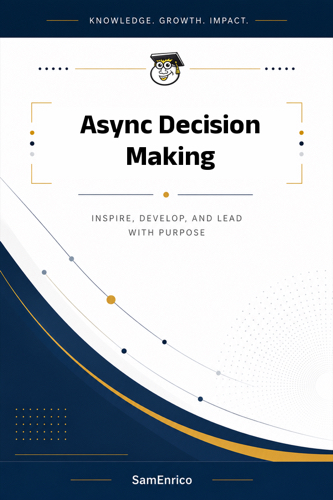
Non-FictionSelf-HelpDecision Making
Async Decision Making eBook
Reach consensus without real time meetings using s
by Daniel Tanya
Reach consensus without real time meetings using shared documents.
Formats
Free sample
Chapter 1: The Meeting Debt--–- Maya’s calendar looked like a crime scene. On Monday morning, she counted forty-seven meetings across her twelve-person product team for the upcoming week. Forty-seven. That was down from fifty-two the month before, after she had bravely canceled five recurring “syncs” that no one could explain. The victory had lasted approximately three days.
New meetings had sprouted in their place like weeds. There was the daily standup (thirty minutes, twelve people, three of whom spoke). There was the weekly product review (ninety minutes, fourteen people including two “optional” attendees who never missed a single minute). There was the cross-functional alignment (sixty minutes, nine people, no agenda). There was the design critique (forty-five minutes, seven people, one designer presenting to six people whose only contribution was “have you considered a dropdown?”).
And then there were the emergency meetings. The “quick syncs.” The “can you hop on a quick call?” invitations that arrived via Slack at 11:47 AM, demanding an answer by noon.Maya was not unusual. She was not incompetent. She was not a martyr. She was, by every measurable standard, an above-average manager at a mid-sized technology company that prided itself on “collaboration.” The problem was that collaboration had become synonymous with real-time conversation.
And real-time conversation had become synonymous with meetings. And meetings had become synonymous with the slow, invisible, compounding death of productivity.This chapter is about the first step out of that nightmare. Before you can fix asynchronous decision-making, you have to understand what synchronous decision-making is costing you. Not in vague terms like “wasted time” or “burnout.” In hard, calculable, spreadsheet-able numbers. This chapter introduces the concept of Meeting Debt, provides a framework for calculating your team’s true meeting costs, and makes the empirical case for why defaulting to documents creates better outcomes.
By the end of this chapter, you will never look at a meeting invitation the same way again.The Hidden Calculus of Real-Time Decisions Let us define three terms that will appear throughout this book. These are not metaphors. They are measurable economic phenomena.Context switching is the cognitive cost of moving between tasks. Every time you interrupt a knowledge worker to ask a question, pull them into a meeting, or even ping them on Slack, you impose a tax. The scientific literature on this is overwhelming and remarkably consistent: after an interruption, it takes an average of twenty-three minutes and fifteen seconds to return to full cognitive focus on the original task.
Not two minutes. Not five. Twenty-three. This means that a single fifteen-minute meeting does not cost fifteen minutes. It costs fifteen minutes for the meeting, plus twenty-three minutes to recover before the meeting (because you knew it was coming, so you didn’t start anything deep), plus twenty-three minutes after the meeting to rebuild your focus.
That is sixty-one minutes for a fifteen-minute meeting. This is not opinion. This is the work of Gloria Mark at the University of California, Irvine, who has studied attention fragmentation for two decades.Meeting debt is the compounding interest of every live conversation that should have been a document. Like financial debt, meeting debt accrues interest over time. When you have a meeting to make a decision, you do not actually make the decision in the meeting.
What you do is talk about the decision, produce a set of ambiguous verbal agreements, assign action items to people who may or may not remember them, and then schedule a follow-up meeting to “close the loop.” The interest payments on that meeting include: the time spent writing notes (if anyone takes notes), the time spent chasing down what was actually agreed, the time spent correcting misunderstandings, the time spent in the follow-up meeting, and the time spent in the follow-up to the follow-up. Maya’s team had a meeting about a pricing change that generated seven follow-up meetings over three weeks. The original meeting was forty-five minutes. The total meeting debt was eleven hours. The decision was ultimately reversed anyway.Recency bias is the psychological tendency to give disproportionate weight to the last thing you heard.
In a meeting, the person who speaks last often wins, regardless of the quality of their argument. This is not because meetings are filled with idiots. It is because human memory is fragile and social pressure is strong. When a senior leader says “I’m not sure about this” in the final two minutes of a meeting, that sentence carries more weight than the thirty minutes of careful analysis that preceded it. Meetings reward the confident, the verbose, and the physically present.
They punish the thoughtful, the introverted, and the time-zoned.These three forces—context switching, meeting debt, recency bias—combine to create a system that produces worse decisions at higher cost than almost any alternative. But because meetings feel like work, and because the costs are invisible, most organizations never question the default.The Wide-Band Communication Advantage Let us compare two ways of communicating the same information. The information is a proposal to change the company’s customer support hours from 9 AM to 6 PM to 10 AM to 7 PM. The proposal includes: a customer survey (n=847), an analysis of peak call volumes, a cost projection for overtime pay, and a competitive benchmark of four similar companies.Scenario A: The Meeting. Maya schedules a one-hour meeting with ten stakeholders: support leads, finance, HR, product, and the head of operations.
The meeting takes sixty minutes. Four of the ten attendees are multitasking (checking email, Slack, or both). Two arrive five minutes late. One leaves ten minutes early because of a conflict. The head of operations speaks for fifteen minutes about a unrelated topic.
The support lead presents the data, but someone interrupts with a question about the survey methodology, and the presentation goes off track. By minute fifty-five, Maya summarizes: “So we’re agreed on shifting to 10 to 7?” Nods around the table. The meeting ends. The next day, three people email Maya saying they actually disagreed. The head of finance sends a Slack message: “Wait, did we approve the overtime budget for this?
I don’t recall that conversation.” The total person-minutes for the meeting: ten people × sixty minutes = six hundred person-minutes, or ten person-hours. The effective information transfer (what people actually remember and act upon correctly) is estimated at roughly forty percent.Scenario B: The Document. Maya writes a one-page D-Doc (Decision Document) using the template we will introduce in Chapter 2. The document includes: a two-sentence executive summary, the specific proposal (“I propose that we shift customer support hours from 9-6 to 10-7”), three alternatives considered, the key customer data (summarized), and a section on disconfirming evidence. She shares the document with the same ten stakeholders, gives them forty-eight hours to comment, and asks specific questions in callout boxes: “Finance: does the overtime budget support this?” and “Support leads: what is the expected impact on morning coverage?” Each stakeholder spends an average of eight minutes reading the document and leaving comments.
Total person-minutes: ten people × eight minutes = eighty person-minutes, or one point three person-hours. The effective information transfer is estimated at eighty-five percent, because each person reads at their own pace, can revisit unclear…
This is the end of the free sample. Get the eBook to keep going. Buy now
About this book
Details
- Author
- Daniel Tanya
- Publisher
- SamEnrico
- Language
- English
- Genre
- Non-Fiction, Self-Help, Decision Making
- Released
- 2026-06-09
- Pages (approx.)
- 139
- Available as
- eBook, Audiobook

Read better in the ZLOADR app
Your eBooks on your phone or tablet. Sign in with your SamEnrico account and start reading.
More by Daniel Tanya
 Small Talk for Parents at SchoolDaniel Tanya$11.99
 The Mayor of Little SaigonDaniel Tanya$11.99
 No Meeting Wednesday ImplementationDaniel Tanya$11.99
 IBS Elmiron Eluxadoline GuideDaniel Tanya$11.99
 Ultimate Handbook Guide to Shenzhen : (China) Travel GuideDaniel Tanya$11.99
 The Lost World of Borneo: Alfred Russel Wallace and the Birth of Evolutionary ScienceDaniel Tanya$11.99
 Bread or Blood: The Great Minnesota Uprising of 1916Daniel Tanya$11.99
 Lean Production SchedulingDaniel Tanya$12.99
 Paga YC Application GuideDaniel Tanya$12.99
 Vans Retail Assistant Store ManagerDaniel Tanya$11.99
You may also like
 Hong Kong Handover 1997Dunn Johnnie$11.99
 Zumba For Postnatal Recovery CourseNeal Christian$11.99
 Zumba for BeginnersLadner Nikia$11.99
 YouTube Comment Mining GuideHumes Pandora$12.99
 Worry Box MeditationCarlin Rudy$11.99
 Workplace Stress MeditationNguyen Lynn$11.99
 Workplace Stress and Sleep RepairHawley Ivory$11.99
 Workplace Perfectionism CureDelaney Jeffry$11.99
 Workplace Injustice Anger GuideWallen Isabelle$11.99
 Work Addiction and Burnout LinkGreenwood Ester$11.99
 Women in Yoga and WellnessBeattie Galina$11.99
 Women in Stand Up ComedyChun Evangeline$11.99