
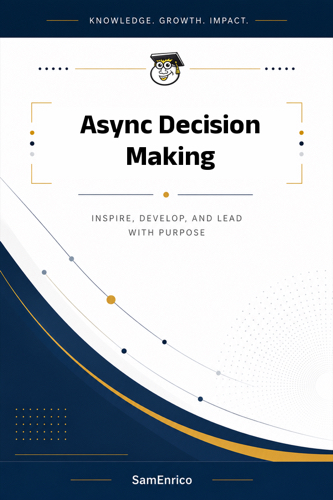
Non-FictionSelf-HelpDecision Making
Async Decision Making
Reach consensus without real time meetings using s
by Daniel Tanya
Reach consensus without real time meetings using shared documents.
Formats
About this book
Free sample
Chapter 1: The Meeting Debt--–- Maya’s calendar looked like a crime scene. On Monday morning, she counted forty-seven meetings across her twelve-person product team for the upcoming week. Forty-seven. That was down from fifty-two the month before, after she had bravely canceled five recurring “syncs” that no one could explain. The victory had lasted approximately three days.
New meetings had sprouted in their place like weeds. There was the daily standup (thirty minutes, twelve people, three of whom spoke). There was the weekly product review (ninety minutes, fourteen people including two “optional” attendees who never missed a single minute). There was the cross-functional alignment (sixty minutes, nine people, no agenda). There was the design critique (forty-five minutes, seven people, one designer presenting to six people whose only contribution was “have you considered a dropdown?”).
And then there were the emergency meetings. The “quick syncs.” The “can you hop on a quick call?” invitations that arrived via Slack at 11:47 AM, demanding an answer by noon.Maya was not unusual. She was not incompetent. She was not a martyr. She was, by every measurable standard, an above-average manager at a mid-sized technology company that prided itself on “collaboration.” The problem was that collaboration had become synonymous with real-time conversation.
And real-time conversation had become synonymous with meetings. And meetings had become synonymous with the slow, invisible, compounding death of productivity.This chapter is about the first step out of that nightmare. Before you can fix asynchronous decision-making, you have to understand what synchronous decision-making is costing you. Not in vague terms like “wasted time” or “burnout.” In hard, calculable, spreadsheet-able numbers. This chapter introduces the concept of Meeting Debt, provides a framework for calculating your team’s true meeting costs, and makes the empirical case for why defaulting to documents creates better outcomes.
By the end of this chapter, you will never look at a meeting invitation the same way again.The Hidden Calculus of Real-Time Decisions Let us define three terms that will appear throughout this book. These are not metaphors. They are measurable economic phenomena.Context switching is the cognitive cost…
This is the end of the free sample. Get the eBook to keep going. Buy now
Contents
- Chapter 1
- Chapter 2
- Chapter 3
- Chapter 4
- Chapter 5
- Chapter 6
- Chapter 7
- Chapter 8
- Chapter 9
- Chapter 10
- Chapter 11
- Chapter 12
Details
- Author
- Daniel Tanya
- Publisher
- SamEnrico
- Language
- English
- Genre
- Non-Fiction, Self-Help, Decision Making
- Released
- 2026-06-09
- Pages (approx.)
- 139
- Available as
- eBook, Audiobook

Read better in the ZLOADR app
Your eBooks on your phone or tablet. Sign in with your SamEnrico account and start reading.
More by Daniel Tanya
 Small Talk for Parents at SchoolDaniel Tanya$11.99
 The Mayor of Little SaigonDaniel Tanya$11.99
 No Meeting Wednesday ImplementationDaniel Tanya$11.99
 IBS Elmiron Eluxadoline GuideDaniel Tanya$11.99
 Ultimate Handbook Guide to Shenzhen : (China) Travel GuideDaniel Tanya$11.99
 The Lost World of Borneo: Alfred Russel Wallace and the Birth of Evolutionary ScienceDaniel Tanya$11.99
 Bread or Blood: The Great Minnesota Uprising of 1916Daniel Tanya$11.99
 Lean Production SchedulingDaniel Tanya$12.99
 Paga YC Application GuideDaniel Tanya$12.99
 Vans Retail Assistant Store ManagerDaniel Tanya$11.99
You may also like
 Hong Kong Handover 1997Dunn Johnnie$11.99
 Zumba For Postnatal Recovery CourseNeal Christian$11.99
 Zumba for BeginnersLadner Nikia$11.99
 YouTube Comment Mining GuideHumes Pandora$12.99
 Worry Box MeditationCarlin Rudy$11.99
 Workplace Stress MeditationNguyen Lynn$11.99
 Workplace Stress and Sleep RepairHawley Ivory$11.99
 Workplace Perfectionism CureDelaney Jeffry$11.99
 Workplace Injustice Anger GuideWallen Isabelle$11.99
 Work Addiction and Burnout LinkGreenwood Ester$11.99
 Women in Yoga and WellnessBeattie Galina$11.99
 Women in Stand Up ComedyChun Evangeline$11.99