
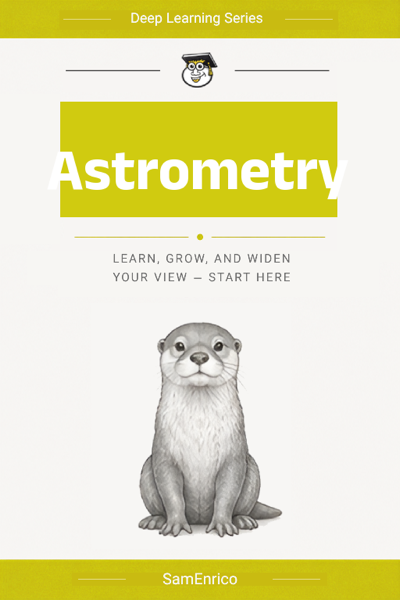
Non-FictionInformativeEducational
Astrometry eBook
A Coursebook on Astrometry
by See Jazmine
A Coursebook on Astrometry
Formats
Free sample
Chapter 1: The Stick That Measured the Universe...--It begins, as so many great journeys do, with a stick.Not a magical staff, not a sophisticated instrument of polished brass and crystal—just a simple, sun-bleached stick planted vertically in the sand. Around 240 BCE, in the bustling Egyptian city of Alexandria, a man named Eratosthenes drove such a stick into the ground. He waited for noon on the summer solstice, the day when the Sun stood highest in the sky. Then he measured the shadow. What he saw should have been unremarkable: a short shadow, indicating the Sun was nearly overhead.
But Eratosthenes knew something that no one else in his library had connected. Five hundred miles south, in the city of Syene (modern-day Aswan), another stick cast no shadow at all on the same day. At noon on the solstice, the Sun shone directly down a deep well, illuminating the water at the bottom. The Sun was perfectly vertical.How could that be? If the Earth were flat, two sticks at different locations would cast shadows in the same direction relative to the Sun.
They did not. Eratosthenes measured the angle of the shadow in Alexandria—about 7.2 degrees, or one-fiftieth of a full circle. He reasoned that this angle equaled the angular separation between the two cities on a spherical Earth. Multiplying the distance between Alexandria and Syene (approximately 800 kilometers, as measured by camel caravans) by fifty gave him the circumference of the Earth: roughly 250,000 stadia, or about 46,000 kilometers—remarkably close to the true value of 40,000 kilometers.With a stick, a shadow, and geometry, Eratosthenes became the first astrometrist. He measured the size of our world without leaving it.This is the story of astrometry: the oldest, quietest, and most revolutionary branch of astronomy.
It is not about building bigger telescopes to see farther. It is not about splitting light into rainbows to decode the chemistry of stars. Astrometry is simpler and more ancient than either of those. Astrometry is the science of measuring where things are on the celestial sphere—and, crucially, how they move.From that humble beginning, astrometry has given us every major revolution in our understanding of the cosmos: the proof that the Earth moves, the discovery that stars are not fixed, the first map of the Milky Way, the confirmation of Einstein's general relativity, the detection of black holes invisible to any telescope, and the ongoing search for Earth-like planets around other stars. All of this, from measuring positions.Why This Book Exists (And Why You Are Here)Before we plunge into spherical trigonometry, coordinate transformations, and the mind-bending precision of modern space observatories, let us be honest about something.
Astrometry has an image problem. To most amateur astronomers and even to many professional physicists, astrometry sounds like the dullest corner of astronomy. It conjures images of old men in wool vests measuring photographic plates with hand-cranked machines, muttering about proper motions in milliarcseconds per century. The term "astrometry" itself feels technical, bloodless, academic.Nothing could be further from the truth.The real story of astrometry is a detective story spanning two thousand years. It is a story about measuring the invisible.
Every chapter of this book will ask you to do something remarkable: deduce a hidden truth from a position measurement. In Chapter 6, you will deduce the distance to a star from its apparent wobble. In Chapter 10, you will deduce the mass of an invisible black hole from the wobble of its visible companion. In Chapter 12, you will deduce the orbit of a piece of space debris from three blurry photographs. Each time, the raw material is the same: a set of numbers representing angular positions on the sky.
Each time, the answer changes our understanding of the universe.This book is called Astrometry: A Coursebook on the Position and Motion of Celestial Bodies, but do not let the subtitle fool you. It is not a dry reference manual. It is a training manual for cosmic detection. By the time you finish these twelve chapters, you will be able to:Compute the distance to any star within a few thousand light-years using the same parallax method that took astronomers two thousand years to perfect Convert between time systems (UTC, TAI, TT) with the confidence of a professional observatory scheduler Correct your observations for the bending of starlight by Earth's atmosphere and by the Sun's gravity Determine the mass of a binary star system from its orbital motion Find an exoplanet hidden in astrometric data Navigate a spacecraft using nothing but star positions These are not theoretical exercises. Amateur astronomers today routinely perform reductions that would have impressed Tycho Brahe.
Students with a laptop and an internet connection can download Gaia data and discover previously unknown binary stars. The tools of astrometry are no longer locked in professional observatories. They are on your desk.The Arc from Arcminutes to Microarcseconds To appreciate the leap that astrometry has made, you must understand the scale of the numbers involved. We will spend this entire book swimming in angular measurements, so let us get comfortable with them now.A full circle contains 360 degrees. Each degree contains 60 arcminutes (symbol: ').
Each arcminute contains 60 arcseconds (symbol: "). If you hold your pinky finger at arm's length, it covers about one degree. The full Moon covers about half a degree, or 30 arcminutes. The planet Jupiter, at its largest, appears about 40 arcseconds across—roughly the size of a small coin seen from a kilometer away.Hipparchus, the greatest astronomer of antiquity, measured star positions to within about 10 arcminutes. That is better than the width of your finger at arm's length.
For a society with no telescopes, no clocks, and no printed star charts, this was a miracle of systematic observation.Tycho Brahe, working in the late 16th century without a telescope (but with enormous brass quadrants and sextants), improved that precision to about 1 arcminute. This does not sound like much—only ten times better than Hipparchus. But those 1-arcminute measurements were sharp enough for Johannes Kepler to deduce that planets move in ellipses, not perfect circles. Kepler's laws of planetary motion, published between 1609 and 1619, were the first direct evidence that the ancient Greek model of celestial perfection (circles upon circles) was wrong. They were also the first step toward Newton's theory of gravity.
All of this came from measuring positions ten times more accurately than before.The telescope arrived in 1609 (Galileo, though credit is contested). Within decades, astronomers were measuring positions to 10 arcseconds—six times better than Tycho. By the 19th century, with micrometers and transit circles, precision reached 1 arcsecond. By the 20th century, photographic plates pushed it to 0.1 arcseconds. The Hipparcos satellite, operating from 1989 to 1993, achieved 0.001 arcseconds (1 milliarcsecond) for the brightest stars.And then came Gaia.Launched by the European Space Agency in 2013, Gaia is currently mapping over 1.8 billion stars with a precision of 0.00002 arcseconds (20 microarcseconds) for the brightest ones.
To understand how small that is, imagine a Euro coin sitting on the surface of the Moon. From Earth, that coin appears about 50 microarcseconds across. Gaia can measure the position of a star to less than half the width of that coin. It can measure the parallax (the apparent shift due…
This is the end of the free sample. Get the eBook to keep going. Buy now
About this book
Details
- Author
- See Jazmine
- Publisher
- SamEnrico
- Language
- English
- Genre
- Non-Fiction, Informative, Educational
- Released
- 2026-05-08
- Pages (approx.)
- 131
- Available as
- eBook, Audiobook

Read better in the ZLOADR app
Your eBooks on your phone or tablet. Sign in with your SamEnrico account and start reading.
More by See Jazmine
 Vascular Health And Dementia LinkSee Jazmine$11.99
 Remote Collaboration TimeSee Jazmine$11.99
 Medical Assertiveness for PatientsSee Jazmine$11.99
 Lonely Night Shift WorkerSee Jazmine$11.99
 The Daily Creative ConstraintSee Jazmine$11.99
 The Silk Road of Cricket: How a 19th-Century British Officer Brought Cricket to the Middle EastSee Jazmine$11.99
 ECA for Canadian GraduatesSee Jazmine$12.99
 Founder Newsletter Pre LaunchSee Jazmine$12.99
 Learn to Play the Contrabassoon/double BassoonSee Jazmine$11.99
 How to Start a Phosphates (natural) Mining Business (Beginners Guide)See Jazmine$11.99
You may also like
 Hong Kong Handover 1997Dunn Johnnie$11.99
 Zumba For Postnatal Recovery CourseNeal Christian$11.99
 Zumba for BeginnersLadner Nikia$11.99
 YouTube Comment Mining GuideHumes Pandora$12.99
 Worry Box MeditationCarlin Rudy$11.99
 Workplace Stress MeditationNguyen Lynn$11.99
 Workplace Stress and Sleep RepairHawley Ivory$11.99
 Workplace Perfectionism CureDelaney Jeffry$11.99
 Workplace Injustice Anger GuideWallen Isabelle$11.99
 Work Addiction and Burnout LinkGreenwood Ester$11.99
 Women in Yoga and WellnessBeattie Galina$11.99
 Women in Stand Up ComedyChun Evangeline$11.99