
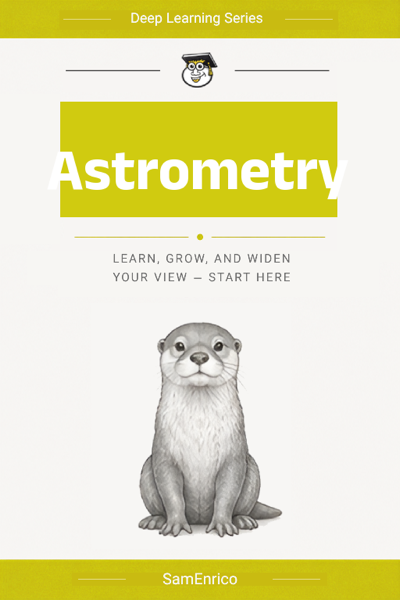
Non-FictionInformativeEducational
Astrometry Audiobook
A Coursebook on Astrometry
by See Jazmine
A Coursebook on Astrometry
Formats
Free sample
Chapter 1: The Stick That Measured the Universe...--It begins, as so many great journeys do, with a stick.Not a magical staff, not a sophisticated instrument of polished brass and crystal—just a simple, sun-bleached stick planted vertically in the sand. Around 240 BCE, in the bustling Egyptian city of Alexandria, a man named Eratosthenes drove such a stick into the ground. He waited for noon on the summer solstice, the day when the Sun stood highest in the sky. Then he measured the shadow. What he saw should have been unremarkable: a short shadow, indicating the Sun was nearly overhead.
But Eratosthenes knew something that no one else in his library had connected. Five hundred miles south, in the city of Syene (modern-day Aswan), another stick cast no shadow at all on the same day. At noon on the solstice, the Sun shone directly down a deep well, illuminating the water at the bottom. The Sun was perfectly vertical.How could that be? If the Earth were flat, two sticks at different locations would cast shadows in the same direction relative to the Sun.
They did not. Eratosthenes measured the angle of the shadow in Alexandria—about 7.2 degrees, or one-fiftieth of a full circle. He reasoned that this angle equaled the angular separation between the two cities on a spherical Earth. Multiplying the distance between Alexandria and Syene (approximately 800 kilometers, as measured by camel caravans) by fifty gave him the circumference of the Earth: roughly 250,000 stadia, or about 46,000 kilometers—remarkably close to the true value of 40,000 kilometers.With a stick, a shadow, and geometry, Eratosthenes became the first astrometrist. He measured the size of our world without leaving it.This is the story of astrometry: the oldest, quietest, and most revolutionary branch of astronomy.
It is not about building bigger telescopes to see farther. It is not about splitting light into rainbows to decode the chemistry of stars. Astrometry is simpler and more ancient than either of those. Astrometry is the science of measuring where things are on the celestial sphere—and, crucially, how they move.From that humble beginning, astrometry has given us every major revolution in our understanding of the cosmos: the proof that the Earth moves, the discovery that stars are not fixed, the first map of the Milky Way, the confirmation of Einstein's general relativity, the detection of black holes invisible to any telescope, and the ongoing search…
This is the end of the free sample. Get the Audiobook to keep going. Buy now
About this book
Details
- Author
- See Jazmine
- Publisher
- SamEnrico
- Language
- English
- Genre
- Non-Fiction, Informative, Educational
- Released
- 2026-05-08
- Pages (approx.)
- 131
- Available as
- eBook, Audiobook

Listen in the VoxFlicks app
Audiobooks and audio dramas wherever you go. Sign in with your SamEnrico account and press play.
More by See Jazmine
 Vascular Health And Dementia LinkSee Jazmine$11.99
 Remote Collaboration TimeSee Jazmine$11.99
 Medical Assertiveness for PatientsSee Jazmine$11.99
 Lonely Night Shift WorkerSee Jazmine$11.99
 The Daily Creative ConstraintSee Jazmine$11.99
 The Silk Road of Cricket: How a 19th-Century British Officer Brought Cricket to the Middle EastSee Jazmine$11.99
 ECA for Canadian GraduatesSee Jazmine$12.99
 Founder Newsletter Pre LaunchSee Jazmine$12.99
 Learn to Play the Contrabassoon/double BassoonSee Jazmine$11.99
 How to Start a Phosphates (natural) Mining Business (Beginners Guide)See Jazmine$11.99
You may also like
 Hong Kong Handover 1997Dunn Johnnie$11.99
 Zumba For Postnatal Recovery CourseNeal Christian$11.99
 Zumba for BeginnersLadner Nikia$11.99
 YouTube Comment Mining GuideHumes Pandora$12.99
 Worry Box MeditationCarlin Rudy$11.99
 Workplace Stress MeditationNguyen Lynn$11.99
 Workplace Stress and Sleep RepairHawley Ivory$11.99
 Workplace Perfectionism CureDelaney Jeffry$11.99
 Workplace Injustice Anger GuideWallen Isabelle$11.99
 Work Addiction and Burnout LinkGreenwood Ester$11.99
 Women in Yoga and WellnessBeattie Galina$11.99
 Women in Stand Up ComedyChun Evangeline$11.99