
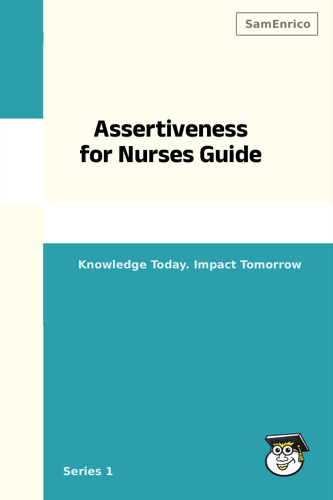
Assertiveness for Nurses Guide eBook
Advocate for patients and speak up to doctors usin
Advocate for patients and speak up to doctors using this practical healthcare guide.
Formats
Free sample
Chapter 1: The Hidden Epidemic--–- The moment that changed everything for me came during a night shift in the cardiac intensive care unit, three years into my nursing career. I was caring for a sixty-eight-year-old retired teacher named Eleanor who had undergone a routine coronary artery bypass grafting procedure earlier that day. Her vitals had been stable for hours. Her family had gone home to sleep. The plan was to extubate her in the morning.At two seventeen in the morning, I noticed something wrong.
Eleanor's heart rate had increased from eighty-eight to one hundred twenty-four over thirty minutes. Her blood pressure had dropped from one hundred thirty-two over seventy-eight to ninety-six over fifty-two. Her urine output had slowed to a trickle. These were subtle signs individually, but together they painted a picture I recognized from nursing school lectures and board exam questions: early septic shock.I called the surgical resident. He was post-call, exhausted, and visibly annoyed when he answered.
"What's the white count?" he asked. I told him her most recent lab work was three hours old and showed a normal white count. "Then she's not septic," he said. "Give her a fluid bolus and call me if she drops below ninety systolic."I hung up. And then I did something that still shames me when I remember it: I gave the fluid bolus, I charted the call, and I waited.
I did not call back. I did not escalate to the attending. I did not use the chain of command. I was a good nurse, a competent nurse, a nurse who had passed every certification and impressed every preceptor. And I stood at that bedside for the next ninety minutes watching Eleanor's blood pressure fall, knowing something was wrong, and doing nothing but monitoring and waiting.At three forty-five, Eleanor coded.
We got her back after twenty-two minutes of CPR, but the hypoxia had caused an anoxic brain injury. She spent the next eight weeks in a long-term acute care hospital, trached and pegged, her family rotating through a vigil that should never have been necessary. She died on a Wednesday. Her family never looked at me the same way again. I do not blame them.
I cannot look at myself the same way either.I tell you this story not because it makes me look good. It makes me look like exactly what I was in that moment: a nurse who had the clinical knowledge to recognize a deteriorating patient and lacked the assertive skill to do anything effective about it. I tell you this story because you have a version of it too. Maybe not as dramatic. Maybe not with the same irreversible outcome.
But you have stood somewhere, at some point, knowing something was wrong, and watched your voice dissolve between your brain and your mouth.This book exists because of Eleanor. And because of the thousands of nurses like me who have been trained to recognize deterioration but never trained to speak about it effectively. This chapter is the diagnosis. The rest of the book is the cure.The Silent Majority Let me share a statistic that should terrify everyone who has ever been a patient or loved someone who has been a patient. In a landmark study of nearly two thousand nurses across multiple hospital settings, researchers found that more than half of all nurses reported remaining silent when they had a patient safety concern.
Half. Not a small minority. Not the timid ones. Half of all nurses, including experienced charge nurses and unit educators, admitted to watching potential harm unfold without saying the words that might have stopped it.The same study asked nurses why they stayed silent. The answers formed a pattern so consistent it might as well be a diagnosis.
"I didn't want to seem difficult." "The doctor had already dismissed another nurse earlier." "I wasn't completely sure I was right." "I didn't have the right words." "I was afraid of retaliation." "I didn't want to be that nurse." The reasons are different, but they all lead to the same destination: a patient harmed, a nurse traumatized, and a system that continues to function exactly as designed.The hidden epidemic is not a disease. It is not a medication error rate or a hospital-acquired infection statistic. The hidden epidemic is silence. And it is killing patients by the thousands while destroying the careers and consciences of the nurses who remain silent.What This Chapter Will Do For You Before we go any further, I need to be clear about the purpose of this opening chapter. This is not the chapter where you will learn scripts and techniques.
That is Chapter Four. This is not the chapter where you will assess your personal communication style. That is Chapter Three. This is not the chapter where you will explore the legal and ethical mandates for advocacy. That is Chapter Two.This chapter has a more foundational purpose.
This chapter exists to reframe everything you think you know about assertiveness in nursing. By the time you finish these pages, you will understand assertiveness not as a personality trait that some people have and others lack, but as a clinical competency that can be learned, practiced, measured, and mastered. You will understand that passivity is not kindness and aggression is not strength. You will understand the true cost of silence in the currency that matters most: patient lives, nurse careers, and professional consciences.And you will receive something that most nurses have never been given: permission. Permission to speak.
Permission to question. Permission to take up space in conversations where you have every right to be heard. The Assertiveness Bill of Rights at the end of this chapter is not a set of suggestions. It is the foundation on which every skill in this book will be built.The Three Communication Styles To understand what assertiveness is, we must first understand what it is not. Every interaction you have in the clinical setting falls into one of three communication styles.
Understanding the differences between these styles is the first step toward choosing the one that actually saves lives.Passive Communication: The Cost of Kindness Passive communication is the language of silence. It prioritizes the comfort of others over the safety of patients and the truth of clinical reality. The passive nurse says "okay" when they mean "I have a question." They say "sorry" when they have done nothing wrong. They wait to be called upon rather than volunteering critical information. They assume that if they are quiet, agreeable, and small, they will be liked and safe.Passive communication sounds like this: "I'm sorry to bother you, but if you have a moment, when you're not too busy, could you possibly come take a look at Room Four?
No rush, I know you're busy, it's probably nothing, but her blood pressure is a little lower than it was earlier." The message is buried under apologies and qualifiers. The listener may not even recognize that a concern is being raised. To the passive nurse, this feels polite and professional. To the receiving physician, it sounds like background noise.The tragedy of passive communication is that passive…
This is the end of the free sample. Get the eBook to keep going. Buy now
About this book
Details
- Author
- Redding George
- Publisher
- SamEnrico
- Language
- English
- Genre
- Non-Fiction, Self-Help, Healthcare Communication
- Released
- 2026-06-06
- Pages (approx.)
- 131
- Available as
- eBook, Audiobook

Read better in the ZLOADR app
Your eBooks on your phone or tablet. Sign in with your SamEnrico account and start reading.
More by Redding George
 HIIT For Weight Loss GuideRedding George$11.99
 Progressive Muscle SleepRedding George$11.99
 Cello Secrets of a SoloistRedding George$11.99
 The Exercise Timing GuideRedding George$11.99
 Silk and Scandal: The Fall of the First Lady of FashionRedding George$11.99
 The Breeder's Guide to Gotland HorsesRedding George$11.99
 Insurance Retention PlaybookRedding George$12.99
 Community Free to PaidRedding George$12.99
 A Beginners Guide to Haxey Hood (Volume 1)Redding George$11.99
 Framing CarpenterRedding George$11.99
You may also like
 Medical Error DisclosureCavazos Shantae$11.99
 Medical Assertive GuideStern Dorthy$11.99
 NVC For Medical ConversationsAbbott Craig$11.99
 Listening For Medical ProfessionalsGladden Jayna$11.99
 NVC In Healthcare HandbookGoebel Candida$11.99
 Medical Patient Nonverbal GuideParsons Joshua$11.99
 NVC for Healthcare ProfessionalsGroves Loreen$11.99
 Nurse Patient ConversationCecil Hee$11.99