
Non-FictionSelf-HelpLegal Advocacy
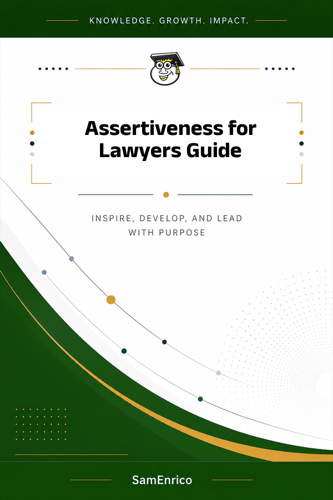
Assertiveness for Lawyers Guide eBook
Advocates for clients while managing opposing coun
Advocates for clients while managing opposing counsel and judges.
Formats
Free sample
Chapter 1: The Three Tensions––Every lawyer remembers the moment they first confused aggression with effectiveness. For me, it was a deposition in my third year of practice. The opposing counsel was a notorious bully—loud, interruptive, and personally insulting. I matched his energy. I shouted my objections.
I refused every courtesy. I left that room feeling victorious, having given as good as I got. Then my supervising partner pulled me aside and said something I have never forgotten: "You won nothing today. The witness gave us nothing. The judge now thinks you're unstable.
And opposing counsel knows exactly which buttons to push next time."That was my first encounter with the central lie of legal advocacy: that assertiveness means winning at all costs, that volume equals conviction, and that the lawyer who fights hardest fights best. This book exists to dismantle that lie.Over the past two decades, I have trained thousands of litigators across every practice area—from solo practitioners handling small claims to partners at global firms arguing before the Supreme Court. I have watched brilliant legal minds destroy their own cases not because they lacked legal knowledge, but because they lacked a framework for assertiveness. They either folded under pressure or exploded in counterproductive rage. Both responses come from the same misunderstanding: that assertiveness is a single thing, a volume dial you turn up or down.In truth, assertiveness for lawyers is the art of managing three unavoidable tensions.
Every legal matter, from a routine contract dispute to a multi-million dollar tort, contains these three tensions. Ignore them, and you will lose—not because you are wrong on the law, but because you have mismanaged the human dynamics of persuasion. Master them, and you will win cases that, on paper, you should lose. Judges will grant you leeway. Opposing counsel will settle on better terms.
Clients will trust you with their hardest problems.This chapter introduces the three tensions that define legal persuasion. It then provides the foundational framework—the Goldilocks Zone of Advocacy—that determines where on the assertiveness spectrum you should operate in any given situation. By the end of this chapter, you will understand why some of the most effective litigators rarely raise their voices, while the least effective often shout the loudest.The First Tension: Creating Value Versus Distributing Value The first tension lies at the heart of every negotiation and settlement discussion. Lawyers must simultaneously perform two contradictory functions: expand the pie (create value) and claim their share (distribute value). Most lawyers default to the second function because it feels like winning.
But that default destroys the possibility of the first function, and the client ultimately pays the price.Consider a typical settlement negotiation. Two lawyers sit across a table—or, increasingly, on opposite ends of a Zoom call. The plaintiff's lawyer believes their job is to demand as much as possible, as aggressively as possible. The defense lawyer believes their job is to offer as little as possible, as stubbornly as possible. They volley numbers.
They cite adverse precedents. They personalize the dispute. This is distributive negotiation: a fixed pie, a zero-sum battle, one winner and one loser.But here is the problem. Almost every legal dispute contains hidden opportunities for value creation—trade-offs that make both parties better off than any simple split of money could achieve. Maybe the plaintiff wants a quick payment but is indifferent to an apology.
The defendant wants confidentiality and a structured payment schedule. A purely distributive negotiation ignores these preferences. It fights over the single number while leaving value on the table.The assertive lawyer knows how to sequence assertiveness. First, you create value through interest-based exploration. You ask questions designed to uncover what each party actually cares about.
You resist the urge to demand or concede. You treat the negotiation as a problem to be solved jointly, not a war to be won alone. Then, and only then, you shift to distributive assertiveness—claiming your share of the value you have helped create.The science here is clear. Research in negotiation psychology consistently shows that parties who engage in value-creating behaviors (sharing information, asking about interests, proposing creative trade-offs) achieve better objective outcomes than those who simply demand and defend. But here is the twist: they also achieve better outcomes when they subsequently negotiate distributively.
The sequence matters. Create first, then claim. Reverse the order, and trust evaporates.Let me give you a concrete example from my own practice. I represented a small software company whose former employee had violated a non-compete agreement. The employee had taken a job with a direct competitor.
On paper, my client had strong legal claims: breach of contract, misappropriation of trade secrets, tortious interference. The opposing counsel opened with a classic distributive move: the case was without merit, they would fight every motion, and my client would be bankrupted by fees.I could have matched his aggression. Instead, I asked a series of interest-based questions. Did the new employer know about the non-compete? (No, the employee had hidden it.) Did the employee have any source code on his personal devices?
(The employee claimed no, but we had evidence suggesting otherwise.) Was the new employer willing to put the employee on a different project? (Potentially, yes.)Within an hour, we had created value. The new employer agreed to reassign the employee to a role that did not compete. The employee agreed to a forensic examination of his devices, at his own expense, to prove he had taken no code. My client received a cash settlement that was less than the original demand but far more than they would have netted after years of litigation.
Value was created. Then, and only then, did I shift to distributive mode to claim the final number.The unassertive lawyer skips value creation entirely and fights over a shrinking pie. The pseudo-assertive lawyer creates value but fails to claim, leaving money on the table. The truly assertive lawyer does both, in the correct sequence.The Second Tension: Empathy Versus Assertiveness The second tension cuts to the core of client management. Clients need to feel heard and understood—that is empathy.
But they also need hard truths about case weaknesses, unfavorable law, and low odds of success—that is assertiveness. Most lawyers swing too far in one direction, and both swings are disastrous.The over-empathizing lawyer becomes, effectively, a therapist. They listen endlessly. They validate every frustration. They absorb the client's anxiety.
But they never deliver the hard message: your case has significant weaknesses, the other side has a strong argument, and you might lose. This lawyer is beloved right up until the moment the jury returns a defense verdict. Then the client is devastated—not because the result was unexpected, but because no one told them to expect it.The over-assertive lawyer goes the opposite direction. They deliver the hard truth in the first conversation—your case is weak, you should settle, don't get your hopes up—but they never build the emotional container that allows a client to hear that message. The client feels dismissed, unheard, and disrespected.
They may fire the lawyer. Or they may stay but withhold critical information, sabotage the representation, or refuse reasonable settlement…
This is the end of the free sample. Get the eBook to keep going. Buy now
About this book
Details
- Author
- Davison Deandra
- Publisher
- SamEnrico
- Language
- English
- Genre
- Non-Fiction, Self-Help, Legal Advocacy
- Released
- 2026-06-06
- Pages (approx.)
- 133
- Available as
- eBook, Audiobook

Read better in the ZLOADR app
Your eBooks on your phone or tablet. Sign in with your SamEnrico account and start reading.
More by Davison Deandra
 The Titanic Wreck Discovery GuideDavison Deandra$11.99
 Self Talk For JealousyDavison Deandra$11.99
 Pomodoro for Audio ProductionDavison Deandra$11.99
 Breaking the Barriers: The Untold Story of New Zealand's First Female OlympiansDavison Deandra$11.99
 How to Become a Shake SawyerDavison Deandra$11.99
 InternetDavison Deandra$11.99
 Fast Track Developer TimelineDavison Deandra$12.99
 Pricing for Restaurants and Food ServiceDavison Deandra$12.99
 Understanding OphthalmophobiaDavison Deandra$17.99
You may also like
 Hong Kong Handover 1997Dunn Johnnie$11.99
 Zumba For Postnatal Recovery CourseNeal Christian$11.99
 Zumba for BeginnersLadner Nikia$11.99
 YouTube Comment Mining GuideHumes Pandora$12.99
 Worry Box MeditationCarlin Rudy$11.99
 Workplace Stress MeditationNguyen Lynn$11.99
 Workplace Stress and Sleep RepairHawley Ivory$11.99
 Workplace Perfectionism CureDelaney Jeffry$11.99
 Workplace Injustice Anger GuideWallen Isabelle$11.99
 Work Addiction and Burnout LinkGreenwood Ester$11.99
 Women in Yoga and WellnessBeattie Galina$11.99
 Women in Stand Up ComedyChun Evangeline$11.99